Thailand’s acting Prime Minister Phumtham Wechayachai has warned that the fighting with Cambodia “could develop into war” but “for now it remains limited to clashes.”
There seems to be another confrontation brewing in the world with a potential to “develop into war”, this time in Southeast Asia. According to international media, the death toll from clashes between Thai and Cambodian troops has risen to 15 in Thailand and one in Cambodia. As many as 120,000 people living along both sides of the disputed border separating the two countries have fled in the ongoing fighting
Thailand’s acting Prime Minister Phumtham Wechayachai has warned that the fighting with Cambodia “could develop into war” but “for now it remains limited to clashes.” “The situation has intensified and could escalate into a state of war”, Wechayachai was quoted as saying on Friday, adding that for now, the clashes have involved heavy weapons.
Thailand has already recalled its ambassador to Cambodia, which too has withdrawn diplomats from Thailand and ordered all Thai diplomats to leave.
The confrontation
This has been the bloodiest military confrontation between the two Southeast Asian neighbours in more than a decade. The recent violence is a result of a long-running border dispute between the two countries.
According to reports, there has been significant escalation in the dispute in recent days, resulting in armed clashes, civilian casualties and diplomatic breakdowns. It is also causing significant humanitarian crisis in the region
The root cause
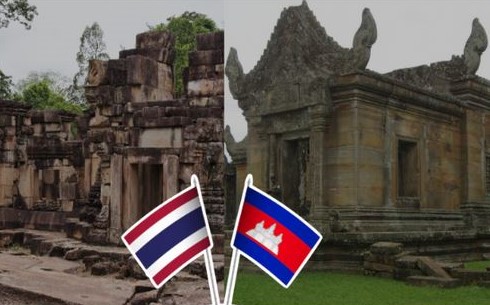
At the root of the conflict are contested territories and some ancient Hindu temples like Preah Vihear located along shared border in the Dangrek Mountains
The dispute basically stems from colonial-era maps drawn by France, which was controlling Cambodia in the early 20th century.
One of these maps depicted the border along a watershed line but placed the Preah Vihear temple on the Cambodian side.
According to the International Court of Justice, “Cambodia complained that Thailand had occupied a piece of its territory surrounding the ruins of the Temple of Preah Vihear, a place of pilgrimage and worship for Cambodians, and asked the Court to declare that territorial sovereignty over the Temple belonged to it and that Thailand was under an obligation to withdraw the armed detachment stationed there since 1954.
“Thailand filed preliminary objections to the Court’s jurisdiction, which were rejected in a Judgment given on 26 May 1961. In its Judgment on the merits, rendered on 15 June 1962, the Court noted that a Franco-Siamese Treaty of 1904 provided that, in the area under consideration, the frontier was to follow the watershed line, and that a map based on the work of a Mixed Delimitation Commission showed the Temple on the Cambodian side of the boundary. Thailand asserted various arguments aimed at showing that the map had no binding character.
“One of its contentions was that the map had never been accepted by Thailand or, alternatively, that if Thailand had accepted it, it had done so only because of a mistaken belief that the frontier indicated corresponded to the watershed line.
“The Court found that Thailand had indeed accepted the map and concluded that the Temple was situated on Cambodian territory. It also held that Thailand was under an obligation to withdraw any military or police force stationed there and to restore to Cambodia any objects removed from the ruins since 1954”.