
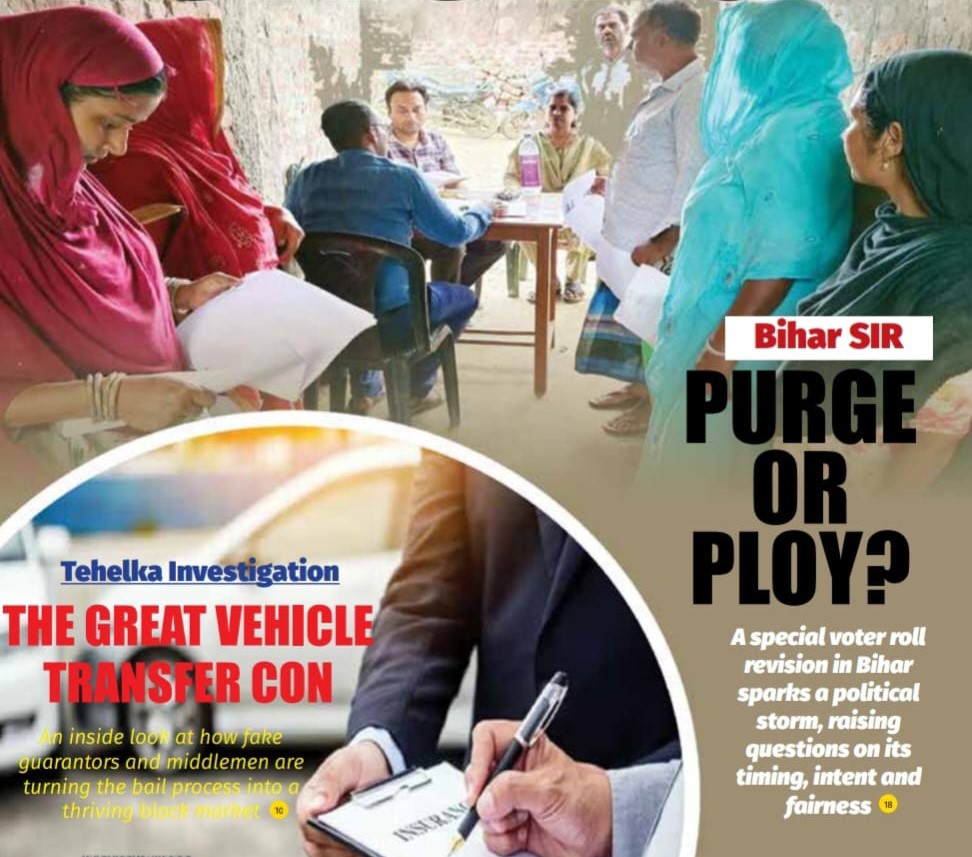
Tehelka’s refreshed layout now includes features like astrology, Bollywood behind-the-scenes, puzzles, and spiritual columns. But its essence—fearless investigative journalism—remains firmly intact. The latest edition reaffirms Tehelka’s commitment to exposing the uncomfortable truths others shy away from.
In this issue, Vibha Sharma’s cover story, “Purge or Ploy?”, unravels the controversy around the Election Commission’s Special Intensive Revision (SIR) of electoral rolls in Bihar. The process, aimed at ensuring that only eligible voters are listed, comes under scrutiny from opposition leaders. They argue that if voter rolls in Bihar—whose 40 MPs helped shape the current Lok Sabha—are found faulty, those MPs should be disqualified immediately.
The EC defends its decision, stating that the revision aims to create “accurate and error-free electoral rolls,” critical for free and fair elections. The exercise involves including eligible voters and removing ineligible ones—due to death, migration, or illegal immigration. The scale is massive: from August 1 to September 1, the fate of 64 lakh flagged voters will be reviewed, requiring outreach to over two lakh people daily.
However, critics have raised concerns about the timing and speed of the process, which coincides with upcoming Assembly elections. They also challenge the restrictive list of documents accepted by the EC as proof of citizenship and voter eligibility. The Supreme Court has so far refused to stay the revision but continues to hear petitions challenging its execution. The burden of proof, especially in Bihar, appears to be shifting to the citizens.
Continuing its focus on systemic corruption, Tehelka’s Special Investigation Team (SIT) brings to light “The Great Vehicle Transfer Con”, revealing a large-scale fake vehicle registration racket in Delhi-NCR. Used-car dealers and brokers exploit loopholes to register vehicles using fraudulent rent agreements and Aadhaar details, allowing buyers to sidestep legal requirements for local address proof.
These bogus registrations are more than just a paperwork scam—they serve as a backbone for organised crime. Criminals use such vehicles for smuggling, trafficking, and evading law enforcement. Forged registration documents, counterfeit number plates, and tampered VINs (Vehicle Identification Numbers) help mask the true identity of these vehicles.
Tehelka’s investigation shows how dealers assure customers they can register a vehicle in any Delhi-NCR city, even without proper documents. This not only undermines law and order but also poses a threat to national security.
Meanwhile, the Commission for Air Quality Management (CAQM) has barred diesel vehicles older than 10 years and petrol vehicles older than 15 years from refuelling in Delhi starting November 1, 2025. The decision, initially enforced on July 1 but deferred after public outcry, will impact over 62 lakh vehicles. While curbing air pollution is vital, authorities must also address the widespread fake registration menace—another invisible pollutant in the system.
Tehelka’s stories serve as a call to action: against flawed governance, unchecked crime, and regulatory apathy. The medium may have evolved, but the mission remains unchanged—to speak truth to power.