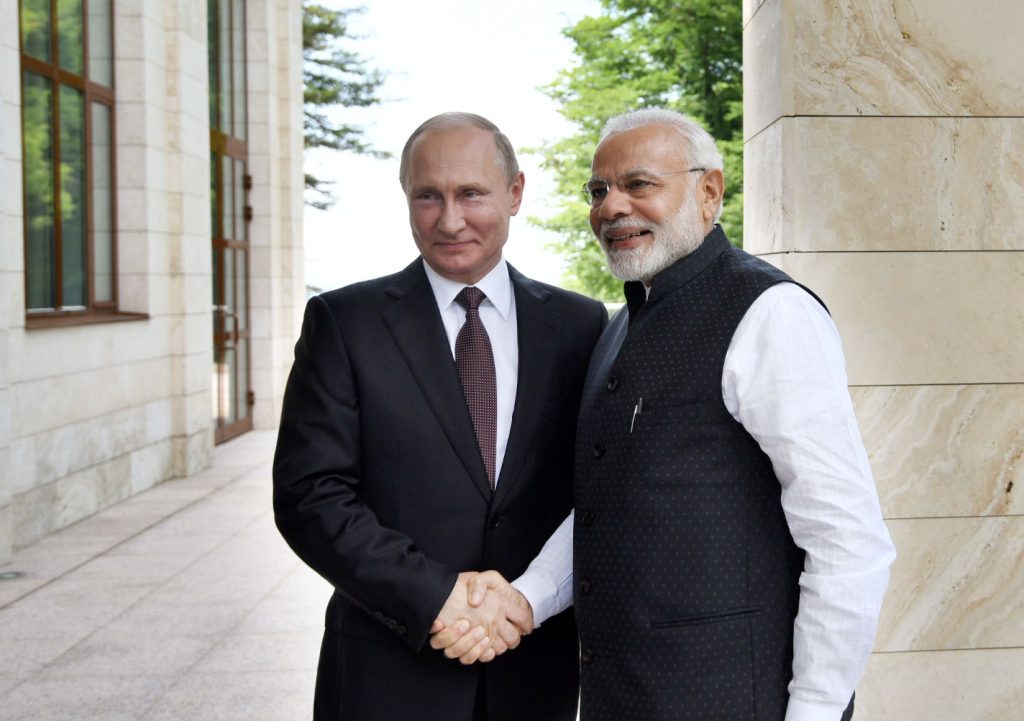
This global geopolitical moment is extremely complex. The Modi-Putin summit is currently a hot topic in diplomatic discourse. The Modi-Putin Summit has resulted in the ‘PutinNamo,’ a new well-liked alliance. What did Puti Namo provide us?
Both sides were required to maintain strategic autonomy. Putin is eager to dispel the perception of isolation in the wake of the conflict between Russia and Ukraine. Additionally, they don’t want to come across as unduly dependent on China. Additionally, India is currently involved in a complex negotiation, which has placed it in a challenging diplomatic position. India wants to finalise the trade package with the US as soon as possible, and negotiations are ongoing with the United States. It was clear that Putin and Modi frequently touched on the topic of Ukraine during their recent conversation. Modi reaffirmed India’s support for any peace initiatives, saying, “India is not neutral, but India is for peace; we welcome this.”
In defiance of standard diplomatic protocol, Modi accepted Putin’s offer by travelling to the airport, riding in a car with him, taking selfies, and more. Not just in India, but throughout the world, these body language and gestures have had a significant influence.
Russia’s ties to China are a frequent concern for the West, India, and especially the United States. Therefore, in this context, both Moscow and Delhi have expressed their desire to accelerate bilateral ties through a migration and mobility agreement, a program for the development of strategic economic collaboration, and diversifying the economic basket beyond defence and energy. All of these are crucial and long overdue, particularly in the areas of defence and energy, though there is a careful stocktaking, and India wants Russia to expedite the delivery of military hardware that has been greatly delayed. Particularly in the context of Trumpian America and revisionist China, Russian assistance is crucial. India maintains its connections with both of these nations with extreme caution.
The complex international relationship comes next. I believe that Narendra Modi’s aggressive diplomacy was necessary and is a positive tactic to improve relations with Russia. Below is a step-by-step breakdown of the strategy.
1. Trumpian America is currently one of India’s most challenging clients. Trump is pursuing isolationist policies, as we are working on a trade agreement. He didn’t give much thought to relations with other nations, including Russia, and Trump ordered India to cease importing oil from Russia before he would relax his stance on trade with India. However, India has often stated that it does not wish to sever its traditional ties with Russia. This connection is crucial to India’s geostrategic position and has a badge of history.
2. Although China and the United States are perceived by the public as having a tense relationship, there is access between China and Russia. Besides, the relationship between China and India is also not favourable. Additionally, the way the undercurrents are spreading throughout India’s neighbours is extremely harmful. In addition to Bangladesh, the consequences have extended to Myanmar and the Maldives. Bangladesh has become problematic due to the Pakistan ISI chief’s frequent visits, the Pakistani army’s dominance over Bangladesh, and Pakistan’s and Bangladesh’s quick efforts to strengthen their ties while concurrently maintaining ties with China. Why would India jeopardise its relationship with Russia at such a critical juncture? India’s strategy has traditionally focused on establishing and preserving positive ties with other countries.
During the Cold War, the US and the USSR were at odds with one another. However, the same Cold War scenario is currently being redeveloped once more, pitting America against China.
In addition, America is not only controlling India but also has adversarial relations with the European Union, Europe, and even Canada, an old ally of the United States. India would be irresponsible to jeopardise the India-Russian partnership in this circumstance. However, Russia and America also have differences; thus, creating a polycentric world is preferable to a bipolar one. Russia and other European nations are reacting more strongly to Trump’s diplomatic attempt to introduce a concept similar to the G20, which is G2 with China. Even though Europe is backing Ukraine in the conflict with Russia, bringing Putin to India was probably not a very pleasant thing for Europe. However, Europe understands that maintaining relations with Russia is crucial for dealing with America.
Therefore, Modi performed the balancing act flawlessly.
3. Russian President Vladimir Putin, who concluded his two-day visit to India, has every reason to return to Moscow with a bright smile. Vladimir Putin, the president of Russia, has every cause to return to Moscow grinning after his two-day visit to India. Putin being received by the Prime Minister of India and riding back to the official residence with the host himself is a very significant act for a leader facing international isolation and sanctions, and it has been widely publicised in various Western capitals. Therefore, Putin would have liked both the positional images of his visit and his substantive results.
4. Europe is the most upset with India’s red carpet welcome to Putin at a time when he is intensifying the conflict in Ukraine. However, Europe is more concerned about the US’s unpredictability and its persistent bullying of Ukraine. Taking into account every facet of India’s actions, the country has extensive experience navigating challenging geopolitical environments with shifting implications and protecting its strategic autonomy as a guiding principle, as demonstrated during Putin’s visit. Thus, India-Russian relations are still strengthened by their past link. Additionally, there are platforms, such as nuclear submarines, which have anti-missile capabilities. Therefore, the only nation that shares technology with India is Russia.