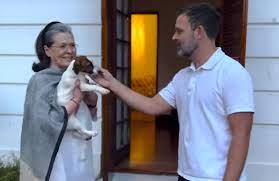
New Delhi : A complaint has been filed against Congress leader Rahul Gandhi at Prayagraj district court in Uttar Pradesh for giving a name to a dog that also finds place in the Holy Quran.
The complaint has been filed by AIMIM spokesperson Mohd Farhan through his lawyer Amjad Ali.
Interestingly, an FIR was also lodged against Farhan himself for making objectionable comments against Prime Minister Narendra Modi three months ago.
Farhan has received a stay on his arrest. Mohd Farhan said in the complaint that he gathered through English and Hindi newspapers that Rahul gifted his mother and party chief Sonia Gandhi a puppy on October 4, the World Animal Day.
Farhan claimed that the puppy was named ‘Noori’ by Rahul and said that since the name is connected to the Prophet Muhammad, it is considered pure and holy.
“Noori’ has been mentioned in the Holy Quran multiple times. Many mosques are also of the same name and thus using this name for a dog has hurt the sentiments of Muslims, ” the AIMIM spokesperson said.
The complaint has been filed before the chief judicial magistrate.
Farhan’s lawyer Ali said the chief judicial magistrate has fixed November 8 for recording statements of the complainant. He said that Rahul Gandhi also shared the photograph of the puppy on his Facebook and YouTube accounts.
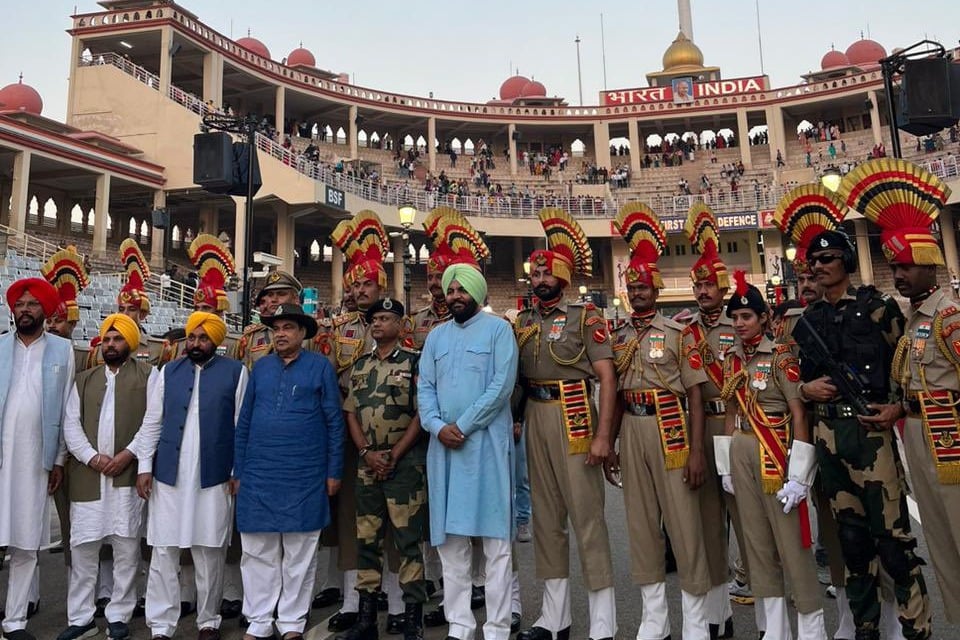
Amritsar : Minister of Road Transport and Highways Nitin Gadkari on Thursday inaugurated the highest national flag of 418 feet at the Attari-Wagah international border near here in Punjab.
Chief Minister Bhagwant Mann was present at the event.
After inaugurating the flag, Gadkari said, “It is the golden day of my life. I have come to the Attari-Wagah border for the first time. NHAI has installed the tallest national flag here. This is a place that inspires you to be patriotic.”
“I have done a lot of things in life — tunnels, bridges but this is the most amazing. I am delighted and I thank the jawans who are guarding our borders, ” he said.
The Indian flag stands 18 feet higher than Pakistan’s.
Costing around Rs 3.5 crore, this flagpole replaces the 360-foot high one India had installed at the same location in March 2017. In response, Pakistan had erected a 400-feet tall flag.
The Attari-Wagah international border is around 30 km from Amritsar and 22 km from Lahore in Pakistan.
The flag-hoisting, ceremonial drill and Beating Retreat are daily events at the Attari-Wagah joint check post of India and Pakistan. The border guards stomp their feet and raise them high, besides shouting.
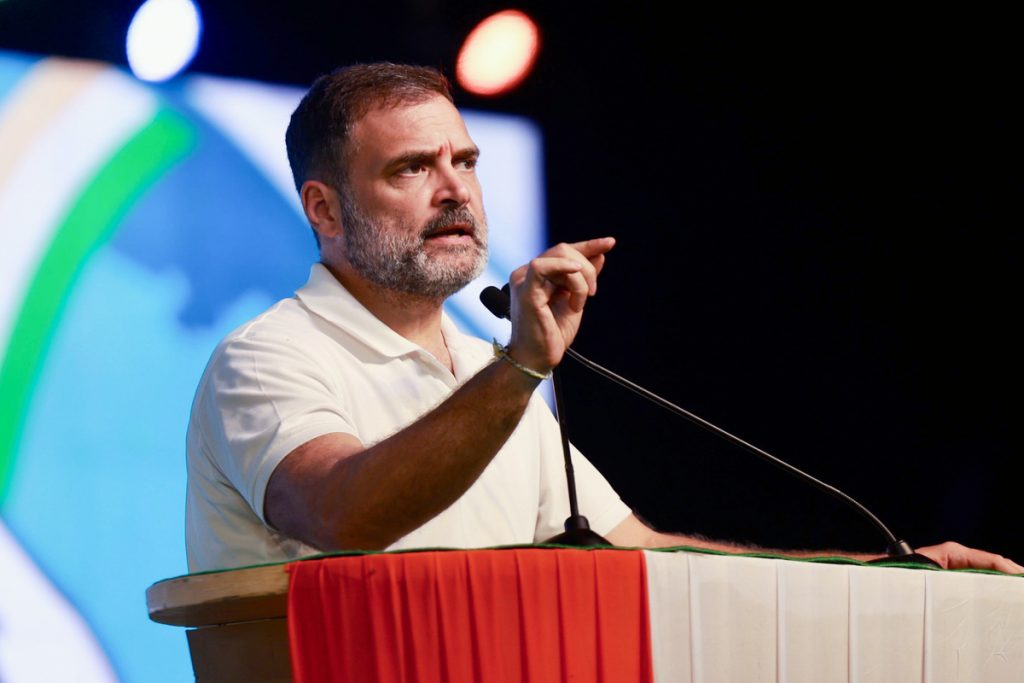
Malugu, Oct 18 (ANI): Congress leader Rahul Gandhi addresses during a public rally, in Malugu on Wednesday. (ANI Photo)
Telangana-Congress leader Rahul Gandhi on Wednesday launched the party’s campaign in Telangana for next month’s Assembly elections with a call to the people of the state to defeat BRS, saying “a vote for BRS will be a vote for BJP.”
Reiterating the allegation that the BRS, BJP and MIM were together, he said that the Congress is engaged in an ideological battle with the BJP across the country.
Stating that the Congress will never compromise with the BJP, he exuded confidence that the grand old party would defeat the BJP in all five states going to polls next month and in the entire country.
The Congress MP was addressing a public meeting in Mulugu along with his sister and Congress General Secretary Priyanka Gandhi after launching the party’s ‘Vijaya Bheri Yatra’.
Stating that the fight in Telangana was between the BRS and the Congress, he said the BJP was already facing defeat in the state and was aware of it.
“But the BJP wants the BRS to win in Telangana. They are working together and the MIM is also with them, ” he said.
Rahul Gandhi alleged that the BRS extended support to the BJP whenever required, in Parliament. The Congress leader claimed that the biggest evidence of the collusion between the BRS and the BJP was that there was no CBI, ED or I-T inquiry against Chief Minister KCR.
“There are cases against all Opposition leaders. There are 24 cases against me. They evicted me from my house and snatched my Parliament membership, ” he said.
“The BJP attacks the Congress across the country. They file cases against our leaders. They know that the Congress is an ideology-based party and we can never compromise with the BJP, ” he added.
The Congress MP listed out the six guarantees announced by the party last month. Speaking in a region with a large tribal population, he promised that once voted to power the Congress would give them back rights on Podu lands and assigned lands.
He also assured that if the Congress was voted to power at the Centre, the Sammakka Sarakka tribal festival of Mulugu will be given the status of a national festival.
Claiming that the Congress does what it promises, Rahul Gandhi said the Congress promised Telangana state in 2004 and it carved out the state despite knowing that such a decision could damage the party politically.
Targeting KCR, the Congress leader said he did not fulfill his promises of three acres of land for every Dalit family, a job for one person in every house, and clean governance in the state.
He reiterated that there was a scam of Rs.1 lakh crore in the Kaleshwaram project. He alleged that people’s lands were snatched through the Dharani portal scam.
“He promised houses for you. He promised to farmers that their loans of one lakh rupees will be waived off, but failed to fulfill them, ” he said.
The Congress MP urged the people to see Congress-ruled states like Karnataka, Rajasthan, Himachal Pradesh and Chhattisgarh where the Congress did what it had promised.
He claimed that the healthcare system of Rajasthan was the best in the country while farmers in Chhattisgarh get the highest MSP for their produce.
“In Karnataka we gave five guarantees and in the very first Cabinet meeting we implemented them. Today women are travelling free and farmers and women are getting money in their bank accounts every month. We have done what we had promised, ” he added.
The Jammu and Kashmir has established a high-level panel with the primary objective of identifying foreign nationals who have been residing illegally or overstaying in the Union Territory since January 1, 2011.
The panel includes key officials such as the Foreigners Regional Registration Officer (FRRO), Bureau of Immigration Amritsar (Punjab); Senior Superintendent of Police, CID, Special Branch, Jammu; Senior Superintendent of Police, CID, Special Branch, Srinagar; all district SSPs/SPs (FROs) and State Coordinator, IVRFT, NIC, J&K. As per its terms of reference, the panel’s primary responsibility is to compile a monthly report identifying foreign nationals who have gone missing within Jammu and Kashmir. These reports are to be submitted to the Ministry of Home Affairs by the 7th of each month.
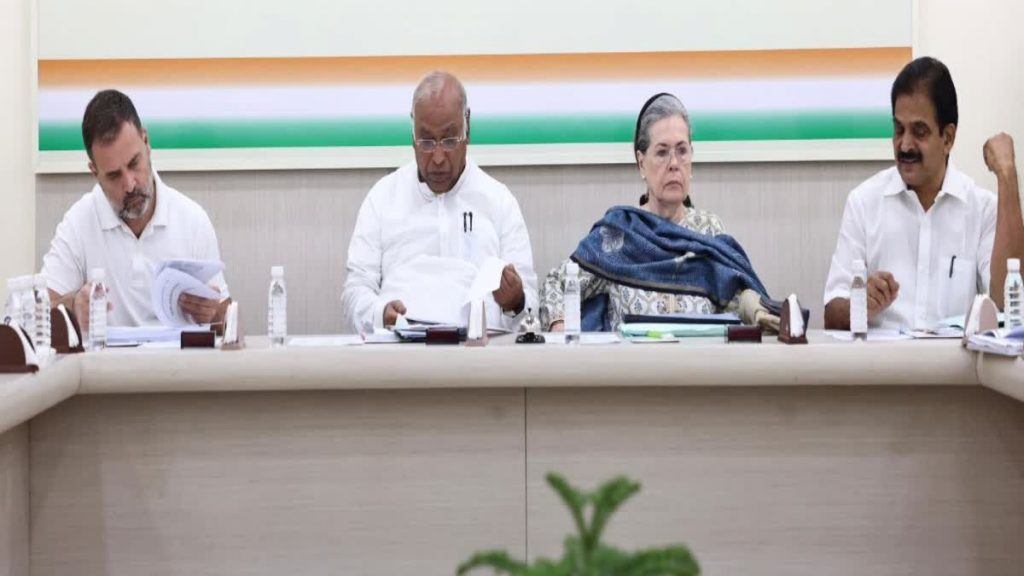
New Delhi : Congress President Mallikarjun Kharge on Wednesday chaired a meeting of the Central Election Committee (CEC) here to finalise the candidates.
Kharge arrived at the party headquarters here for the CEC meet. Besides him, CPP chairperson Sonia Gandhi, former Congress chief Rahul Gandhi, senior party leaders Ajay Maken, K.C. Venugopal, Rajasthan screening committee chairperson Gaurav Gogoi, Rajasthan Chief Minister Ashok Gehlot, state unit chief Govind Dotasara, state incharge Sukhjinder Randhawa and many others were also present.
According to the party leaders, the much anticipated first list of Congress will be released after the CEC meet.
Meanwhile, a party source said that about 120 candidates will be discussed out of the 200 and at least 15 to 25 sitting MLAs might be denied tickets in the upcoming polls.
The Gehlot-led government has launched several pro-people schemes ahead of the crucial polls. The Congress is eyeing to make a comeback in the state riding high on the schemes.
The BJP has already announced several candidates for the desert state. The polling for the 200-member Assembly is scheduled on November 25 and counting of votes will take place on December 3.
By raising ‘caste census ‘demand, the Opposition bloc eyes consolidation of secular forces for social justice to counter the BJP’s Hindutva plank in the upcoming 2024 general elections, writes Mudit Mathur
Why the demand of caste census raised by the Congress-led INDIA alliance was branded by Prime Minister Narendra Modi as “anti-Hindu” to create division among them? Is he jittery over the issue of caste census? Is caste census going to inestimably change poll dynamics of the nation to his disadvantage? Is there any political compulsion before him behind changing stand of the government on the issue of caste census?
The revelations by Bihar government about caste composition once again reaffirmed and reconsolidated the politics of socio-politico oriented ideology fighting for social, political and economic justice to the people. The escalating demand of caste census could pose serious challenges in 2024 elections before the emerging new cult of religious-politico clamour of Hindutva, led by Modi and his team of saffron creed. The issue to go for caste census could have potential to dismantle the web of social engineering done by BJP, working out political alignment with many leaders of caste-based regional parties in different states.
The master move of declaration of its caste survey findings by Bihar government has once again triggered momentum from the other non-BJP ruled states and opposition leaders at large for demanding a caste census in all the states and the union territories to ensure justice to deprived classes of the society. The Rajasthan and Chhattisgarh governments too have announced similar caste surveys in their states. The Bihar assembly had passed a resolution in favour of a caste census twice, which was supported by the BJP when they had coalition government with Janata Dal (United).
The majority Hindu community of India is traditionally graded into various castes but there is no accurate data for decades now about the population of these castes and sub-castes to give them equal opportunities and representation in all forums of governance. India has only done a caste headcount through the Socio-Economic Caste Census (SECC) in 2011. But the BJP government rejected the report in 2015. The full data of SECC was never made public. The last time a caste census was carried out was in 1931 when India was under British rule. The lack of recent data meant affirmative action was insufficient and available data is by and large unreliable and cannot be relied upon to formulate plans for their upliftment.
Initially, the BJP government in 2018 was in favour of a caste-based census. The then home minister Rajnath Singh made a statement to this effect in Parliament. Amazingly, the government changed its idea by July 2021and informed the Lok Sabha that the 2021 census would not have a caste count.
Many observers have reasons to believe that Brahminical hierarchy-led controlling parent organisation of BJP – Rashtriya Swayam Sevak Sangh (RSS) – has conflicting opinions of its functionaries and still lack unanimity over the contentious issue that perhaps forced the Modi government to back out from its earlier stand on caste count in Parliament. Recently in the rallies in poll-bound Telangana and Chhattisgarh, Prime Minister Narendra Modi echoed similar sentiments, when he said: “Caste count is an attempt to divide the Hindu society and cut into the share of the minorities.”
Earlier in 2018, participating in a debate in Rajya Sabha on the 102nd constitutional amendment for constituting National Commission for Backward Classes (NCBC), Union Minister of Education Dharmendra Pradhan, an OBC leader with an RSS background, said in the last session of 2019, “Caste-based census is a revolutionary process. It is not that caste census has not happened. Many states have considered it as the basis.” This opens up a window for the states to do their own survey rather than bank on the Centre. Late Gopinath Munde, an OBC leader from Maharashtra, had in 2011 made a passionate pitch in Parliament in favour of such a caste-based head count.
Though Prime Minister Narendra Modi, who belongs to an OBC caste, has helped the BJP shed the image of being a party of Brahmins and Baniyas alone, yet, ideologically, in the 1990s and later in the first decade of the 21st century, the party had opposed the move. The BJP has come a long way since the Mandal movement of the 1990s, wherein it built its electoral fortunes by supporting the interests of the upper castes.
The party leadership is still in a dilemma over how to tackle complex issue of caste census which is building up as major electoral issue in upcoming 2024 general elections. Even its allies like Apna Dal, Nishad Pary, AIADMK, Republican Party of India (Athawale), YSRCP and Biju Janata Dal have been strongly pleading for a caste count. The 2021 census was unduly delayed on account of pandemic and will now be conducted next year after parliamentary elections as per plan. Its results are awaited in 2026 while many G-20 nations have already completed this exercise.
The caste survey held by the Mahagathbandhan government led by Nitish Kumar in Bihar puts OBC numbers at 63% of the state’s population, with 36% being EBCs. These propositions may overturn the various social engineering equations in many cow belt states including Uttar Pradesh, Uttarakhand, Bihar and Madhya Pradesh that forged a successful political arrangement with some sections of non-Yadav OBCs, most backward and Dalit castes to gain power at the centre and in states.
The Bihar caste survey data makes it evident that its dominant castes comprise just 15.5 percent, while its marginalised castes — OBCs and Dalits — make up for a staggering 84 percent of the state’s population. The findings have the potential to change the narrative the country’s politics, as marginalised groups demand better representation in public institutions and political life of the country.
Thus, the BJP strategists are deeply nervous over the findings of Bihar caste survey as it used to send vociferous faces of hardliner Hindutva – like Giriraj Singh, Ravi Shankar Prasad, Ashwini Kumar Chaube, Radha Mohan Singh, Rajiv Pratap Rudi, Nityanand Rai, Janardan Singh Sigriwal and Shushil Kumar Singh to Lok Sabha. Five Lok Sabha members from Bihar belong to Thakur community, while they constitute just 3.5 percent of the population of the state. Thus, the survey deeply upset its poll prospects that are mostly woven around upper caste equations.
Meanwhile, the Supreme Court questioned the Bihar government as to why it published its caste survey data but refused to restrain it from making public further data, and said it may examine if the state has power to conduct such an exercise. A bench of Justices Sanjiv Khanna and S V N Bhatti issued a formal notice on a batch of pleas challenging the August 1 order of the Patna High Court that gave the go-ahead for the caste survey in Bihar.
The SC bench listed the matter in January, 2024. It rejected the petitioners’ contention that the state government has already published some data pre-empting a stay. They sought a complete stay on further publication of data. “We are not staying anything at this moment. We cannot stop the state government or any government from taking a policy decision. That would be wrong. We are going to examine the other issue regarding the power of the state government to conduct this exercise,” the bench said.
The issue of caste census may also scuttle the preconceived plan of delimitation of Lok Sabha and Vidhan Sabha seats, further deepening the north-south divide, in 2026 after national census. It appears that BJP leadership aimed to shift the political balance of power in the hands of states under its influence of saffron ideology.
The counter strategy of opposition parties has set the stage to replay the unity of secular consolidation for social justice to counter the saffron surge in upcoming 2024 general elections following the same footings that of 1990. It is being envisaged as reply to “Kamandal” politics by consolidating backward, most backward and Dalit classes of society for a caste census to ensure social, political and economic justice to them.
On August 7, 1990, Prime Minister V.P. Singh announced that the Other Backward Classes (OBCs) would get 27 per cent reservation in jobs in Central government services and public sector units. The announcement was based on the recommendations of the Mandal Commission, headed by former Bihar Chief Minister B.P. Mandal, which the Morarji Desai government had constituted in 1979 to address the complex issue of caste discrimination.
The nation witnessed sharp decline of the polity of saffron- surge (Hindutva) when caste consciousness awakened in 1990 over implementation of B. P. Mandal Commission report for reservation of backward classes of the society.
Analysing the delicate issue of delimitation, the BJP government led by Atal Behari Vajpaiyee had frozen it until 2026 seeing its grave implications of disturbing equilibrium of representation in Lok Sabha among different states, in terms of their success in achieving targets of population control and those who failed to do it.
The passage of women reservation legislation (Nari Shakti Vandan Adhiniyam) in specially convened session of Parliament could not bring desired impact in the overall atmosphere as it was unanimously passed with the supporting Congress-led opposition demanding reservation of OBC women in it. All Opposition parties, including those such as the Samajwadi Party, RJD and JD(U), which opposed women’s reservation in the past, voted for the Act, while demanding an OBC quota.
The Bihar caste survey further override the expected political milage to BJP from women quota Act in near future, in view of uncertainty that loom large over its date of its implementation after census and delimitation exercise. The Opposition’s demand for an OBC quota within the quota for women has also merged nicely with the Bihar caste survey.
Another move of one nation-one election also stood deferred as it failed to get support even from the state leadership of BJP-ruled states, looking into the risk of come back to power. Haryana Chief Minister Manohar Lal Khattar had announced that Haryana will go for polls next year as due after Lok Sabha elections. Now with the declaration of the Assembly poll schedule for five states in November the chapter is closed for now.
Most of the Dalit movements for social justice sparked from southern states and part of Maharashtra where BJP has negligible presence as people consider it a party of high castes. That is perhaps a reason why BJP decided to go for delimitation to increase number of seats in the northern states under areas of its core influence. But it all will happen after the report of census is published and Election Commission constitute a Delimitation Commission headed by retired judge of either Supreme Court or High Court.
Supporting the demand of caste census, the Congress leader Rahul Gandhi addressed a press conference after specially convened meeting of the Congress Working Committee (CWC) which discussed caste census issue in the light of caste survey report released by Bihar government, for more than four hours. Rahul termed caste census an “X-ray” of the country that will throw light on the condition of OBCs, Dalits and tribals, and said his party would force the Centre to conduct this exercise “come what may”.
Rahul came down heavily on PM Narendra Modi for not carrying out a caste census in the country, saying the decision to conduct a caste census was not political but based on justice. “PM Narendra Modi is “incapable” and was employing distraction tactics to avoid the survey. He would bring many distractions in the coming days,” Rahul remarked.
Rahul said the CWC had taken a historic decision with regard to caste census, stressing that the decision was unanimous and there was not a single person in the room who did not support the concept of caste census. He also said that the Congress-ruled states would conduct caste census at the state level. “It is not about caste or religion. It is about poverty. Caste census will open a new development paradigm,” he said.
Questioning the BJP’s credentials with regard to commitment to the OBC cause, Rahul said that while three of the four Congress chief ministers belonged to the OBC category, out of the ten BJP chief ministers, only one was from the OBC community, and quipped that he, too, would soon be defeated. Karnataka CM Siddaramaiah, Rajasthan CM Ashok Gehlot, Chhattisgarh CM Bhupesh Baghel and Himachal Pradesh CM Sukhvinder Singh Sukhu also joined dais with him.
“The Prime Minister is incapable of doing the caste census.Why can’t he declare in his speech that the data of the caste census would be released or that the next census would have a caste count? The PM does not work for the OBCs. His main task is to distract the attention of the OBCs, the Dalits and the Adivasis,” Rahul remarked.
The CWC resolution stated that the party promises that a government led by it will conduct a nationwide caste census as part of the normal decadal census which was due in 2021 and also implement the 33 per cent reservation for women in the Lok Sabha and state legislative assemblies at the earliest, ensuring adequate representation for women belonging to Scheduled Castes, Scheduled Tribes and including OBCs as well.
“The unnecessary obstacles of Census and delimitation imposed by the Modi government will be removed,” it promised. It further resolved to remove the cap of 50 per cent through legislation for the reservation of OBCs, Scheduled Castes and Scheduled Tribes, in line with the proportionate share of population.
The apex decision making body, CWC while welcoming the release of the caste survey conducted by Bihar government, said in its resolution, “The disparity between representation and share in population revealed by the final figures of the survey highlights the urgent need to take effective steps to ensure social justice.”
The CWC resolution further stated that it welcomes the objective of the Justice Rohini Commission of sub-categorisation within OBCs, which was set up by the Narendra Modi government, but it also underlines that it will remain incomplete without detailed data on the socio-economic position of various communities, which can be obtained either from the still unreleased data from the 2011 Socio Economic and Caste Census or a fresh caste census.
“The Modi government has cheated the OBC communities and other deprived sections of the country by not releasing the data of the 2011 Socio Economic and Caste Census and not carrying out a fresh Caste Census; it has also failed in its Constitutional duty by inordinately postponing the decadal Census that ought to have been conducted in 2021 or soon thereafter. It is a matter of shame that India remains the only country in the G20 that has failed to carry out the Census,” the Congress resolution added.
Earlier in a rally in poll-bound Telangana, Prime Minister Narendra Modi for the first time paddled into the imminent issue of delimitation, due in 2026, choosing a state where his stakes are not as high. Playing with the Rahul Gandhi’s remark in a rally during Karnataka assembly polls, “Jitni Aabadi, Utna Haq”, Modi said, “On the one hand, Congress leader Rahul Gandhi is openly saying ‘Jitni Aabadi, Utna Haq’, which means more seats for those states with higher population. And on other hand, his partner DMK is worried that southern states will lose seats.
The Prime Minister has sarcastically remarked that, “If the country follows Rahul’s politics, then southern states will lose a hundred seats.” “Will South India accept this? Will South India forgive the Congress? I want to tell Congress leaders not to fool the nation. Make it clear why they are playing this game,” Modi contended.
Taking on the Congress and other opposition parties for raising the demand of a caste census and giving reservation to communities based on their numerical strength, he alleged that this is an attempt to divide the Hindu society and cut into the share of the minorities. In a rally in Jagdalpur, Chhattisgarh, Modi asserted that for the BJP, “It is the poor who have the right to the benefits and resources of the country and the party is committed to their welfare.”
“The country is now talking about the next delimitation. It will mean that wherever the population is less, the Lok Sabha seats will come down, and rise where the population is high. The southern states have achieved remarkable progress in population control, but will stand to lose heavily if the Congress’s new idea of rights in proportion to population is implemented. South India stands to lose 100 Lok Sabha seats,” Modi remarked in rally in Telangana.
Questioning both the Congress and INDIA alliance to “clarify if they are against South India”, the PM Modi said: “I want to specify that this new thought is injustice to southern India.” His master oratory once again displayed in creating confusion among the partners of INDIA alliance from southern states.
RJD president Lalu Prasad in a veiled attack on BJP, charged critics of caste census with being against the humanistic principles of social, economic and political equality and proportionate representation. The former chief minister of Bihar, one of the tallest leaders to have emerged from the Mandal wave of 1990s.
Earlier, key Congress ally and Tamil Nadu Chief Minister M K Stalin termed the 2026 delimitation a “Sword of Damocles” hanging over the heads of the southern states, as they face the prospect of their numbers going down in Parliament. Other chief ministers too have raised similar concerns, asking whether the South was being “punished” for successfully controlling its population, and accomplishing population control targets set by the Centre itself.
Delimitation is a Constitutional under Article 81 which is required to be carried out after every Census, to readjust the number of seats and their boundaries on the basis of latest census data. But the number of seats for the Lok Sabha and state Assemblies has remained frozen for the last 50 years, because of opposition from political parties from the South.
The Article 81 of the Constitution provides that there can be no more than 550 members in the Lok Sabha – 530 from states and 20 from Union Territories. It also says that “the ratio between (the number of seats) and the population of the state is, so far as practicable, the same for all states”. So, each constituency across the country should ideally have the same population.
The Article 82 of the Constitution states that after every Census is completed, the allocation of Lok Sabha seats to each state must be adjusted based on population changes. The Election Commission defines delimitation as the process of drawing boundaries of constituencies for elected bodies based on the population in the most recent Census.
Under these constitutional provisions, an independent Delimitation Commission has to be set up once every decade to reapportion seats among states. The Commission is appointed by the President of India and comprises a retired judge of the Supreme Court or a high court, the Chief Election Commissioner and the State Election Commissioner. The Commission, in consultation with State Election Commissions, examines changes in the population to redraw constituencies or create new ones.
It then publishes in the Gazette of India its draft report, which is open for public feedback. After accounting for the feedback, the Commission publishes its final report. Once published, the Commission’s orders are final and, as per the Delimitation Commission Act 1952 and Article 329A of the Constitution, have the “full force of law and shall not be called into question in any court”.
Delimitation also affects the number of seats reserved for Scheduled Castes (SCs) and Scheduled Tribes (STs), which are determined on a state-by-state basis as per the share of these communities’ populations in each state. The last such exercise was conducted in 2008.
The History of Delimitation
Prior to 2021, an updated Census has been published every decade since 1951, but a Delimitation Commission has been set up on only four occasions – 1952, 1963, 1973 and 2002.
The 1952 delimitation exercise set the maximum number of Lok Sabha seats at 500 after the Commission held three public meetings to gather feedback. In the 1952 Lok Sabha polls though, elections were held in 489 seats. In 1957, 494 seats went to polls.
In 1963, the Delimitation Commission made its first set of changes to the composition of the Lok Sabha. Noting that the average population per constituency had risen from 7.3 lakh to 8.9 lakh, the final order raised the total Lok Sabha seats to 522. Despite the increase in total seats, Uttar Pradesh lost one seat, and Andhra Pradesh and the erstwhile Madras lost two each. Assam, Gujarat, Karnataka, Kerala, Madhya Pradesh, Punjab, Rajasthan and West Bengal were among the states that saw their seats increase.
In its 1973 order, the Commission raised the maximum Lok Sabha members to 545 to account for population growth and the formation of new states. Since then, the number of members has remained unchanged. Of the 545 members, 543 were directly elected and two were nominated posts for the Anglo-Indian community, until a 2019 Constitutional Amendment removed this provision. So, the Lok Sabha strength now is 543.
In 1976, the then Prime Minister Indira Gandhi suspended exercise of delimitation for 25 years till 2001 census citing “family planning policies” saying it did not want to punish states with effective population control measures, as their representation in the Lok Sabha would fall compared to states with high population. The idea was to give states time to reduce their fertility rates and ensure parity across the country. The 42nd Amendment to the Constitution during emergency period froze the number of Lok Sabha seats and put off delimitation for 25 years until the 2001 Census under Article 82.
The Atal Bihari Vajpayee-led BJP government in 2002, further delayed delimitation for another 25 years, passing the 84th constitutional Amendment. Though constituency boundaries were redrawn to account for changes in population according to the 2001 Census, the total number of Lok Sabha seats and the number of seats allotted to each state remained unchanged. The Amendment froze the allocation of seats under Article 82 until “the relevant figures for the first Census taken after the year 2026 have been published”.
The BJP’s enthusiasm on delimitation is clear and that give rise to apprehensions of the Congress and other Opposition parties. Following the rise of the BJP through the late 1980s and early 1990s on the back of the Ram Temple movement, and the emergence of regional parties for the cause of social justice after the Mandal movement, Congress has been marginalised in the Hindi heartland. Thus, issue of caste census has assumed political dimensions to unite forces of social justice to checkmate saffron surge of politico-religious dominance.
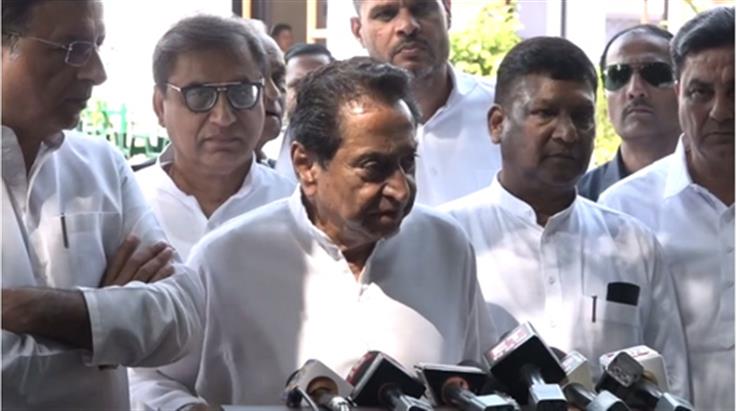
Bhopal: The Madhya Pradesh Congress Committee (MPCC) on Tuesday will release its manifesto, named ‘Vachan Patra’ for the November 17 Assembly election.
The ‘Vachan Pratra’ has promises for every section and voters — youth, women and senior citizens. The party is likely to include special packages for the Scheduled Tribe and Scheduled Caste voters.
The document will be unveiled by MP Congress President Kamal Nath and AICC General Secretary Randeep Surjewala at Bhopal’s Ravindra Bhavan, a party spokesman said.
The party has already announced 12 promises, which includes — Rs 1, 500 per month for women under ‘Nari Samman Yojana’, implementation of the old pension scheme (OPS), free electricity up to 100 units, farm loan waiver.
Congress General Secretary Priyanka Gandhi Vadra in her last public rally in Dhar made two major announcements — free education for school children (in government schools) and cash incentives — Rs 500 for students up to Class 8 and Rs 1, 500 for students of Class 11 and 12.
As per media reports Congress is likely to promise a fixed monthly income to farmers, a guaranteed minimum support price for crops and a youth unemployment allowance of up to Rs 8,000 in its poll manifesto.
In 2018, the Congress had promised youth unemployment allowance in its manifesto but could not implement it as Kamal Nath remained the chief minister only for 15 months, party functionaries said. After a rebellion by 22 Congress MLAs, who switched over to the Bharatiya Janata Party, Nath resigned and was replaced by Chouhan.
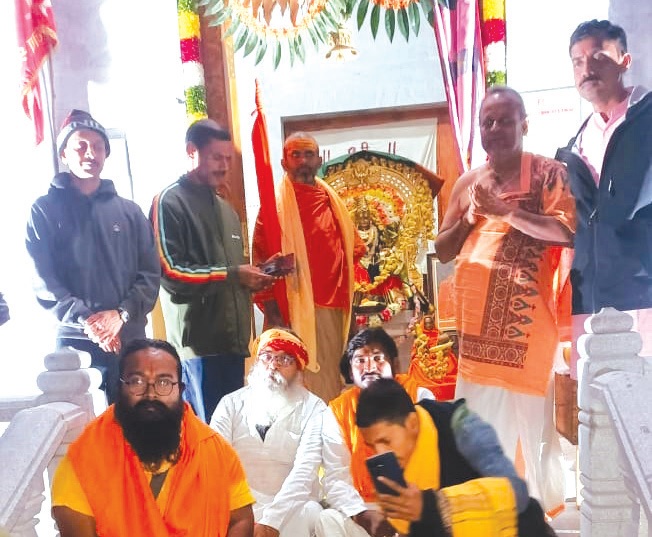
The Sharda Devi Temple, located near the Line of Control (LoC) in Teetwal village of Jammu and Kashmir’s Kupwara district, hosted Navratri Puja for the first time since 1947. The event took place on the first day of Sharad Navratri, attracting a considerable number of pilgrims from across the country.
Swami Govindananda Saraswati of Hampi led the celebrations, reaching Teetwal village with his followers on a Rath Yatra from Kishkinda, the birthplace of Lord Hanuman in Karnataka. The Puja also saw the presence of Kashmiri Pandit pilgrims, including A.K. Raina, a theatre personality known for his role in the movie ‘Kashmir Files.’
Amit Shah, while celebrating the Navratri Puja at the historic temple, expressed its profound spiritual significance.
“It is a matter of profound spiritual significance that for the first time since 1947, the Navratri pujas have been held in the historic Sharda Temple in Kashmir this year,” he said. “This not only signifies the return of peace in the valley but also marks the rekindling of our nation’s spiritual and cultural flame under the leadership of Prime Minister Narendra Modi.”
The Sharda Devi Temple is an ancient shrine and one of the 18 Maha Shakti Peethas. Situated in the Neelam Valley of Pakistan-occupied Kashmir, the temple is dedicated to the Hindu Goddess Maa Sharda, often regarded as an incarnation of Saraswati, the Goddess of knowledge and wisdom. According to legend, the temple’s origins can be traced back to the period of exile of the Pandavas. King Lalitaditya Muktapida, who ruled the region during the 8th century, is believed to have undertaken the temple’s renovation.
The Maa Sharda Devi Temple holds significant religious importance for Hindus, especially within the Kashmiri Pandit community. Devotees from various parts of India visit the temple to seek blessings and offer prayers to the Goddess.
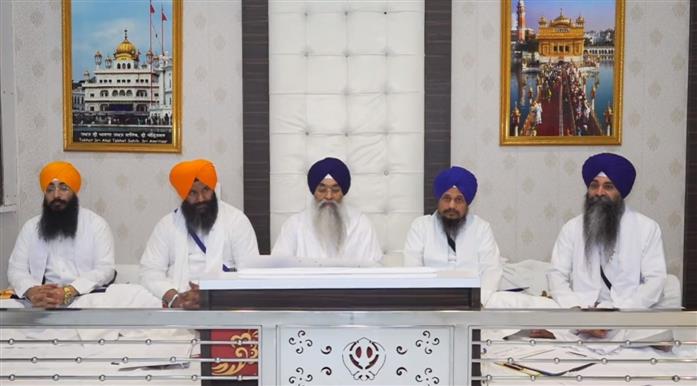
Amritsar : Akal Takht the highest Sikh Temporal seat taking serious seat of same sex marriage, disqualified the Sikh priests to perform religious services in the Gurdwara ( Sikh shrine) Sri Kalgidhar Sahib in Bathinda after the marriage of two girls on September 18 inside the Gurdwara in the presence of their families.
Akal Takht Jathedar Giani Raghbir Singh said that as per Sikh tenets there was no room for same-sex marriage as it was utter violation of Sikh religious customs.
In this regard the the five high priests led by Jathedar Giani Raghbir Singh taking a serious note of the marriage of two girls which was solemnised at Gurdwara Sri Kalgidhar Sahib in Bathinda on September 18, disqualified the entire managing committee of the Gurdwara concerned forever.
Head Granthi (priest) Hardev Singh, Priest Ajaib Singh, Raagi Sikandar Singh and Tabla vadak Satnam Singh were blacklisted for five years for being part of the controversial wedding which was solemsied in their presence in the Gurdwara. In future, all these people would never be allowed to perform any religious service in any of the Gurdwara or religious event, said Jatehdar.
Akal Takht deadly against the marriage of same sex for the last several decades and had issued Hukamnama (religious edict) when Giani Jogidner Singh Vedanti was Jatehdar Akal Takht in January 2005, while issuing a ‘hukumnama’ (edict) denouncing the same-sex marriages and urging the worldwide Sikh community not to allow such marriages to take place at any Gurdwara.
Taking serious view of the proposed move of the Government of Canada to introduce same-sex marriage bill in the House of Commons, Vedanti described it as ‘anti-Gurmat’ trend that had no place in Sikhism. The directive, the first of its kind, has been issued under the seal of Akal Takht.
The directive reads that the rising trend of same-sex marriages in western countries was a matter of concern. The move of certain countries to give legal accordance to such marriages had already initiated a worldwide debate. He said Sikh code of conduct did not allow such marriages.
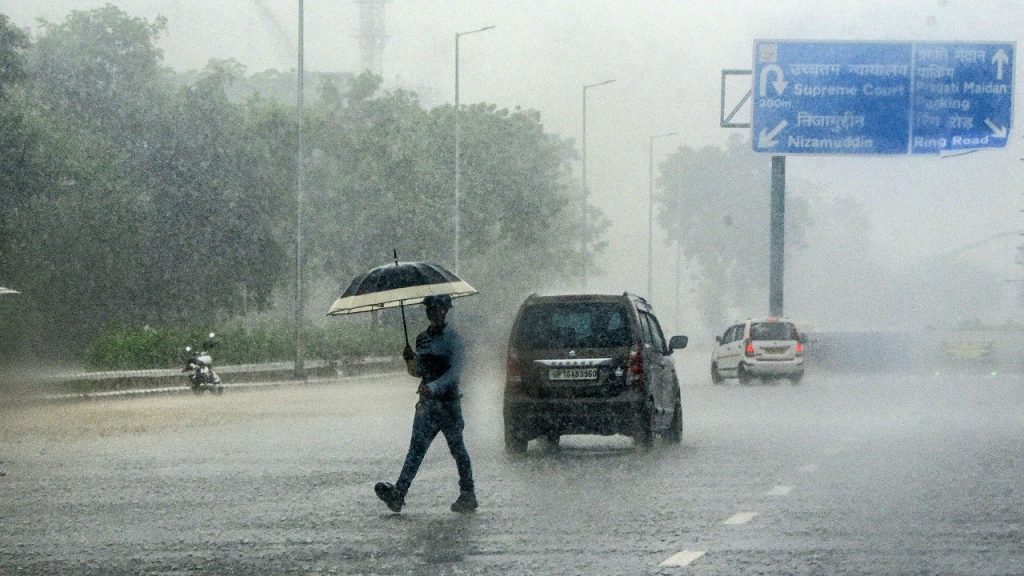
New Delhi : After overnight rains, the minimum temperature in the national Capital on Tuesday settled at 17.2 degrees Celsius, two notches below the normal, according to the India Meteorological Department (IMD).
The weatherman has predicted a generally cloudy sky with light rain.
However, the maximum temperature is expected to hover around 27 degrees Celsius.
On Monday, the maximum temperature had reached 30.5 degrees, three notches below the normal.
Moreover, the relative humidity at 8.30 a.m was recorded at 80 per cent.
As per IMD, the national capital recorded five mm of rainfall till 8:30 a.m. this morning.
Meanwhile, the air quality was under the “moderate” category as the quality index was recorded at 169 level.
According to the System of Air Quality and Weather Forecasting And Research (SAFAR), the concentration of both PM 2.5 and PM 10 in the environment was recorded at 169 and 156 respectively under moderate category respectively.
Notably, the AQI between zero and 50 is considered “good”, 51 and 100 “satisfactory”, 101 and 200 “moderate”, 201 and 300 “poor”, 301 and 400 “very poor”, and 401 and 500 “severe”.