
LK Advani has said the BJP hasn’t given up on the Ram temple issue and is committed to building it.
He is lying. The BJP has used the Ram temple issue only for political gains. They don’t give a damn for Lord Ram or the temple. As long as the BJP and the VHP are attached with this issue, it will never be sorted.
But wasn’t the demolition of the Babri Masjid meant to liberate Lord Ram’s birthplace?
The demolition of the Babri Masjid has brought misery to Ram Lalla [Ram’s idol]. When the Babri Masjid stood, the idol was protected from the sun and the rains. Now, rainwater flows through its temporary roof. I had to set up an umbrella to protect the idol. When the Babri Masjid stood, Lord Ram was draped in finery. Today, he stands like a beggar in rags. Before the demolition, devotees could have darshan from very close. Now, the nearest a devotee can get is 16 metres. The number of devotees visiting has fallen drastically. Thanks to security, the approach route is too circuitous and long. The police search every devotee and don’t allow any to even bring in prasad ki pudia [offerings in envelopes]. There is no akhand kirtan [ritual chanting]. No Ramcharitamanas paath. The loudspeakers are silent. First-time visitors swear they won’t come back. None of this happened when the Babri Masjid stood, thousands then thronged it every day. But by demolishing the Babri structure, the Rambhaktas have devastated Ram Lalla’s temple.
When do you think the temple will be built?
When the emotions of the Hindus and the Muslims are one on this. When both sides remember Iqbal’s words — sarey jahan se achcha Hindustan hamara.
What is the support for the VHP in Ayodhya?
Except for two or three old-timers, not a single new mahant or sadhu has joined the VHP since the demolition. People have realised that they use religion to mislead Indians. They pedaled Lord Ram’s name to seize the throne in Delhi.
Haven’t you made enemies among the Hindutva forces?
They have tried many times to have me removed as the head priest. They allege that I have no faith in Lord Ram. They have petitioned the Commissioner of Faizabad for my removal. But a Supreme Court ruling following the demolition protects my position as the head priest of what the Supreme Court calls the ‘makeshift structure’. The court says nothing can be changed here till the case is decided.
Who runs the management?
The Commissioner of Faizabad is the receiver. All offerings go into a bank account. Part of this money is used for the upkeep of Ram Lalla. But even that is sometimes released with difficulty, after I complain to the media. The rest of the money cannot be touched.
What is your view of Ayodhya’s Muslims, one of whom has filed a court case to reclaim the Babri Masjid?
Vo satya roop mein Ayodhyavasi hain (they’re true residents of Ayodhya). The Muslims of Ayodhya stitch clothes and make garlands for our idols. If these Muslims were evil they could easily slip in a bomb in the firecrackers they supply for our festivals. But they have never done that and never will.
So what’s the solution to this dispute?
Politicians will never solve it. Nominate a Hindu and a Muslim and ask them to sit and find a solution. But promise that everyone will accept that solution. It’s that simple.
‘Thanks to BJP, Ram Lalla stands like a beggar’
‘Naxals will rise again like the phoenix’

What is your information about the killings of policemen by Naxals in Gadhchiroli district in Maharashtra?
Initially, it was shown as an encounter and it was claimed that the CPI (Maoist) [the Naxals’ party] had suffered heavy losses. But it was revealed later that a landmine had killed 17 policemen and the Naxals hadn’t suffered any losses. Such lies are spoken only to maintain police morale.
The Chhattisgarh Government says the 19 people killed by the Salwa Judum [police-backed anti-Naxal tribal militia] in Dantewada last month were Naxals and not innocent villagers.
That’s a lie. Those killed were innocent adivasis [tribal people]. They belonged to villages that have long resisted government pressure to abandon their villages and move to the Salwa Judum camps. That’s why the Salwa Judum kidnapped and killed them. We expected this after [Chief Minister] Raman Singh claimed his victory in the Chhattisgarh election last year was the people’s approval of the Salwa Judum violence. Of course, now that the Supreme Court has ruled against the Salwa Judum, the state may abandon that and hire one or two thousand from them as regular police and turn it into a paramilitary force like Andhra’s Greyhounds. The BJP is a fascist and a terrorist party and may naturally go this way.
The government says it is the Naxals who have terrorised the people.
False. Why do people support the Naxals if they are terrorised? Most people are kept in Salwa Judum camps by force. Many want to go back to their villages.
Hasn’t Naxalism collapsed in Andhra Pradesh since the police began killing Naxal leaders and squads in 2005?
We suffered heavy losses in the region of Nallamara forests [in south Andhra Pradesh] as it isn’t contiguous with Orissa, Chhattisgarh and Maharashtra. But the Naxal leadership of Telangana [in north Andhra Pradesh] now works from these adjacent states. The Andhra leadership is guiding the Orissa movement also.
Strategically, the picture is not so gloomy. During the Telangana armed struggle of the 1940s, all the leaders were killed in Warangal and Nalgonda districts. But the struggle revived. In Srikakulam district, where the movement was strongest since 1968, the top leaders were wiped out by 1972. The movement was rebuilt during the Emergency [1975- 77]. During 1978-80, every single district secretary of the party was killed in fake encounters. The movement rose again.
Like the Phoenix, we would rise again from the ashes. Even the enemy can’t say the whole thing is over. For 30 years the armed struggle has been on in one place or the other. The people are overwhelmingly with the Naxals because, if nothing else, the movement has brought them selfrespect after decades of bonded labour, torture and destruction. The Naxals don’t accept the lordship of the landlords.
Would you say holding talks with the Andhra Pradesh Government was a bad idea as the Naxals came out and police got wind of their hideouts?
In principle, no, it wasn’t. Karl Marx says you can use any form of struggle. We gained politically from the talks. The middle class is now convinced that if the Naxals take power, they will have a perspective on every aspect, such as democratic rights, land reforms and self-reliance. The greatness of the revolutionary party lies in that it agreed to the talks because the people wanted talks, despite the brutal nine-year rule of Chandrababu Naidu and despite the fact that we had no illusion about the Congress rule since.
The Chhattisgarh Government says Naxal leaders driven from Andhra are creating trouble in Chhattisgarh.
Forty percent of the Naxal militia, including the women, in Chhattisgarh is adivasi. The movement has built up in Chhattisgarh since 1980. Its district level leadership comes from within. In Dantewada alone, the Chhatra Natya Manch, the cultural group that supports the movement, has 6,000 members.
Chhattisgarh aims to copy the Andhra ‘model’ of wiping out the Naxals.
The Centre and the state are coordinating on this. No Prime Minister ever spoke on the Naxals. But Manmohan Singh has repeatedly said Naxalism is cancerous and a bigger threat than the threat of terrorism. You must see this in the context of the government’s imperialist policies of globalisation. For the first time, trade organisations are talking about the Naxal ‘problem’. The Naxals represent the people’s rights to self-reliance against MNC interests.
All political parties support the MNCs. Manmohan Singh and [Union Home Minister] P Chidambaram are World Bank agents. When the Finance Minister becomes the Home Minister, it only means the Home Ministry serves the interests of industry and finance. You can’t reach anywhere if you view this only from the point of view of violence versus nonviolence. There is mass resistance to the Tatas’ steel project in Chhattisgarh, as is to the Posco steel project in Orissa.
But why oppose industrialisation?
We don’t. Did we close down the public sector? Lakhs lost their jobs with the closure of IDPL and Allwyn. Did we do that?
The Naxals have massed in Orissa. Is that the next battleground then?
The movement is now very strong in Orissa. The government there is creating a Salwa Judum in south Orissa, adjoining north Andhra, and in Mayurbhanj, which adjoins Jharkhand.
What’s the Naxals’ key agenda?
Land to the tiller, workers’ rights over the factory, and political power to the people, flowing from the grassroots. The Maoist theory explains that you first occupy the land of the village; the landlord then sends his mafia; you fight back; then the police come in support of the landlord; you then adopt guerilla methods to fight the police and the state. The economic programme is to occupy the land, the military programme is the guerilla struggle, and the political programme is to bring power to the people by organising gram rajya [village rule] committees. In 1995, the party decided to adopt alternative development programmes for drinking and irrigation water and primary health and education, among others, under the gram rajya committees. The party asked people not to pay taxes to the government and not vote in elections. That’s how it defies the state.
The state claims to work for the same issues of water, health and education.
It only claims to work on these issues, but doesn’t practice what it says. Uneven development is an imperialist characteristic.
Why do the Naxals reject elections?
The 60-year Parliamentary history is a hurdle for the revolution. One has to overcome that to achieve people’s power.
Is Naxalism on an irreversible decline?
The people are looking forward to the Naxals’ comeback. They know it is only a lull. In A Tale of Two Cities, Charles Dickens wrote these are the worst days and also the best days. All the political parties, from Narendra Modi to Buddhadeb Bhattacharya, are united in their repression of the people. But everyone fighting imperial globalisation — not only the revolutionaries but true patriots, Gandhians, Sarvodaya people, Lohiaites, nationalists, Muslims, minorities, advisasis, dalits and women — have hopes only in the alternative revolutionary movement. They see that only the Naxals can protect our sovereignty, under threat especially from the SEZs.
Why must the revolution kill people?
The movement doesn’t believe in killing. It only believes in resistance. Ours is revolutionary violence as against the violence of the ruling class and the state. All the tools of exercising violence are in the hands of the propertied classes. You get a gun license if you have five acres of land. The whole effort of Marxism is to reinforce people to resist state violence.
Is Gandhian nonviolence irrelevant?
Even Gandhians realise Gandhi is not relevant. [Former Prime Minister] VP Singh once said if he were 20 years old he would join the CPI (Maoist).
When Brother Fights Brother

YOU WOULD bet on any screenshot of Singaram village to clinch a picture postcard contest. There is a surfeit of National Geographic moments here. As the sun warms up behind the thick forested hills, sinewy village acrobats glide up the toddy trees to tap their day’s white poison; someone hurries to the monthly cockfight 12km south, a throaty fat bird with an angry frown pinched tight in his underarms; the tireless granny shifts cots about and noisily sweeps her mud hut’s porch. Teenagers here guess their ages by when they broke their moustache or began menstruating. Older, they forget even that. Asked for a past event’s time, people wave at the sky to show where the sun had been that moment. As night falls, a hushed darkness cloaks the village, which has never known electricity. Embers of firewood glowing in faraway huts round off the idyllic picture. For backpacking trekkers ever on the lookout for an off-the-beaten track, this should be it.
It isn’t. Singaram’s tragedy lies in the ruins of its school that no one has entered in years, in the abject terror of forest officials who turned their backs on its development a decade ago, in the roads destroyed by the raging Maoist insurgents, the Naxals, to stop the “others” from coming in ever. It seems utterly unbelievable on a visit, but the singular truth about Singaram and hundreds of such villages across thousands of square kilometres in south Chhattisgarh is the overwhelming and brutal violence that rules them, matching some of the worst militia-ravaged parts of the world such as in Colombia, Sudan and Iraq.
If anything, this is CNN country twentyfour seven, not that India’s news organisations are much interested in the rural violence here. Locals say heavily armed Naxal women and men boldly roam the region in battle fatigue and freely swoop on villages for nightly rests and daytime meals, but especially for their signature monthly meetings. They levy taxes on trades such as on the tendu plant leaves used for rolling bidis. They also kill “traitors” — anyone they think is a police informer or an ideological opponent, or the worst: a double agent — often by beating them for hours and slashing their throats in full view not just of hundreds of villagers but even the dying woman’s or man’s spouse, children and parents.
[box]
A GRIM REALITY
SP Rahul Sharma claims Naxals hold 40 percent of Dantewada and are fighting bitterly to seize another 20 percent
Government estimates admit Naxal ranks have swelled 20 times since the Salwa Judum was raised in 2005
In 2007, Naxals freed 300 from a prison. They also killed 52 policemen and 30 SPOs that year
Activist Himanshu Kumar says Naxals control three-fourths of 1,350 villages here
[/box]
THE NAXALS control 40 percent of Dantewada, basically its remote areas,” says Rahul Sharma, Superintendent of Police (SP) of this district in south Chhattisgarh. “The government controls a similar size. Both are fighting on the rest 20 percent.” Human rights activist Himanshu Kumar, who runs the NGO Vanvasi Chetna Ashram in Dantewada’s villages, laughs at Sharma’s figures. “The Naxals control everything except the few towns in this region,” says Kumar, whose organisation helps those it believes are innocent victims of police brutalities or are falsely accused as Naxals. To be precise, says Kumar, the Naxals control three-quarters of the 1,350 villages in Dantewada and the adjacent Bijapur district, which was carved out of the larger Dantewada in August 2008.

Both Sharma and Kumar, however, agree that violence is bound to shoot up dramatically in the region following the January 8, 2009 killings of 19 villagers, who the police say were Naxals, near Singaram village. Even as the Naxals called on the tribal people to observe a ‘Black Day’ on January 26, India’s Republic Day, police shot and killed five more men in the Bijapur district the previous day, claiming they were Naxals who fired the first shots in their “encounter”. Predictably, local villagers alleged that the police were lying and had, in truth, dragged the five unarmed men from their homes and shot them point blank. Kumar told TEHELKA he has sent out activists to investigate.
The renewed violence from the state seems the second stage of a strategy of offense launched in 2005, when police began burning down random villages to rob the Naxals of their support, their rations and hiding areas. (Police claim it was the Naxals who burned the villages, forcing the displaced villagers towards them.) The police moved these displaced villagers to hastily erected hutment collectives along the state highways, 20-odd of which are in operation in Dantewada and Bijapur, reportedly housing between 30,000 and 50,000 people. Able-bodied men and women among them were recruited as Special Police Officers (SPOs) to take on the Naxals, and kitted up with arms and uniforms. Today, some 1,200 of such young women and men, many of them, in fact, seemingly still in their teens, are each paid Rs 2,150 a month and used as frontline boots on the ground.

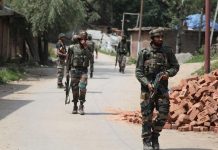
Now, as part of the second phase of the strategy, an elite group from among these SPOs is being trained in more critical counterinsurgency operations at a jungle warfare school in the town of Kanker, 250km north of Dantewada. The SPOs that participated in the January 8 raid near Singaram were trained here. They are now part of what is called a Special Task Force (STF) and report directly to Dantewada SP Sharma. The team has reportedly also trained in Jammu & Kashmir with an Indian Army unit. According to Soyam Muka, a former schoolteacher who heads seven Salwa Judum camps in Dantewada, these men have fully moved out of the camps and report directly to Sharma. Sharma told TEHELKA the unit would now get more aggressive in a bid to “flush out” the Naxals.
This elite team that led the January 8 attacks was equipped with two AK47s, a 7.62 LMG and 35 INSAS guns, which are infantry weapons in the Indian Army. Sharma also has a helicopter on demand, which was used to evacuate three SPOs who were allegedly injured on January 8. After Union Home Minister P Chidambaram’s visit to the state capital Raipur in the third week of January, Chhattisgarh Home Minister Nanki Ram Kanwar told TEHELKA the Centre had virtually offered unlimited funds and training for the counterinsurgency operations. Sharma believes this will translate into better weaponry for the SPOs.

For activist Kumar, none of this bodes well. “The Salwa Judum’s earlier attacks created terror in hundreds of villages,” he says. “Thousands of boys and girls have since picked up arms and are now roaming with the Naxals.” Kumar claims Salwa Judum attacks have killed more than 5,000 people. Last year, the state government admitted that the ranks of the Naxals may have increased more than 20 times since the Salwa Judum was raised. Over two years ago, in 2006, Naxals daringly attacked a Salwa Judum camp and killed 34 people.

A staunch supporter of the police action against Naxals, Muka, president of the seven Salwa Judum camps in Dantewada, however, knows the limitation of tit-for-tat against the Naxals, entrenched for decades. “Tribal brothers are dying on both sides,” Muka told TEHELKA at his residence in the small town of Konta, 170km south of Dantewada. “Ultimately, we must push for dialogue as that alone will bring lasting peace.”
‘Violence will go up. This is total war’

The relatives of those killed on January 8 say they were not Naxals but innocents shot in cold blood by rival tribesmen you have hired as Special Police Officers (SPO).
The last two years have seen some eight encounters. Each time they said we killed innocents. This is the Naxals’ propaganda warfare. They use the institutions of democracy — the courts, the NGOs — for their ends. This was no stage-managed killing. It is an absolutely false allegation that we killed defenceless people. It was a genuine encounter. No media comes when my boys are martyred. But every time we kill Naxals, a media trial takes place. I have been on the Naxals’ hit list for nearly two years. I have lost 60 policemen, including an Additional SP. I have carried their bodies on my shoulders. And then I’m told that the Naxals are “simple villagers who are innocent”. Not fair. In December 2007, Naxals ambushed and killed 12 policemen, and it took us two days to bring back their bodies. Their widows came to me and said, “You could have at least brought our husbands’ bodies back earlier.” It was a very emotional moment. You can understand this only when it happens to you. Nobody comes to grieve with us when my men die.
What are the major problems in counter insurgency ops against the Naxals?
The Naxal-controlled areas are very remote. The Naxals have bombed the roads. In the December 2007 incident, I had to go in with 100 men to retrieve the dead bodies of the 12 policemen using a helicopter. Until the January 8 killings, police hadn’t been to Singaram [the village near where the killings took place] in five years.
What are the goals of the police against the Naxals?
I am fighting to establish the authority of the state. The fact is people have lost the fear of the law because they feel they can get away with anything. My job is to take hard police action against the Naxals. The fear of the law is to be ingrained in the people.
How well-equipped are you to do that?
We have a sanctioned strength of 1,800 policemen in Dantewada, but we have only 900. The current average number of policemen per police station is 35. This needs to go up to about 70 or 80. We are now recruiting 600 more. Over the next five years, we will have 5,000 men in Dantewada. We are training many policemen at the Counterinsurgency Jungle Warfare School at Kanker [in south Chhattisgarh]. I have myself trained with the Indian Army at Mizoram and with the College of Military Engineering at Pune. We have AK47s, SLRs, INSAS, and two-inch mortars. The CRPF has rocket launchers. We have anti-landmine vehicles, one of which, however, was blown off by the Naxals in 2005 when they planted a powerful 100-kg bomb. Twenty-four men in that vehicle were martyred. We also have 1,200 SPOs, though we need more. The CRPF has three battalions in Dantewada, with over 2,000 men. One battalion of the Sashastra Seema Bal guards the [Salwa Judum] relief camps.
Is the police ready for the fight?
The police are in a defensive mentality because the Naxals rule the region and kill them at will. The IPS officers rarely completed their terms here. The state government has now made a policy that all young IPS officers must do a two-year tenure in these areas. We need more special laws like the Chhattisgarh Special Powers Act. Paramilitary organisations such as the CRPF want the Armed Forces Special Powers Act to be invoked here. Please understand: the situation here is more precarious than in the northeast. The casualty rate here [of the forces] is the highest in the country. In 2007, we lost 123 jawans from all the forces, not including the SPOs. Last year, we lost 67 men. Right now, it is a negative attrition rate: more policemen than Naxals are killed. We have to reduce our casualty rate. We need to hit them hard. In Jammu & Kashmir, the ratio of men in uniform killed to the terrorists killed is 1:4. We have to get to that ratio. I know this is crude, but we are working in a crude situation. It will not be easy. Villagers tell me, “you come once a year, but the Naxals beat us everyday.”
Do the January 8 killings mean you are upping the ante? Will violence on both sides go up?
Violence is definitely going to go up on both sides over the next two-to-three years. That is because we have disturbed the status quo, which was in the Naxals’ favour. If they kill my men, I have to retaliate. It is a full-fledged war. We have to be on the offensive. Singaram was offensive: we went into their territory. The police have become strong. The Naxals are scared and targeting truckers and road contractors.
Is hard police action the only way? What about bringing development?
Police can kill Naxals but not Naxalism. Without development, this problem cannot be solved. Improving education, healthcare and public distribution has to be the thrust. We also want the displaced people in Salwa Judum relief camps to go back to their villages. But the Naxals don’t want development. They don’t want the roads because that will bring schools and development, and wide exposure to the villagers. All government departments surrendered to the Naxals long ago. No one goes into the forests.
Do you have political support?
Chief Minister Raman Singh and Director-General of Police Vishwa Ranjan have told me that we must hit the Naxals and not go back on this. Enough is enough. ‘Live and let live’ won’t work. We will carry out searchand- destroy operations in their territory. We are going to follow the model of Andhra Pradesh where the Greyhounds have managed to control the Naxals.
The Jungle Justice Of The Trigger Happy

MADKAM DEVA is a tribal, the sort characterised romantically in social science schoolbooks and museum artifacts illustrative of India’s remotest jungle peoples. There is nothing charming though about the chilling tale of a bloodbath he recalls staccato, walking barefoot as always in the sprawling southern forests of Chhattisgarh, waving at the deep red blood clots thickened on fallen leaves, still enough food in them for frenzied golden ants two weeks after human gore was spilled here. Deva’s blood would be here, too, had he not ducked the machinegun fire in a nanosecond, leapt behind the shrubbery like frightened deer, and bolted through the cascading landscape.
“They made us stand in a line and ordered us to bow our heads,” Deva says of those terrifying moments between life and death. “I was the last and that gave me just enough time to escape.”
Four more proved lucky. But 19 others did not. A posse made largely of men from the Salwa Judum (literally, Peace Gathering), the tribal militia raised by the state as a quasi police force, killed 15 men and four women at this spot on the afternoon of January 8, 2009, triggering a massive furor across the state and worsening the battle lines between the armed Maoist insurgents, popularly called the Naxals, and the state police.
Immediately, the police named the killings a huge — and rare — success in their grim and often adverse battle against the Naxals who, for three decades, have had a free run of some 15,000 sq km in Bastar, the traditional name for the vast heavily forested tribal region that now encompasses five districts in south Chhattisgarh. “Our fight to the finish has begun,” Chhattisgarh Home Minister Nanki Ram Kanwar told TEHELKA in the state capital, Raipur, this week. “We will soon reoccupy our lands that the Naxals have controlled for decades.”
[box]
WHAT HAPPENED: THE POLICE VERSION
The Salwa Judum SPOs had intelligence that Naxals were to meet near Singaram
The 84-strong SPO party patrolled the area without entering any village
At 4pm, as they crossed Singaram, a group of Naxals opened gunfire on them
The SPOs retaliated with heavy firing, and the encounter lasted 90 minutes
15 of the “outer layer” of Naxals were killed. But the “hardcore” cadre escaped. Rifles, grenades and other arms were recovered
The SPOs left the bodies behind and returned with the collected weapons
[/box]

NANKI RAM KANWAR
Home Minister, Chhattisgarh
That may be long in the coming, if at all. For now, the rebels have reacted strongly, slamming the killings and vowing revenge in banners, pamphlets and posters distributed across the region; calling successful general shutdowns; blocking highways by digging up roads and cutting trees; and burning trucks. A massive cry has gone up across the state’s tribal region, among human rights groups, and from the opposition Congress and Communist parties, rejecting the police claims, alleging instead that those killed were innocent villagers picked up forcibly from their homes, marched into the woods, and shot in cold blood. “All the dead bodies were found lying together, which wouldn’t be the case if this was a genuine encounter,” says Manish Kunjum of the Communist Party of India (CPI), a three-term ex-MLA who organised a massive protest rally of thousands of tribal people.

EMLA HUNGA
Survivor, Danteshpura village
The state High Court has stepped in, too, demanding full facts from the police, after some 20 relatives of those killed, reached by an NGO in their remote villages, walked 70km and then bussed 500km to Chhattisgarh’s northern city of Bilaspur to file a petition before the Court seeking a probe into the killings. Says Kopa Kunjum, a human rights activist with the NGO Vanvasi Chetna Ashram, who walked two days to the remote villages to bring these relatives to the city: “By all accounts, those killed did not have weapons. This was a one-way shootout; only the police had the guns.”

MADKAM MUDRAJ
Ex-Naxal, now Salwa Judum SPO
TESTIMONIES TEHELKA has gathered from extensive travels in the Naxal-controlled territory over a week suggest that the police story might be just that: a story. We extensively interviewed three of the five men who claim they survived the bloodbath; the kin of eight of those killed; and many villagers who claim they witnessed the Salwa Judum enter four villages and abduct 24 people.
We walked four hours to the remote village of Singaram, from where four of those killed were allegedly abducted, and spoke over two days with their relatives and other witnesses. We spoke to them individually, grilling them at length, checking especially to see if the truth indeed lay in the police version — that a Naxal group fired on the Salwa Judum patrol, forcing it to retaliate, and that the villagers’ narrative was a false one thrust upon them by the Naxals. Apart from the survivors, we took a dozen villagers to the scene of the killings some three kilometres from Singaram, and heard them describe their visits there the day after the killing to locate the dead. Such testimonies largely corroborate each other.

ANKIT ANAND
SDM in charge of probe
On the other hand, there are discrepancies in the narratives of two individuals TEHELKA spoke to from the police. One is Rahul Sharma, IPS, who is the Superintendent of Police (SP) of Dantewada, the district in which Singaram falls and which is one of the state’s two most heavily Naxal affected districts.Sharma directly planned the January 8 incursion into the Singaram region, the deepest the police or its militias have ever gone in the Naxal territory in Chhattisgarh. The second is Kichche Nanda, 27; the plucky leader of the militia-police combine who claims his 84-men team ran into the Naxals and killed them.
Importantly, though the survivors and the relatives of those killed vehemently deny links with the Naxals, several others, including those who allege that the Salwa Judum militia shot defenceless people in cold blood, concede the police claim that at least a few of those killed were indeed the “outer layer” of the Naxals or were closely linked to the Maoists. “It is known that Sitakka alias Seetey worked with the Naxals,” said a villager requesting anonymity, referring to the woman killed who the police claim was the leader of the group that was killed. “She had trained in providing medical care to the Naxals.”

MANISH KUNJUM
CPI leader & ex-MLA
Here’s what the survivors of the gunfire and other villagers claim happened on January 8, 2009. Around 9am, a group of 150 to 200 men wearing battle fatigues and carrying guns entered a village named Danteshpura, and immediately began ransacking its homes. Here, they abducted nine people, including two women, and forced them to carry their backpacks. “They told us they will take us to a police station 30km away and then let us go,” says Emla Hunga, one of the five survivors. “We believed them and started walking with them.” Of this group of nine, only Hunga survived the subsequent massacre. His brother, who was also abducted, died.
Before noon, this party had reached another village named Korrusguda. Here, they picked up a woman and eight men, including Madkam Deva, one of the five who escaped the bloodbath and is quoted at the beginning of this report. Deva was atop his granary near his hut when two men jumped him. These nine, too, were made to carry backpacks. Finally, by 3pm, the abductors and their hostages reached Singaram. Here, four more were caught, including Sitakka, who the police say led the “Naxal group”.
Shortly after leaving Singaram, the party stopped by a forest stream three kilometres ahead. “They asked us to rest here, saying they will give us food,” recalls Hunga. But that was not to be. Instead, the militia opened the backpacks and took out shirts and trousers. They forced seven men to discard their lungis, the tribal people’s wraparound, and wear trousers. They were also forced to wear shirts over their vests. One man was forced to wear a battle fatigue. The militia then divided the hostages in three groups. Fifteen men, including Deva, were moved away in one direction. Four women, one of whom was taken hostage moments ago as she was walking past, were taken to another corner. Hunga and four others were forced to stay by the stream.
“We heard the women scream, then gunshots, then silence,” Deva recalls. Between the gunshots and the screams, he saw the abductors go into batches towards where the women were taken. Says Emla Harma, still sitting by the stream, who later escaped: “The women cried out for their mothers a long time.”

KOPA KUNJUM
Activist, Vanvasi Chetna Ashram
THESE TESTIMONIES, and those of the villagers’ who fetched the dead the next day and claim the women’s bodies were partially or fully naked, have brought the allegation that the women were raped before they were killed. Some of the pictures of the dead bodies taken by journalists from nearby towns of Andhra Pradesh, who visited the scene of the killings a day later, indeed showed the women’s clothes disheveled, even in a state of undress.
After the women were killed, the 15 men were lined up between the trees. Soon, bullets were flying around. Fourteen died instantly. Deva alone escaped. That left the party of five men, still by the stream, stricken with fear. The abductors now forced these five men to lift the backpacks and start walking again in a file. Harma led the queue. Hunga was number four. “Suddenly, one of the gunmen stepped to a side and opened fire,” says Hunga. “I turned and saw blood gushing from the man behind me.” In a flash, the other four threw the backpacks and darted in the forest, surviving the hail of bullets chasing after.
The five survivors reached their respective villages late at night and shared their harrowing tales. By then, Dantewada’s SP, Sharma, had gone public with the claim that his men had killed 15 Naxals in an encounter near Singaram. The next morning, scores of villagers descended on the scene of the killings. So did the journalists from Andhra Pradesh, who extensively took pictures of the dead and went back to write the first stories questioning the police claim of an “encounter”. Sharma told TEHELKA the police had seized 10 backpacks, five rifles, five hand grenades, two 2-inch country-made mortars, 6kg gelatin, and some “bomb-making material”. These were presented before the media at a police station the next day.

Photo: File Pictures
Survivors Hunga and Deva had recognised up to four of the men in the Salwa Judum. They are called Special Police Officers (SPOs). The survivors say these four SPOs are tribal people from other villagers, and once worked with the Naxals but later crossed over to the Salwa Judum. They include Madkam Mudraj, who confirmed to TEHELKA he was indeed once a child Naxal soldier but was now an SPO and had played a key role in the January 8 killings.
The police, on the other hand, claim that this party of Salwa Judum SPO and some regular policemen had been patrolling the region since the night of January 6. “We were walking in two groups apart by 500m when the Naxals saw one group and started firing at it,” says Nanda, who led the patrol. The Naxals, he says, were in the middle of the two groups of SPOs and this made them sitting ducks. But there are discrepancies:
• Sharma says the group had 54 SPOs and 30 policemen. Nanda says they were 74 SPOs and five policemen with four others.
• Sharma says the “police party generated intelligence at village Danteshpura that a large quantity of ration had moved towards Singaram village”. But Nanda said his party did not enter any of the villages or talk to anyone there.
• Sharma says three men received body injuries. But, when pressed, Nanda said one man was injured on his palm, while the other two “fainted because they were shooting on hungry stomachs”. Within a week, the one with the palm injury had returned to work.
• Sharma admits the arms recovered are old but says that’s because the “hardcore” Naxals, who use sophisticated guns, had run away quickly leaving behind only the “outer layer”. But Nanda says the encounter lasted 90 minutes with massive firing from both sides.
• Inexplicably, Nanda, who had an AK47, only fired 15 rounds in 90 minutes. He says he didn’t need to shoot more as “I shoot only if I can see a person”. Yet he couldn’t say if he killed anyone.
[box]
WHAT HAPPENED: SURVIVORS’ TALES
150-200 SPOs entered four villages, looted them, and abducted 24 people
The hostages were forced to carry backpacks and walk over 15km
Just outside Singaram, the SPOs forced seven men to wear shirts and trousers
Marched ahead, 4 women were heard screaming until gunshots rang out
15 men were lined up and shot at. 14 died but one, Madkam Deva, escaped
The five remaining men were made to walk again with backpacks. Four of them escaped as one was shot dead
[/box]
So, how come not a single SPO died or even received gunshots? Why did the SPOs, who numbered over 80, not carry with them the 15 dead bodies they claim to have counted on the spot? Why don’t the police carry out tests on the body of Sitakka, which lies buried in Singaram, to establish if she was raped?
For now, Ankit Anand, an IAS officer in his first posting at Dantewada as a sub-divisional magistrate, is holding a “magisterial inquiry”. He has visited Singaram and recorded 24 statements, both from the villagers and the police-SPOs. His mandate is to establish (a) whether the police had “sufficient reason” to believe they were Naxals and (b) whether the police had “sufficient chance” to catch them without killing them. He says he has found “different points of view” in the testimonies. “Prima facie we may feel that they are contradictory,” he says, “but in the end, we will get a story that is generally coherent.” Just how?
More Evidence Of Lashkar Role, More Evidence Of Our Bungling

Photo: Deepak Salvi
‘What makes terrorism particularly threatening at this moment is the impression of vulnerability combined with the display of greater sophistication in techniques and methodologies of terrorist outfits. The challenges before us are to demonstrate that we have both the capability as well as the sophisticated instrumentalities to anticipate and overcome the shifts and changes in terrorist methods. We cannot, therefore, afford to conceptualise narrowly. We must not react merely to immediate events.
This is the underlying message contained in the Home Minister’s letter inviting you to this meeting. It is important at this juncture to demonstrate our combined will, and for that we are effectively galvanising the internal security system to deal with future terrorist attacks. Technology is empowering nonstate actors across the globe and it is necessary for us to come up with a comprehensive strategy that combines the best of technological and human capabilities within the country to defeat terrorism in all its manifestations.
The Home Minister has already outlined a number of steps that have been taken in recent weeks to erect additional mechanisms to counter future terrorist attacks. The main message is that we need to break down barriers to information sharing between the various agencies.

What I would add is that we need better intelligence and perhaps, more importantly, sophisticated assessment and analysis of the intelligence that is available. Complaints are often heard that the intelligence provided by the agencies is not actionable. All intelligence produced is actionable, though it may not always be specific. It depends on the capability and ingenuity of those who assess the information to further develop and convert the fragmentary pieces of intelligence into a complete whole and for those who have to act on it to possibly pursue each and every lead.’
— Excerpts from Prime Minister Manmohan Singh’s opening remarks at the inaugural session of the Conference of Chief Ministers on Internal Security on 6 January.
IF THE Prime Minister chose to pointedly focus on the crucial issue of ‘information-sharing between various agencies’, it was with a reason. He knew that vital and critical intelligence had simply been ignored. It lay unattended in various files, in the offices of different premier intelligence agencies. He is aware that if all the intelligence that came in two months before the Mumbai terror attack on 26/11 had been put through a ‘sophisticated assessment and analysis’, senior officers could well have been able to join the dots and zero in on the fact that terrorists were going to use the sea route to come into Mumbai and attack five-star hotels. Incredibly, sources in the highest quarters in New Delhi have told TEHELKA that the mobile numbers that were used by the Mumbai terrorists were available with the Intelligence Bureau at least five days before 26/11.
Highly placed sources shared the contents of a ‘Secret’ note that contains 35 mobile numbers. Of the 35 SIM cards, 32 had been purchased from Kolkata and three from Delhi, by “overground” workers of the Lashkar-e-Toiba, and sent to Pakistan-occupied Kashmir by mid- November. The precise contents of the ‘Secret’ note could not have been more direct: “The numbers given below have been acquired from Kolkata by overground workers (OGWs) and have been sent through Pakistan trained militants based in Kashmir to PoK. These numbers are likely to emerge in other parts of the country. These numbers need to be monitored…” The note contains more: “These numbers need to be monitored and the information taken from these numbers regarding the contents of the conversation, current locations of the call detail records are required for further developing the information. The monitoring is possible at Kolkata.”

Photo: Reuters
Highly placed sources reveal that this crucial and stunning piece of information was received by the Intelligence Bureau (IB) on 21 November, at least five full days before Ajmal Amir Kasav, the lone surviving terrorist and his nine accomplices got off the inflatable dinghy at Mumbai’s Badhwar Park on the evening of 26/11. The Prime Minister and Home Minister are aware that for all the five crucial days that the numbers were available, they were not being monitored. The lapse is all the more critical because at least three of the 32 numbers contained in the Secret note, were the exact same cell numbers that the Mumbai terrorists used to keep in touch with their handlers in Pakistan. It is well possible that the terrorists only activated their mobile numbers after reaching Mumbai but that does not excuse the fact that the numbers were not put under surveillance despite the knowledge that they had been sent to trained militants in PoK.
This was perhaps uttermost in the Prime Minister’s mind while he was addressing the conference of chief ministers on internal security. That is perhaps why he emphasised this: “All intelligence produced is actionable, though it may not always be specific. It depends on the capability and ingenuity of those who assess the information to further develop and convert the fragmentary pieces of intelligence into a complete whole and for those who have to act on it to possibly pursue each and every lead.” He knew that crucial information was available, which if analysed, could have been converted into a ‘complete whole.’ The agencies had failed in monitoring the vital numbers.
On 18 September, for example, the Research and Analysis Wing had intercepted a satellite phone conversation which clearly indicated that a hotel at the Gateway of India in Mumbai would be targeted. Crucially, the intercept also revealed that the sea route would be used to launch this operation. Again, on 24 September, RAW recorded another conversation. This time, the hotels were mentioned by name and they included the Taj, the Sea Rock Hotel and the Marriott hotel. If these inputs were being analysed, it would have become clearer that hotels in Mumbai would be attacked and that the sea route would be used.
THIS IS not all. Again on 19 November, RAW picked up another piece of conversation in which a voice said, “We will reach Bombay between nine and 11.” RAW tracked the coordinates of the call and frighteningly discovered that it came from the sea near Mumbai. RAW passed on this vital piece of information to the IB who in turn sent it to the Navy but the terrorists, who were first aboard the hijacked trawler MV Kuber and subsequently on the inflatable dinghy, still managed to sail into Badhwar Park, ironically, almost at the promised time: between nine and 11.

Photo Reuters
They were off only by less than an hour or so, for according to the dossier which the Ministry of External Affairs has handed over to
Pakistan, the 10 terrorists arrived at Badhwar Park at 8.30 pm. The dossier says, “The ten terrorists performed watch duties on board MV Kuber. Log sheets maintained by them have been seized. The MV Kuber reached a point four nautical miles off Mumbai at 1600 hours on November 26, 2008. As soon as it was dark, the team leader, Ismail Khan, contacted their handler in Pakistan, who directed them to kill Amar Singh Solanki, the captain of MV Kuber. After killing Solanki, the terrorists along with their weapons and IEDs, boarded the inflatable dinghy. They traversed the last four nautical miles to Mumbai in about one hour and 15 minutes, reaching the locality of Badhwar Park (Cuffe Parade) in South Mumbai at about 2030 hours.”
If the intelligence was being analysed and not ignored and if the Secret note which the IB received on November 21 had been connected with RAW’s intercepts, and the numbers had been put under surveillance, an alert intelligence apparatus may have been able to connect the activation of the Kolkata numbers with the arrival of terrorists in Mumbai. Were the phones activated at 1600 hours or at 2030 hours? The answer to this question was not known, at least, on the day of the attack.
[box]“The numbers given below have been acquired from Kolkata by overground workers (OGWs) and have been sent through Pakistan trained militants based in Kashmir to PoK. These numbers are likely
to emerge in other parts of the country. These numbers need to be monitored…”
( CRUCIAL INTER-ORGANISATION MEMO DATED 21/11/2008 )[/box]

SOURCES REVEAL that the numbers were not being monitored. It is only after Ajmal Kasav and his accomplice Ismail Khan (the 10 had broken up into five pairs) had killed 58 passengers at Chhatrapati Shivaji Stadium, after ATS Chief Hemant Karkare had been shot dead along with two other officers; after the remaining four pairs had lodged themselves at their intended targets (Nariman House and the Taj and Oberoi Hotels) that someone in the IB woke up to the fact that it had received a list of phone numbers. Quick calls were then made to Kolkata, the service providers alerted and the blood curdling truth soon hit home — at least three of the 35 numbers that ought to have been monitored, were being used by the terrorists.
It was only after this that the Mumbai Police was alerted and the process of recording the conversations began. The dossier of evidence provided to Pakistan emphasises the fact that the terrorists were using mobile phones to stay in touch with their handlers in Pakistan. It however, does not go into the details of which numbers the terrorists were using or how they were procured. The dossier says, “Even while the terrorists had occupied the target buildings and the security forces were engaging them, the terrorists were in contact with their controllers/ handlers over mobile telephones. They also used mobile telephones belonging to hostages/victims. Shortly after the attack on Taj Mahal Hotel, Indian agencies were able to intercept mobile telephone calls made from and to the Hotel. The controllers/ handlers used the virutal number to contact a mobile telephone with one of the terrorists [obviously one of 35 numbers]. This conversation was intercepted and thereafter, all calls made through the virtual number [being used by the handlers] were also intercepted and recorded.”
The dossier also contains excerpts from these recordings. The intercepted conversations are listed as per the location of the terrorists and also have a timeline. The timing reveals also therefore that the entire procedure of recording the conversations started, not on 26/11, the day of the attack, but in the early hours of 27/11. For example, one of the intercepts, located at Hotel Taj Mahal was recorded on 27/11 at 0126 hours and it reads:
Caller: Are you setting the fire or not?
Receiver: Not yet. I am getting a mattress ready for burning.
Caller: What did you do to the dead body? [Probably Solanki, the captain of MV Kuber]
Receiver: Left it behind.
Caller: Did you not open the locks for the water below? [Probably of MV Kuber]
Receiver: No, they did not open the locks. We left it like that because of being in a hurry. We made a big mistake.
Caller: What big mistake?
Receiver: When we were getting into the boat, the waves were quite high. Another boat came. Everyone raised an alarm that the Navy had come. Everyone jumped quickly. In this confusion, the satellite phone of Ismail got left behind.
The terrorists were not the only ones who had made a mistake. The intelligence agencies too had made crucial mistakes. It is clear from the above transcript that the handlers were able to call the terrorists in Mumbai because part of their advance planning included sourcing SIM cards from India. Ironically, the numbers were available with the ‘handlers of intelligence’, but they were simply not monitored. The casual attitude with which information is gathered but not analysed and acted on is what makes India a soft state. Another reason why, in the same address to the Chief Ministers, the Prime Minister stressed the need for ‘zero tolerance’ saying it is imperative to “effectively galvanising the internal security system to deal with future terrorist attacks. Technology is empowering non-state actors across the globe and it is necessary for us to come up with a comprehensive strategy that combines the best of technological and human capabilities within the country to defeat terrorism in all its manifestations.”
Covert operations are key to gathering advance information and keeping pace — if not staying at least one step ahead — with what terrorist groups are planning. In this case, in a superb covert operation, Indian forces had managed to penetrate the ranks of the Lashkar-e- Toiba and plant 35 SIM Indian cards with them. In other words, the SIM cards used by the Mumbai terrorists were like Trojan horses in the LeT ranks. But in a terrible communication and execution bungle the scrupulous follow-up monitoring of the SIMs that should have taken place was not done. And now, ironically, despite the gravity of the Mumbai attack and the Prime Minister’s call for information-sharing between various agencies, the agencies are once again engaged in a blame game, with the IB blaming the Jammu and Kashmir Police for having provided the SIM cards in the first place!
THE TRUTH of the matter is that the J&K police is hardly to blame since it passed on the details of the mobile numbers to the IB. Having been shown up and embarrassingly caught out for not monitoring the numbers, the rivalry has reached tragic proportions. Mukhtar Ahmed, the J&K police constable who travelled from Srinagar to Kolkata to procure the SIM cards (used to infiltrate the LeT), has been arrested and jailed. In a knee-jerk reaction, the agencies have also temporarily deactivated all the mobile numbers instead of putting them under surveillance, a move that could perhaps yield further intelligence!
The government has launched a massive diplomatic effort against Pakistan through credible evidence that it has succeeded in getting. A similar offensive is needed to ensure that the different intelligence agencies work in tandem and not at cross-purposes. Prime Minister Manmohan Singh emphasised precisely this when he said, “The information available from diverse sources, thereafter needs to be properly channelised to reach a common point such as the recently revitalised Multi-Agency Centre (MAC) in Delhi for collation and analysis. It will, hence, be necessary to establish centers locally, at the state and lower levels across the country, to collate all the available information which might have a bearing on a potential terrorist situation.”
In fact, if there is one important lesson post 26/11, it is this — that the diverse agencies work on a coordinated manner to process information, for if there is one thing that will help prevent future attacks, it will be advance intelligence.
Cast Away

On December 10, 2008, in a remote village of coastal Gujarat, 14-year-old Mahesh circled a funeral pyre quietly and set it aflame. On top of it was laid an effigy of grass draped in cloth, to represent his father whose dead body he never got to see. Mahesh’s father, Ramesh Nagji, 35, was one of the five-men crew of the boat Kuber, which 10 Pakistani terrorists hijacked last month on the high seas.
It is believed that the terrorists killed Nagji and three other fishermen and threw their bodies in the waters below immediately after seizing the boat. The terrorists killed the boat’s captain a few days later when he reached them to Mumbai, where they went on the rampage, killing at least 170 people over three days.
“Father phoned the day he was leaving Porbandar for fishing,” Mahesh recalled, haltingly, speaking to TEHELKA right after Nagji’s pseudo-funeral. “He asked if he should bring a mobile phone on his next visit home. I said, maybe later.”
No One Has Yet Come To Tell The Family Of Kuber’s Fisherman Ramesh Nagji That He Has Been Killed
In the weeks since the November 26-29 terror attacks on Mumbai, while vocal urbanites across India angrily demanded parity in the public grief for the elite killed at luxury hotels and those killed at Mumbai’s railway station and other locations, no one — politician, government official, news reporter, socialite, concerned citizen, NGO, prowar, antiwar — had cared to visit the Nagji household in the remote village of Simar in Gujarat’s Junagarh district.
Nobody lit candles for him or waved placards seeking to avenge his death. Indeed, no one had even told Nagji’s family that their beloved son, who was, importantly, their biggest source of income with his princely salary of Rs 3,000 a month, was no more.
“People at the highway teashop read the boat’s name in a newspaper and asked me if it wasn’t the one my son worked on,” says Ramesh’s father, Nagji Lakha Bambaniya, a 60-year-old labourer who earns a daily wage in road construction. Yes, four policemen came calling, twice. On both occasions, they grilled him to check if Ramesh had behaved suspiciously in recent months. “Even they didn’t tell me that my son was dead. But I saw TV at a neighbour’s and knew the truth.”
Both The Centre And The State Government Are Silent On Compensation For Solanki’s Family
With his widowed daughter-in-law, Bambaniya went to Porbandar, 250 km up north, where his son had lived six years during the fishing season. “Your son is dead,” the boat’s owner, Hiralal Masani, told him and gave him Rs 5,000. “When we last spoke on the phone my husband said he was keen to visit us soon,” recalls his widow Jassi, distraught and now dependant on her son, Mahesh, to feed her and her three younger daughters. “With my husband gone, I don’t know what to do now.”
On the day of Nagji’s ‘funeral’, the family and friends of Kuber’s captain, Amar Singh Solanki, had gathered in his village of Zoravadi in the nearby Union Territory of Diu, to get their heads shaved. They were luckier than Nagji’s family had been: they actually got a dead body to cremate, as the terrorists had left Solanki’s body behind in the boat after killing him at Mumbai. The local Congress chief and the district collector had visited Solanki’s family right after the tragedy, but no one has since turned up. Said Dileep, 20, the eldest of Solanki’s three sons: “We just don’t know how we will pay for our household expenses, leave alone our fees. We want the government to help us continue our studies.” Not surprisingly, both the Centre and the state government have been silent on providing any compensation to Solanki’s family.
 Fishermen say their lot is hardly any better even when they are alive. For one, their income is inversely proportional to the risks of being caught by the Pakistan marines. Then, while they bring riches to those up the food chain — boat owners, meat-processing units and exporters — the fishermen themselves eke out a miserable life.
The Pakistanis twice caught Ramesh Devji, 35, a boat captain from Diu who works in Porbandar. The first time he was in jail 17 months, the second time only four. “I don’t quite like this work,” he told TEHELKA last week even as he prepared to sail out for another 10 days of fishing. “The money is bad and there is too much uncertainty.”
But few have another option. Premji Shoma, a 25-year-old boat captain from Diu, was released from the Karachi jail just three weeks back. Pakistani marines caught him in November 2006. Quite obviously, his employers didn’t bother to pay his family any upkeep for the duration that he was in Pakistan. Yet, he thinks he is incredibly lucky. “I never thought I’ll be free before six or seven years,” he beams as he says. In the jail, Shoma had no contact with the outside world. He didn’t know if his family knew that he was alive. Some Indian High Commission officials visited the inmates at the jail and raised their hopes of an early release. “They said 15 days. We waited six months. Nothing happened.”
The family of 25-year-old Dinesh Lakshman Chudasama, a rare boat owner who also captains his boat, is, however, praying that he will be let off sooner. Chudasama’s boat was seized on October 1 last, as he was preparing to turn back and return home in time for the Nauratra festival. “He just got engaged,” his sister, Sumitra, said.
Incredibly, Chudasama called them once from the jail in Karachi, from a borrowed mobile phone. “One of his boat hands arrested with him was a daily wage labourer whose family doesn’t know he was hired for the trip,” Sumitra said. “My brother asked that his family be informed of his whereabouts.”
A Mindset Of Insecurity

THE STORY of Al Kuber — the shipping trawler in which the heavily-armed men who attacked Mumbai travelled from Karachi to Mumbai — tells the story of India’s security apparatus in so many ways. It was one of the estimated 50,000 trawlers registered in Maharashtra and Gujarat — an awesome number, the Navy Chief Admiral Sureesh Mehta now tells us. Yet, it was only one of those 50,000 trawlers that came back to shore — Porbandar in this case — on November 13 and sailed out soon after. Its captain, Amar Sinh Solanki, was a happy man that day. He had been out on the high seas for a fortnight — as most fishing trawlers are wont to do — and had come back with 1,000 kilograms of fish. Enough for the captain or ‘Tendel’ as captains are referred to, to rest a few days with his families.
The possibility of an attack from the sea has been a matter of record since 2006
But quite unlike all the other 50,000 trawlers, Al Kuber set sail again on November 14. This should have alerted the coastal authorities’ but Kuber sailed on. When Solanki set sail aboard Kuber on November 14, he was not alone. Another trawler, Ma, with Jeevabhai Hardasbhai as its tendel, too sailed out of Porbandar. The two navigated the waters side-by-side for two days and kept in touch over VHF radio sets for at least ‘seven sunsets’. Investigators who have spoken to Hardasbhai know that he had harboured Ma on a safe shore due to choppy weather, nine days after leaving Porbandar and are now trying to find out if Kuber merely strayed into Pakistani waters or whether Solanki — whose dead body was found in the engine room — deliberately steered the vessel there.

Solanki, in all probability, steered the trawler deeper into Pakistani territory because the GPS (now being examined by investigators) has two directions logged into it: Mumbai to Karachi and Karachi to Mumbai. Investigators reveal that Kuber traveled along the coast in its onward journey and returned via the high seas. But this is hindsight. The question that the internal security network needs to ask is — why was there no alert when Kuber went missing. Neither Ma’s tendel, nor Solanki himself, called for help.
The Kafka Project

Photo:AP
ON THE morning of September 27, 2001, Shahid Badr Falahi, a doctor of the alternative medicine system of Unani and the president of the Students’ Islamic Movement of India (SIMI), sat with a few colleagues in the SIMI office in a Muslim neighbourhood of South Delhi, wondering what’s next. Fatigued from two weeks of public meetings across Uttar Pradesh from where he had returned only the previous night, Falahi had just finished speaking with SIMI’s office-bearers across India. Using the local STD booth as his office phone had been dead for hours, call after call fetched an echo: anxious SIMI activists in Mumbai, Lucknow, Indore, Kolkata, Chennai, Kozhikode, Patna and other cities said the police had sealed their offices the previous night without explanation. At 4 pm, Falahi got to know why. The television news announced that the Union Home Ministry had invoked a 1967 law against “unlawful activities” and banned SIMI for two years with immediate effect.
“The nature of this organisation had become apparent and preliminary information sent by various state governments only confirmed its tendencies,” LK Advani, then Union Home Minister, told reporters that evening. The notification his ministry issued that day banning SIMI qualified Advani’s assertion. “SIMI has been indulging in activities which are prejudicial to the security of the country and have the potential of disturbing peace and communal harmony and disrupting the secular fabric of the country,” the terse, six-paragraph notification said, strongly suggesting that the government had a watertight case against SIMI with unchallengeable proof. Read More >
EXPOSÉ: The SIMI Fictions

Photo: AP
ON THE morning of September 27, 2001, Shahid Badr Falahi, a doctor of the alternative medicine system of Unani and the president of the Students’ Islamic Movement of India (SIMI), sat with a few colleagues in the SIMI office in a Muslim neighbourhood of South Delhi, wondering what’s next. Fatigued from two weeks of public meetings across Uttar Pradesh from where he had returned only the previous night, Falahi had just finished speaking with SIMI’s office-bearers across India. Using the local STD booth as his office phone had been dead for hours, call after call fetched an echo: anxious SIMI activists in Mumbai, Lucknow, Indore, Kolkata, Chennai, Kozhikode, Patna and other cities said the police had sealed their offices the previous night without explanation. At 4 pm, Falahi got to know why. The television news announced that the Union Home Ministry had invoked a 1967 law against “unlawful activities” and banned SIMI for two years with immediate effect.
“The nature of this organisation had become apparent and preliminary information sent by various state governments only confirmed its tendencies,” LK Advani, then Union Home Minister, told reporters that evening. The notification his ministry issued that day banning SIMI qualified Advani’s assertion. “SIMI has been indulging in activities which are prejudicial to the security of the country and have the potential of disturbing peace and communal harmony and disrupting the secular fabric of the country,” the terse, six-paragraph notification said, strongly suggesting that the government had a watertight case against SIMI with unchallengeable proof. Read More >
 The Thin Red Line
Tehelka’s exhaustive investigation reveals the Indian state in an unjust and dangerous place
By Tarun J Tejpal
Read More >>
 Inside The Whale: State Vs Shahid Badr Falahi
In case after case, the ex-president of SIMI has been the target of the law agencies’ absurd yet sinister charges
Read More >>
 The Good Doctor’s Complications
Absolved by several courts, a former SIMI office-bearer continues to face the stigma that bars him from home and job
Read More >>
 They just want Muslim boys to always be in jail
Moutasim Billah has been a police scapegoat for seven years, even though they acknowledge they have nothing on him
Read More >>
 A Doubtful Crime, And Years Of Unfair Punishment
Yasin Patel is the only SIMI activist to be convicted under POTA. His crime was nothing more serious than an offensive poster
Read More >>
 The Cry Of The Beloved Country
Chilling stories of fathers and brothers swallowed by midnight arrests, as family members lack the resources for legal redress
Read More >>
 The Haunt Of Our Past Lives
A leading Muslim outfit in Tamil Nadu is accused of killing Hindus. But the Centre’s lawyers can’t remember their own evidence
Read More >>
 SIMI Here, SIMI There, SIMI Everywhere
This SIMI litigation is an omnibus case in which the 100 plus accused are now always at hand to be implicated in future cases
Read More >>
 The History Appraiser Caught With His Books
Among Abdul Razik’s crimes: books, old issues of a SIMI magazine and a talk on Muslims in the freedom struggle
Read More >>
 A Man Of God, Not A Man Of Terror
The Centre casually links a septuagenarian religious leader with SIMI — and then fails to sustain its reckless accusation against him
Read More >>
 Dissent Or Don’t, You’re Damned Either Way
Since when did protest get you called a jehadi? Ask M. Elliyas, jailed under a ludicrous law
Read More >>
 The Left Hand Doesn’t Know, Or Doesn’t It?
The bizarre case of Ziauddin Siddiqui, injured in a clash with police, given compensation — and then accused of rioting and sedition
Read More >>
 The Case Of The Absconding Lawyer
Midway through the tribunal, a key SIMI lawyer is suddenly arrested in an old, forgotten case and released as arguments end
Read More >>
 A Judge Stirs A Hornet’s Nest
Mere opinions, a stunning abscence of facts and gross violations of law in the Centre’s case against SIMI are what moved tribunal judge Geeta Mittal to reject the ban
Read More >>
 ‘The Supreme Court’s stay is a murder of justice’
Despite the setback, SIMI’s ex-president Shahid Badr Falahi is confident the body will be legitimate again
Read More >>
 Terror Has Two Faces
A shadowy, pan-Islamic seditious organisation or merely a conservative Islamist and politically conscious student group? Read and draw your own conclusions on SIMI
Read More >>