India INC Rises To The Occasion, Opens Up Its Purse Strings

The India Inc. too stood up and be counted in helping the flood-devastated Kerala and its people. All the top business leaders and captains of industry announced immediate relief in terms of money and materials.

So far, the biggest donor was the Adani Foundation, with 25 crore for immediate relief, and another 25 crore committed for rehabilitation and resettlement. The parent group’s employees have pledged a day’s salary to Kerala. The foundation’s members are working in remote areas of the state distributing relief materials.

The Reliance Foundation contributed 21 crore, and also has placed relief teams on the ground. RF has committed to setting up medical camps with Malayalam-speaking doctors and paramedical staff, supplying medicines to the government for use by district authorities, and providing construction equipment and skilled workers to repair or rebuild public infrastructure. The parent group has contributed relief material close to 50 crore, mostly through Reliance Retail.

It is not just the private sector even the public sector undertakings, individuals, government servants and private sector employees too pitched in with their contributions, Other significant corporate donors to the Chief Minister’s Disaster Relief Fund are the Kerala State Electricity Board (25cr), ICICI Bank (8cr), Ramco Cements (2cr), TVS Motors (1.5cr), Hero Motors, MRF, Muthoot Finance, Sun TV, and TV Sundram Iyengar & Sons (1cr each). And VIT University, Vellore, sent 1 crore. The Mumbai-based Jyothi Laboratories, whose promoters hail from the state, donated 1.28 crore.

Also from West Asia, Dubai-based Fathi Health Care Group and Abir Group of Saudi Arabia donated 1 crore each. Axis Bank donated 2 crore and committed another 3 crore for rehabilitation through partner NGOs.

Employees of GAIL contributed a day’s salary, 1.54 crore. The PSU oil companies donated 25 crore, the Seafood Exporters Association sent 1.15 crore. CII-Telangana said member companies, including TCS, ITC PSPD, Gati, Shree Malani Group, Ankur Biscuits, Ravi Foods, and a few individual donors had sent over 23 tonnes of relief material, and two RO plants from Tata Projects, which can purify 1,000 litres an hour.

Kerala-based Josco Jewellers contributed 2.5 crore and Kalyan Jewellers 1.1 crore.

The others who pitched in with their technology to help in relief and rescue operations include the technology majors like Google, retailer Amazon, Microsoft, Bigbasket and the like.

Google’s Geo platform and Google Developers Experts issued warnings of closed roads across the most affected districts. Google also activated its Person Finder in English and
Malayalam — about 22,000 records were checked at last count, a Google statement said.

Retailer Amazon India is facilitating non-profits Habitat for Humanity India, World Vision India, and Goonj, and encouraging customers to donate relief goods to them through its platform. The company said employees have donated lakhs of rupees through. 

Microsoft is also encouraging donations from its employees from their August salaries, and the company will match that sum, which would fund Oxfam India relief assistance. Similarly, German software-maker SAP has sent out a batch of supplies through HOPE Foundation to the most affected places.

E-commerce major Flipkart and online grocery firms Grofers and Bigbasket are asking people to donate to NGO Goonj.

A Eureka Forbes statement said it sent 16000 water bottles and also collaborated with Habitat India.

Reliance Digital said it would tie up with manufacturers for repair clinics for appliances, with free labour and materials at cost. Reliance Jio has given its Kerala customers free seven-day packages. Idea Cellular has set up call booths at relief camps in the most-affected areas to help people make free calls and waived SIM replacement charges till August 31.

Several Malayali organisations in different cities across the globe collected money and material and sent them to Kerala for immediate relief.

Tragedy and the Whole Truth of Kerala devastation

Tehelka from time to time has been exposing the government and mafias nexus for illegal mining and recently too we did a series beginning with our cover story “The Black Truth”. The Supreme Court of India has now issued notices to the Ministry of Environment, Ministry of Mines and Department of Atomic Energy. However, all leads don’t reach their logical conclusions and the nature takes it revenge. Way back in February 2010, the then Environment Minister Jairam Ramesh had attended a meeting of Save the Western Ghats group activists in Kotagiri in Tamil Nadu. At the meeting, the activists spoke of threats to biodiversity in the entire 1500 km range along the coast with its footprints in Kerala and adjoining states because of mining, industries, hydropower and other construction. After the meeting, the minister announced setting up of a 9 member Western Ghats Ecology Expert Panel under ecologist Madhav D Gadgil who later submitted a report on the fragility of Western Ghats. Had the Kerala Government been responsive to the report of the Gadgil committee, the tragedy of this magnitude would not have happened.

Ecologist Madhav D Gadgil

How the government dumped the Gardgil report could be understood from the fact that a High-Level Working Group formed in April 2013 found that Kerala State Government in particular had objected to the Gadgil panel’s proposed ban on sand mining and quarrying, restrictions on energy projects and complete ban on new polluting industries. The key recommendations of Gadgil submitted in 2011 had suggested against new licenses for mining. Also where mining already existed, it should be phased out in five years by 2016. The report described the entire Western Ghats as an Ecologically Sensitive zone and recommended that no new dams based on large-scale storage and no special economic zones be permitted. The Gadgil Committee said in clear terms that clearance should not be given to commissioning of the Athirappilly and Gundia hydel projects. It also went on to suggest against use of steel, cement, concrete in any new construction and discouraging cultivation of annual crops on slopes. However, in the name of development, the report that warned of an imminent flood was ignored describing it as “too environment-friendly”. Madhav Gadgil has himself publicly argued that had the concerned state governments implemented the report’s suggestions, the scale of disaster in Kerala would not have been as huge as it is -lakhs displaced and the toll close to 400. He has warned that “Goa may face the same fate as the flood-battered Kerala if it does not take precautions on environmental front”. The big question is: Development at what cost?

Without de-reservation, reservation is useless

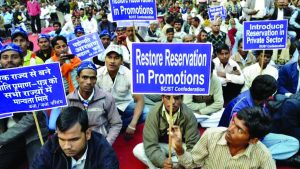
In the ongoing hearing of pleas on whether reservations for SC/ST candidates should extend to promotions or not, the Supreme Court has asked whether the conjecture behind those arguing in favour was that SCs/STs will remain perpetually backward. While failure of the reservations in palliating the condition of the beneficiaries makes this question reasonable, conversely, if the belief is that reservations have been helpful, as can be discerned from the bulk of evidence, then reservations should be applicable only until the beneficiary needs them, not forever. In other words, as one expert points out, “reservations without de-reservations are meaningless and self-defeating.

In recent years, many states have witnessed spate of agitations staking reservation claims — Marathas in Maharashtra, Kappus in Andhra Pradesh, Jats in Haryana and Patidars in Gujarat. Underlying political overtones dictated by “vote-bank” politics elicit support from all political quarters. Political parties have learnt to accommodate these demands lest their votes be affected, resulting in phenomenal growth in such demands, so too unrest and even violence in quota stirs. Remedial judicial interventions in accordance with constitutional propriety are undone by overriding political interests by amending the Constitution paving way for further quota stirs and such a scenario calls for serious focus on creamy layer. 

Creamy layer

While upholding the salience and necessity of reservations at entry level for SCs/STS, the apex court questioned whether these reservations should be used for speedy or special promotion channels in addition to being extended generation after generation. In view of the fact that “creamy layer” indicators are already in place that are applicable to OBCs, the Supreme Court in the ongoing hearings has asked whether something similar should be applicable to SCs/STs or not. 

According to media reports, the term “creamy layer” was first coined by late Justice Krishna Iyer in State of Kerala vs NM Thomas, wherein he observed that “benefits of the reservation shall be snatched away by the top creamy layer of the backward class, thus leaving the weakest among the weak and leaving the fortunate layers to consume the whole cake”. While dealing with creamy layer at length, the Supreme Court in Indra Sawhney vs Union of India, stressed that in the event of member of a backward class having reached an advanced social level or status, he/she would no longer belong to the backward class and would have to be removed from the reservation list. 

However, Article 16(4) of the Constitution stipulates that the State must identify the creamy layer in a backward class and thereafter excluding the creamy layer extend the benefit of reservation to the ‘class’ which remains after such exclusion. However, extension of creamy layer parameter of ‘OBC’ to SCs/STs has now become a debatable issue.

Protagonists opine that denial of reservations to the creamy layer will tantamount to denying reservation to the entire community. Nevertheless, it is argued by the opponents that implementation of creamy layer policy would help reservation benefits percolate to the most deprived and deserving members of that community. Some experts support reservation for the creamy layer in SC/ST category by arguing that depriving such creamy layer of the benefits of reservation could result in their seclusion from their own community leading to disinterestedness in their own community. However, other experts opine that extending direct benefits to the poor of SC/ST could be a better option than passing on the benefits to the creamy layer because the former could help the poor of their own community.

Some critics caution that any change in the reservation policy, including creamy layer, in the SC/ST category could halt their upward ascendance on the trajectory of growth garnered with much difficulty over the past few decades through reservation. According to a news item published in leading English daily dated September 6, 2012, by 2011 in the Central Government, of a total of 149 secretary-level officers, there were no SC officers and there were only 4 ST officers. At the additional secretary level, out of 108 officers, there were just two each from SC and ST. At the joint secretary level, out of 477 officers, SCs accounted for 6.5 per cent whereas ST constituted 3.1 per cent. Out of 590 directors’ posts, only 17 vacancies were filled by SC and seven were allocated to ST.  This data makes it discernible inability of SC/ST candidates facing difficulties in making to the top posts and calls for remedial measures to ensure equitable opportunities for SCs/STs.

Political machination

Undeniably, political parties have often used reservation as a trump card to secure and enrich their vote bank. Quota agitations — be it by Marathas in Maharashtra, or Jats in Haryana or Patidars in Gujarat — are often seen by political parties as opportune occasions to enrich their respective vote banks. Faulty development policies, inadequate facilities and lack of infrastructure for technical education and skill development, sordid state of affairs afflicting the unorganized sector etc., have proved instrumental in limiting the scope of job creations thereby leading to huge disparity between the growing population and job opportunities. The yawning gulf between demand and supply of jobs spurs those outside the reservation category to demand reservation and the vested political interests exploit the situation to their advantage thereby making gullible people fall a prey to divisive politics and resultant unrest.

Almost all political parties are well aware that reservation is not the only panacea to improve the condition of the poor and the backward as Government sector provides less than 4 per cent of total jobs in India. Still these parties grind their own axe at the expense of gullible people. As one critic has aptly observed, “The problem is that the political investment in caste is an almost insurmountable obstacle not only to social transformation but also to legal reform.” It is high time that political parties should shun caste politics, especially on reservation issue. 

Way forward

Agreeably, there is no overnight solution to the problem of reservations, especially in the wake of complex socio-cultural and religious-ethnic structures of the Indian society. Overall equitable, inclusive and sustainable economic growth in which benefits trickle down to the last person at the lowest rung of the society entails sanguinity of finding a way out of this caste-ridden quagmire. Government, from central to municipal level, is called upon to fill up vacant vacancies and generate new opportunities in government jobs as well as self-employment. Besides, specific emphasis needs to be focused on adhering to correction course to undo the ill-effects of demonetization and wrong implementation of the GST on medium and small-scale sector, which is admittedly the largest employment provider.

There is also need to pay heed to sane advice offered by one critic, “We need to ask ourselves, once again, whether it is equality of opportunity that we strive for, or whether we want to rid our society of the caste system.”

Some observers have suggested implementation of creamy layer system in all types of reservations in India including SCs/STsbecause it will help further filtering in the system and allocate the available facilities to the neediest. However, such a suggestion cannot be implemented without the consensus of all concerned and such a consensus to obtain immediately is a herculean task; nevertheless, initiative can be launched through persuasion.

It is interesting here to cite the exemplary instance of Sujat Ambedkar, the great grandson of the legendary Babasaheb Ambedkar, who recently startled a predominantly Dalit rally by announcing that his privileged upbringing did away with the need for reservation. Sujat may be a rare but inspiring exampleof self-abnegation in SC/ST communities and his example needs to be emulated by well-off segments in these communities to voluntarily renounce their privileges in favour of those who need them more direly.

letters@tehelka.com

Governor’s appointment triggers a sense of déjà vu in Kashmir

Unlike other states of India, the governors rival chief ministers in the distinctness of their role in the affairs of J&K. So much so, that in political discourse they are often seen as much responsible for messing up the situation as the politicians. And validly so.

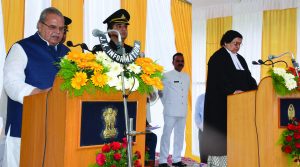
Governors have been direct participants in the history of the state, helping shape and direct it during their respective periods of rule. And this is why the appointment of Satya Pal Malik as the new Governor has made the Valley curious and apprehensive of what might be in store. More so, when Malik is replacing N N Vohra who has been the Governor for two successive terms and has largely enjoyed the confidence of the people both as a ceremonial head as well as the ruler of the state. Unlike some of his predecessors, Vohra has not run into a political controversy. During Vohra’s time, J&K was placed under Governor rule for four times. The state has witnessed a total of eight Governor rules so far. And the first four such rules have often been a subject of intense controversy. One such rule was that of Governor Jagmohan who in 1986 became the ruler of the state after dismissing the government of Ghulam Mohammed Shah.

Jagmohan had earlier sworn in Shah in 1984 after he had engineered a break-up of the then ruling National Conference led by Dr Farooq Abdullah. However, Jagmohan’s 246 day spell as the governor was one of the most popular such rules the state has ever had. The reason for this popularity was the efficient and responsive governance provided by him.

But his appointment again as the Governor in 1989 offers a study in contrast. This was the year when the armed separatist uprising began in Kashmir and Jagmohan was sent back to the state with a hope that he will replicate the success of his previous tenure. He did anything but. His short spell at the helm was marked by a tough security response to the then rampant militancy leading to a series of human rights violations including some massacres. From once a darling of masses, Jagmohan was now the most hated ruler of the state and has been one since. 

He was followed by Girish Chandra Saxena and K V Krishna Rao. Between them they presided over the longest Governor rule – six years and 264 days — which ended in October 1996 after National Conference returned to power in Assembly elections held after a gap of nine-and-a-half years. 

KV Krishna Rao was followed by another military man S K Sinha. His tenure too turned out to be bitterly controversial. It was during his tenure that a tract of forest land was transferred to Shri Amarnath Shrine Board which triggered 2008 unrest leading to killing of around 70 youth. His contentious actions included aggressive promotion of Amarnath yatra which played to fears of a demographic change in Valley, preparing a blue print for establishing religious universities, involving army in the repair and reconstruction of Sufi shrines etc. This alienated vast sections of Kashmiri population and radicalized the new generation.

However, to the credit of Governor Vohra, the deep apprehensions stoked by Sinha were put to rest by him. In his ten years in the state and also during the four times that he got to wield power, Vohra never gave an occasion for people to be concerned about any of his actions. In fact, in his latest spell at the helm, the situation did show some marginal improvement.

Will new Governor be able to live up to Vohra’s reputation? Only time will tell. But apprehensions run deep in Valley. And there are several reasons for it. One of the most obvious is that the appointment has been made by the BJP-led central government whose ideologically rooted stance on the state has made the Valley inherently distrustful of its actions in the state. Malik’s appointment also comes in the backdrop of a tense situation developing in the state over the legal challenge to Article 35A in Supreme Court. The intermittent hearings of the case trigger a spate of protests and shutdowns in the state. And any tinkering with the constitutional provision that forbids people from other parts of the country from settling in J&K can push the state headlong into a fresh turmoil.

The state is also in throes of the rumours of the efforts being made to form a new coalition government between a possible breakaway faction of the PDP and the BJP. Governor Vohra was said to have expressed himself against such an exercise. Would new Governor play a more facilitating role in the realization of such a prospect? The situation is likely to become clear in the weeks to come. Much of Malik’s credibility will depend upon how he handles these two issues. Or to put it correctly, how the centre would like him to respond to them.

Malik has talked of winning the confidence of people and addressing imbalances among the three regions of the state. But this would entail a tightrope walk and in the first few weeks his every move will be closely watched as to what he is up to. One thing that is viewed positively is that he is the first politician Governor the state has ever got. He has earlier been with Congress, Samajwadi Party, Lok Dal and has worked with the former Prime Minister VP Singh. This gives him a vast political experience. But as J&K Governor, Malik will have to do the bidding of the centre. And which would mean he would do what the centre has already planned for the state. So, his first few weeks will deepen the sense of uncertainty in Valley. Article 35A and the anticipated government formation would be the issues that are likely to hurtle to the centre stage. People would expect the new Governor to offer some reassurance as to the fate of Article 35A. And if Malik is unable to offer it, this will adversely affect the public confidence in him that he looks forward to build.

However, the new Governor’s challenge doesn’t stop with his handling of the issues related to the state subject law and the possible new government formation. The situation in Kashmir will be likely of a critical significance for the BJP in the run up to general election next year. Therefore, the party will be keen to see the situation in the state normalise or managed in a way that will be electorally most beneficial for it. And Malik will be expected to make it happen on the ground.

letters@tehelka.com

Man-Made Disaster Sinks Kerala

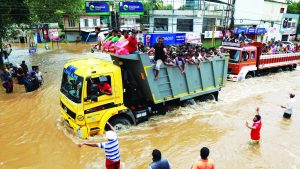
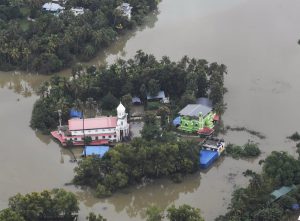
Upwards of 450 is the number of people killed by nature’s fury in Kerala and Karnataka as the worst ever floods in the century hit the two Southern states. More so, the God’s Own Country, Kerala, is slowly picking up the pieces after it went through the worst floods after 1924.

What is more tragic is that though the country by and large stood with Kerala and Karnataka in offering relief and mounting rescue operations, some people made insensitive remarks designed to communalise the tragedy and vitiate the atmosphere. Luckily, such was the reaction from the people at large that these attempts failed to make much headway in their campaign.

But at another level the response of the central government evoked sharp reactions from the ruling dispensation in Kerala as also in Karnataka, both ruled by non-BJP entities.

For the lakhs of flood victims in both the states, this certainly is not the time to analyse the cause of the floods. Rather it is time for rebuilding the state, which at a rough estimate would cost upwards of 20,000 crore. But against a preliminary demand for an assistance of this amount, the central government announced 600 crore, which would take its own time in coming — as a loan, prompting the Left and Congress to launch a diatribe against the Modi government for playing partisan politics.

Besides, citing an old UPA government decision, the central government also refused to take a 700 crore relief announced by the UAE, which has blown into a major controversy, saying India was quite capable of taking care of its own and did not prefer taking foreign help in disaster management during natural calamities.

“In line with the existing policy, the government is committed to meeting the requirements for relief and rehabilitation through domestic efforts,” the Ministry of External Affairs spokesperson said.

It was understood that by ‘existing policy’, the MEA was indicating at the decision taken in 2004 to avoid foreign support in the context of the deadly tsunami that affected a large number of countries in the Indian Ocean region.

Former diplomats have flayed the government decision, saying that it should have been more considerate on the proposed support from the Gulf.

“As country we can give rather than take assistance, but 80% Indians in the Gulf are Malayalis. The offer of flood relief assistance from region must be treated with sensitivity. Saying no is simple, but for Kerala-in-crisis, it’s not so simple,” former Foreign Secretary Nirupama Rao was quoted as saying in the media.

Former Foreign Secretary and National Security Adviser Shiv Shankar Menon said: “…. the 2004 decision was not to accept foreign participation in relief but accept it for long-term rehabilitation case by case.” He said the UAE help could have been utilised  for “rebuilding houses, bridges, roads etc.”

Former foreign secretary Kanwal Sibal said this issue should be thrashed out internally to avoid any long-term fallout.

Rebuilding damaged roads and bridges in the unprecedented deluge in Kerala will take at least one and half years and cost close to 6000 crore.

The Kerala government has sanctioned 1,000 crore for emergency maintenance works and has to raise 5,000 crore for ongoing development projects.

The PWD suffered the maximum financial loss in the calamity and is seeking 4,978.08 crore for the reconstruction of roads, from small ones to state highways. The repair of national highways would need 533.78 crore. Bridges wrecked in the flooding would require 293.3 crore and government buildings 10.09 crore.

The damage to roads is of up to 34,732 km and 218 bridges were damaged.

Irrigation facilities, standing crops and plantations losses are estimated at 20,000 crore, farm experts said. But a final assessment can only be made after situation returns to normal. For the present, close to ten lakh people have been housed in temporary structures.  Slowly as water begins to recede the state government is also pitching in with cleaning the houses and colonies that were flooded. The government has set up a control room in the state capital to cordinate the cleaning process. At the last count, the government teams cleaned one third of the over 15 lakh houses that needed immediate attention. At least, 50,000 volunteers are on the job, aided by the government agencies and donor.

Though the damage is instant, central government assistance will take some time reaching Kerala due to procedural issues. The centre has though promised to speed  up things, the process of assessing the extent of damage and fund release was time-consuming.

The Centre has so far released 600 crore for Kerala as immediate relief.

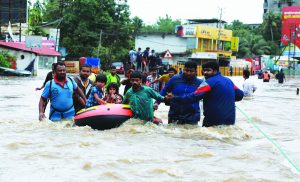
When politicians on either side of divide concentrated on the politicisation of human misery, it is the common man, individually and in groups who came to the rescue of people marooned in their own homes, that flood waters submerged and made difficult to access. The natural disaster was also a leveller of sorts that the floods hit people from every class of the society equally.

But helping Kerala stand back on it’s feet were good Samaritans who sprung up from all across India, other than the defence forces, paramilitary forces and coast guard services personnel who were pressed into service.
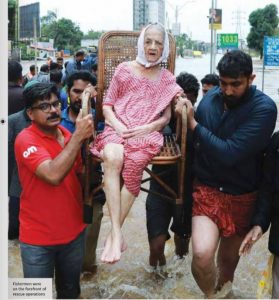
Kerala rains 2018 is something that not many residents of Kerala will forget in their lives. In fact, outflow from reservoirs in Kerala began days before the flooding started, but this release of water did not help prevent flooding. Mainly due to the intensity
of rains.

According to IMD, Kerala received 39% more rainfall than normal during the South West Monsoon.

Classified as “Excess”, the state got 302.7mm actual average rainfall, which is more than thrice the normal rainfall average between August 16 and August 22.

Three years ago in December 2015, Chennai received its largest rainfall in a century to flood the city and neighbouring districts that left a trail of destruction.

If Chennai was a trailer, Kerala and Kodagu (Coorg) in Karnataka, are warning signals to the rest of the country that Mother Nature was angry — angry over wanton destruction of nature due to human greed, and could strike at will anywhere in the country. Experts believe this flooding as a cause of climate change induced by destruction of environment and ecology.

For sure, this is a self-made natural disaster that the mankind has inflicted upon itself and Indians have done it more efficiently — the destruction of nature without any regard for the environment. And will have to pay the price.

Kerala and Kodagu floods were predicted a few years ago, but the warnings were thoroughly ignored by the authorities, under political dispensations of different colours.

Experts predict that next in line would be Goa that is also afflicted with all the ills that environmentalists have been complaining about.

In 2011, the Western Ghats Ecology Expert Panel, chaired by the internationally renowned ecologist Madhav Gadgil, had warned an ill-thought focus on development was impacting the sustainability of the Western Ghats hill chain, one of the world’s most biodiverse areas that run along the west coast of India.

He urged both Karnataka and Kerala, among others, to adopt a more thoughtful approach to conservation, limiting activities such as quarrying, dams, and construction near protected forests in hilly areas. This report was rejected by central as well as state governments.

In 2015, the Karnataka government had cut down thousands of trees to erect High-tension electric wires through Kodagu. Then there is uncontrolled sand mining in river beds, all across India, rapid urbanisation that were leading to flash floods and landslides during heavy rains. Multi-storey buildings were leading to weakening of soil too.

In Kerala, flooding of Kochi airport is a shining example of poor planning that caused a disaster. Built on the paddy fields and wetlands next to Periyar river, it runs up to the banks of the river on one side.

When a number of dams on the river had to be opened due to heavy showers, the airport was submerged and all operations had to be stopped. The estimated loss of at least 500 crore due to closure.

Kerala has 44 rivers and built 61 dams over them. Many of these dams had to be opened to release excess water that led to heavy flooding.

Never were these dams inspected for pre and post-monsoon safety

The Periyar river is not the only one that has been dammed. The state of Kerala has 44 rivers with a total of 61 dams. Many had to be opened across Kerala as they were dangerously full — a step that, while essential during a time of emergency, contributed to the heavy flooding. None of these dams were subjected to pre and post-monsoon inspections.

Kochi is just one example, even Mumbai airport too is susceptible to flooding and Chennai airport too was flooded.

In Kerala, the cumulative rainfall of 2,378 mm over 88 days, four times more than normal was the most intense than the flood of 1924. The reason why Kerala got so battered was that its capacity to deal with such calamities was reduced due to illegal stone quarrying, cutting down forests and grasslands, changing drainage patterns and sand mining on river beds.

“Rampant stone quarrying and digging of pits is the reason behind the landslides and landslips, which worsened the situation in the Kerala floods,” Madhav Gadgil, ecologist and founder of the Centre for Ecological Sciences at the Indian Institute of Science, Bengaluru, was quoted in the media. “These quarries cause deforestation and block the natural streams, which help in reducing the intensity of the floods.”

Most of the 373 casualties in Kerala were caused by landslides in the northern districts of Malappuram and Wayanad, and the central district of Idukki.

Spread across 160,000 square kilometres, more than three times the size of Haryana state, the Western Ghats extend over six states — Kerala, Tamil Nadu, Karnataka, Goa, Maharashtra and Gujarat — along with India’s western coast.

The rain and tropical forests of the Ghats are one of the world’s 10 “biodiversity hotspots”, home to the most diverse range of life in the subcontinent: 7,402 species of flowering plants, 1,814 species of non-flowering plants, 139 mammal species, 508 bird species, 179 amphibian species, 6,000 insects species and 290 freshwater fish species.

The Ghats are also a source of about 20 rivers and tributaries flowing through the Indian peninsula, and its forests and grasslands act as a super sponge, soaking up excess rain.

letters@tehelka.com

Indictment of Major Gogoi suggests few in Army do misuse authority

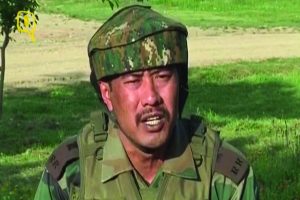
On the day, the Army court of enquiry indicted Major Gogoi for “fraternising” with a local girl at a Srinagar hotel, a local daily ran a story with a telling headline which went as: “Spared for using man as shield, indicted for hotel outing.” In April last year the Army officer had controversially used a civilian named Farooq Dar as human shield by trussing him up on the bonnet of his jeep and parading him through the villages in Budgam, ostensibly to pre-empt stone-pelting. The video of the incident went viral, generating outrage in Kashmir and across the country and also support from a large section of the public opinion outside the state. But far from being punished, Major Gogoi was not only given a clean chit but also conferred with a commendation medal by no less than the Army chief General Bipin Rawat for his “sustained efforts in counter-insurgency operations as well as his presence of mind and initiative to prevent bloodshed in a volatile situation”.
In Kashmir that was seen as adding insult to the injury. Ironically, the Gogoi’s human shield Dar was among the tiny group of people who had defied Hurriyat and the protesters to vote in the then Srinagar parliamentary by-poll, thereby daring to side with New Delhi amid an all-out Azadi campaign in Kashmir. But instead of rising to his defence, central government sanctioned his torture by the Army. Also, despite the facts about Dar being well known, he was projected as a stone pelter to strengthen the argument that using him as human shield was justified under the circumstances.

But now the Army has initiated court martial proceedings against him after holding him guilty of trying to enter a Srinagar hotel with a Kashmiri woman early this year. At the time an altercation had broken out between him and the hotel receptionist who had refused to offer him room. He was found guilty on two counts: one, fraternising with a local person despite official instructions to the contrary, and two, doing so when he was on duty in an operational area.

Interestingly, the Army’s enquiry into the human shield case is yet to be concluded. But its outcome has been rendered irrelevant after the Army chief chose to honour him over the
incident. In Kashmir, the import of the Army’s differential response to the two incidents hasn’t been lost. It has become a fresh cause for grievance against New Delhi’s approach towards the ongoing turmoil in the state. Many have picked fault with the intention behind the Major’s indictment. “Enquiry has no reference to the fact as to why Gogoi brought a minor girl to hotel but as to why he left the camp without informing the commanding officer,” posted one Shafqat Nazir on Facebook. “So, there is nothing for us to cheer about”.

Some, however, saw it as a “poetic justice”. “There is a pin drop silence in the camp of right wingers who openly and emphatically hailed Major Gogoi for violating human rights when he tied Farooq Dar at the bonnet of his jeep, and also defended him when he was caught with a minor girl in a hotel,” wrote Nighat Rather on social media. “Now when the military court has initiated disciplinary action against Major Gogoi, cat caught their tongue. Now they are in big dilemma what to do as they can’t point out fingers on Army and on other hand can’t criticise their hero whom they once hailed it at the top of their voice”.

The human shield victim Farooq Dar himself sees it as divine justice. “For me the justice has been done. And it has been done by God. His stick makes no noise when it strikes,” Dar told Tehelka. “At the time I had cast my vote defying the widespread boycott. But he branded me a stone pelter, tied me to his jeep and beat me up.”

Similarly, the father of the woman who was caught with Major Gogoi has also expressed satisfaction at the indictment of the Army officer and urged the Army chief to live up to his promise of handing an exemplary punishment to the guilty officer. “Our family has suffered a lot since the incident. We have struggled to reconcile with the situation,” the father told the media. “We will be satisfied if the Army officer is punished for what he did to us.”

However, at the same time, the father also wants punishment for Sameer Ahmad Malla, a local resident, who had accompanied Major Gogoi and the woman to a Srinagar hotel and engaged in altercation with the staff there when they refused room to the Army officer. “It was he (Malla) who brought Major Gogoi twice to our home on one or another pretext,” the father said. “He is also the culprit. He shouldn’t be let off”.

The poor family which lives at village Chak-Kawoosa has been facing social stigma since the incident. The woman has been sent to live with the relatives in another district. However, in her statement to the court last year, the woman had accepted that she had willingly gone with the Majir to the hotel.

In Kashmir, the people have tended to look at the Army’s differential approach to two transgressions by one of its officers in a span of one year as of a piece with the New Delhi’s current hardline policy towards Kashmir. “If anything, it shows even the parameters for punishing an army personnel have shifted. If an army personnel has committed excess against a civilian in the state, it can be overlooked, justified and merit even an award. But if it is about a violation of the Army discipline, the erring personnel can be immediately taken to task,” says Naseer Ahmad, a local columnist. “This is why while the probe into Major’s outing with a local girl was completed within a few months that in the human shield incident is pending since one and a half year now”.

Further deepening this endemic sense of grievance is the award of Shaurya Chakra to Major Aditya Kumar on Independence Day for valour while not engaged in direct action with the enemy. In January, Major Kumar’s unit had had fired at a stone-pelting mob in Shopian that left three civilians dead. Following the incident, the Jammu and Kashmir Police registered a case under sections 302 (murder) and 307 (attempt to murder) of the Ranbir Penal Code against the personnel of the army unit, including Aditya. But after Major Kumar’s father, Lt Col Karamveer Singh, moved the Supreme Court for quashing the FIR, the Court restrained the J&K Police from taking any “coercive steps” against army officers, including Major Kumar. The award to Major Kumar similarly triggered outrage in Kashmir. On social media, people slammed the move, some even terming it as New Delhi’s gift to Kashmir on
Independence Day.

“This apathetic policy towards human rights excesses in Kashmir will only further alienate Kashmiris and stoke more anger and violence,” says Naseer. “New Delhi could help its cause more if it is non-discriminatory in how it deals with the erring security personnel in Kashmir”.

letters@tehelka.com

Continue rains, flooding kill 16 people in Uttar Pradesh, IAF called in for rescue operations

As many 16 people have died and many got injured in the last 48 hours due to heavy rains and flooding in 16 districts across Uttar Pradesh .

State Relief Commissioner Sanjay Kumar on September 3 said that four deaths were reported from Jhansi , two from Etawah, and one death each from Firozabad, Raebareli, Auraiya and Shamli.

The worst affected district is the Shahjahanpur, where six people have died.

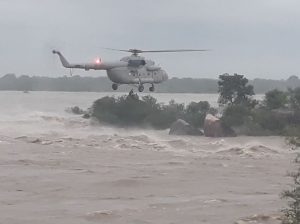
The Indian Air Force (IAF) has rushed choppers from the Gwalior air base for rescue work in the state. So far IAF has rescued 14 people stranded in Lalitpur and Jhansi districts.

IAF helicopters also rescued stranded people stuck in a village in Talbehat tehsil.

According to government data, three persons died in Sitapur District and four in Amethi and Auraiya districts. As many as 18 animals have died and 461 houses have been damaged due to rain and floods.

The weather agency Skymet has predicted “heavy to very heavy rain” at isolated places over western and central parts of Uttar Pradesh.

Alastair Cook announces retirement from International cricket

England opener Alastair Cook has announced his retirement from international cricket. The former England captain will retire from the game after the fifth and final Test against India at the Oval, starting on September 7. It will be his last international assignment.
“After much thought and deliberation over the last few months I have decided to announce my retirement from international cricket at the end of this Test series against India,” said Cook.

“Although it is a sad day, I can do so with a big smile on my face knowing I have given everything and there is nothing left in the tank. I have achieved more than I could have ever imagined and feel very privileged to have played for such a long time alongside some of the greats of the English game. The thought of not sharing the dressing room, again, with some of my teammates was the hardest part of my decision, but I know the timing is right.”

“I have loved cricket my whole life from playing in the garden as a child and will never underestimate how special it is to pull on an England shirt. So I know it is the right time to give the next generation of young cricketers their turn to entertain us and feel the immense pride that comes with representing your country.”

Cook, who made his debut for England in 2006, will retire as the sixth highest run scorer in Test cricket with 12,254 runs and 32 centuries, although he has been struggling for runs in the current series against India having scored just 109 runs so far in four matches at an average of 15.57. He will continue to play for his county side Essex next season but has confirmed his England career is over.

BYPOLLS IN KASHMIR A LITMUS TEST FOR ALL

Jammu and Kashmir is once again looking to hold Panchayat polls in the state. The noise to the effect has grown stronger since the imposition of Governor’s rule. But the clearest signal about the conduct of such polls in near future was given by the Prime Minister Narendra Modi in his Independence Day speech. He said the people from the state were urging him to hold the panchayat election and that the government would organise them over the next three months. 

The then J&K Governor N N Vohra even announced the time frame in his I-Day address. He said, “The elections to urban local bodies are scheduled to take place during September-October and the phased panchayat polls during October- December this year”.

Ever since, J&K Police has gone about preparing a security plan. It is also preparing a report about the requirement of the additional forces to be sent to the Ministry of Home Affairs. And according to additional director general of police Muneer Khan police is also identifying “sensitive and hyper sensitive areas” which would require more security.

The process has received a boost of sorts with the All J&K Panchayat Conference showing its readiness to fight the polls in a memorandum to the former Governor Vohra. But there is a rider: their participation should in no way be linked to the politics and the Kashmir issue.

“We have made it clear that Panchayat polls are purely a community-based exercise. Panchayats existed in the state when there was no government,” AJKPC president Shafiq Mir said. Also, they have urged the government to hold panchayat polls on a non-party basis.

However, Mir hails from Jammu region and his opinion doesn’t reflect the sentiment in Kashmir Valley, the epicentre of turmoil. The situation in the Valley is by and large reverse of the one prevailing in Jammu. Past few years have witnessed a drastic deterioration in the security environment. Last year, the government was unable to hold by-poll for a Parliamentary seat in South Kashmir. The seat is still vacant. And the election for the by-poll in central Kashmir parliamentary constituency could only be held at the cost of the death of seven protesters. What is more, barely 7 per cent people exercised their franchise while the rest boycotted. The situation since has only further worsened making holding of polls even more daunting an exercise. More so, the Panchayat and urban local bodies polls which are fought at the village and locality level.

But for the state and central governments, holding these polls has become both a point of prestige and a test of their ability to make a redeeming difference to the situation. Any sign or semblance of public participation in the. polls would herald a change for better in the situation. After all, last time Panchayat polls were held in 2011 when more than 80 percent of the people cast their ballot defying separatist boycott call, thereby dealing a blow to the then prevailing militancy.

But as of now, ithe situation is entirely different. It seems counter-intuitive to imagine people taking part in the exercise in large numbers. On the contrary, the exercise is believed to lead to a sharp escalation in violence with the candidates and even the voters becoming the target of the militants. Besides, the renewed and reinforced mass sympathy with the separatist cause only further increases the challenge. “For us, militancy is not so much a problem as the public support for it,”. says a police officer. “If people can put their lives on the line to save the militants, they will be that much particular to obey the separatist call for the boycott of polls “

letters@tehelka.com

Young Kashmir is weaving dreams into success

Kashmir, which is known as one of the most heavily militarised regions in the world is not only limited to conflicts and paralysed governance. Kashmir is well-known for its unconditional natural beauty, pristine lakes, clear gushing waters and mountainous peaks. Although, the present condition in the valley is not conducive for its people going by the frequent encounters, protests, unemployment issue or others, as it is not the same case in other states, nevertheless, the youth are thriving best to carve a niche in different sectors. The Youth in Kashmir comprises 60 per cent of total population. Here are the stories of few youths who are restless and are trying to create a space of their own. 

Thirty-year-old Isam Wani, who hails from Rajbagh Srinagar, completed his masters in business administration from the University of Kashmir. Wani was certain to do something different and was fascinated with photography, cinematography and filmmaking from a very tender age. Since Wani belongs to a family that is mostly into the hospitality sector, he got a supportive atmosphere at home when he wished to take up his hobby as a profession. 

Wani had started shooting short documentaries and web series from the tender age of 18 only. He said, “I am more passionate about showing Kashmir in a positive approach and promote it as a travel destination.”

After completing his masters he did a drone pilot course from Mumbai. After coming back, he started his own company namely ‘Colour White Studio’ with his twin brother Minam. Today, Wani is the only licensed drone pilot in Kashmir and is working tirelessly from past two years with the department of Jammu and Kashmir tourism to make short videos of different destinations that are not on the travel map.

“We have been doing a lot of videos of destinations that have not been explored to that extend as of now like Gurez, Gangbal, Aharbal, Tso Moriri Lake, Lolab valley to name a few,” Wani said.

The twin brothers are already excelling against all odds within just two years after establishing their company as they have already shot a documentary for BBC. They also have done cinematography and drone shots in many Bollywood films including Anurag Kashyap upcoming movie Manmarziyan, Sajid Ali’s next flick Laila Majnu that was mostly shot in the Valley of Kashmir, which is all set to release in September this year. Besides, the twin brothers have also done a small cameo for director Anurag Kashyup. They have done a lot of commercial shoots, music videos for Parvaaz band too.

Under the tagline of ‘Colour White Studios,’ the duo try and teach people to get a license for Drone before flying it in Kashmir valley and help and guide them how to apply for a license. Despite living in the common occurrence of a tense situation in the Valley, both the brothers have made it a point to remain focused and excel in their ideas.

Wani mentions that Kashmir is a place where one cannot work for 365 days. “Before starting our dream project, we planned of only 100 days of work every year. In those 100 days, we will give our best and try to be different and creative.” 

In another story, Suhail Nazir, 26, completed his schooling from Burn Hall School. He was not really a science lover so he opted for BBA (Bachelor of Business Administration) from Kashmir University. Following BBA, Nazir completed MBA in HR and Marketing from IUST, Awantipora. After which he started working for Outlook and was earning good but he always had a dream of being his own boss. So, one day, he left the job, decided to come back to his homeland and start his own venture.

Nazir recalled, “Back then, there was a fresh trend of starting your own cafés, but, I decided to do something different. In the back of my mind, I always felt that there are lots of options for men when it comes to hair care and skin care but there was an empty space in the same for women.”

Keeping this in mind, he decided to start a salon by the name of ‘Beauty and the Peach’ and since then he is treating his clients with utmost professionalism and quality care while keeping the price low and pocket-friendly.

“I believe that if a person has a goal and a vision he can achieve anything despite the surrounding conditions. It might be time taken or stagnant for some time but it will work,” said Nazir.

Starting his own venture was not a cake walk but a real challenge because after doing MBA his parents wanted him to work in a corporate set up that will give him financial security. Despite all, Suhail was determined to turn this idea into a reality.

“Now, my family is also supporting and pushing me to open another unit and expand,” he narrated.

He now plans to give away franchises in the coming years in order to expand his business chain. He said, “In future, I aspire to have one salon at least in every district of Kashmir. I also intend to reach to other states as well.”

Shahid Rashid Bhat, 23, is an emerging designer from South Kashmir’s Pulwama district and was fond of colours and thread from a young age but fate had something else in store for him.

Due to the prevailing conditions in the Valley, his parents sent him to Delhi for a course in chartered accountancy. Bhat was hesitant to talk to his parents about his passion and left for Delhi.

“For the initial six months, I attended college, but, I was restless and did not like accountancy at all,” Bhat narrated.

He used to draw sketches, tattoos, Henna Designs and upload the pictures on his social media handles. By chance, when a known fashion choreographer Sam Williams came across his designs, he contacted Bhat and encouraged him to take up fashion designing seriously. After Williams’ suggestion, Bhat searched for possible places where he could pursue a fashion designing course.

“I left my course after six months and qualified National Eligibility Entrance for Designing (NEED) test and got admission in Pearl Academy of Fashion and Designing in 2012, in Delhi, without letting my parents know,” said Bhat.

He funded his education for initial few years by working as a freelance model and finally, when he was in final year of his course, his father came to know about his accomplishments through a newspaper.

“Due to fear of negative response and taboos attached to designing, I did not share anything with my parents, but, when my father came to know he was all support and praise and then financed my further education,” Shahid mentioned.

After graduating, Shahid was selected by Pantaloons as fashion illustrator where he tirelessly worked to reinvent Kashmir’s traditional dresses and give them a new life. He reinvented pheran (Cloak) and gave it a new look to take it to national and international market.

“When I applied for my first fashion show, I saw designers from different cultures, states, countries but not even a single one from Kashmir and I made my mind to fill this gap,” said Shahid Bhat.

Recently, he started a fashion designing school in Kashmir where he teaches more than 25 students and also launched his own label SRB Style Statement and a website. Today, Bhat’s pheran designs are in demand in Pakistan, China, UK, Afghanistan, Jakarta and other countries as well.  In 2015, he was chosen as Designer of the Year by the Fashion Design Council of India (FDCI). Presently, he’s doing Masters in Craft Design from the University of Kashmir. 

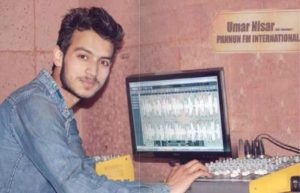
In 2014, when cloudburst and floods devastated the Valley, 19-year-old Umar Nisar started a community radio station within the lawn of Islamic University of Science and Technology.

Umar, who hails from South Kashmir, is a class 12th student. He was working on ideas to make the community radio station commercial.

“After I started, the frequency was the main issue and I came up with an internet based app solution. While tuning in the frequency one can listen to the radio station with the help of the internet,” said Umar.

He named it ‘Pannun FM Digital Media & Broadcasting Network’, a digital media network and radio station to encourage the young talents in Kashmir. Prior to the launch of Panun FM, Umar was a regular contributor to 102.6 FM.

He has been presented with the ‘CRDP Award’ of the year for his for his contributions as an innovator by the Centre for Research and Development Policy. He is also one of the youngest Kashmiris to speak in a TEDx programme.

Eyeing on the Bollywood, Nisar is currently working on many projects but, right now, studies are his main focus.

“I majorly aspire to become an actor, but, I also want to focus on my studies simultaneously,” concluded Umar.

letters@tehelka.com

MOST POPULAR

HOT NEWS