After weeks of negotiations and ideological adjustments, Germany’s conservative and centre-left parties have sealed a power-sharing deal, setting the stage for Friedrich Merz to take over as chancellor and lead a new coalition government in May. A report by Amit Prakash Singh
After about six and a half weeks of regular deliberations between the two political parties, an agreement to form a new government in Germany has been reached. The talks between the conservatives (CDU/CSU) and the outgoing alliance of the centre-left Social Democrats (SPD) were not smooth at all times but continued steadily across various issues.
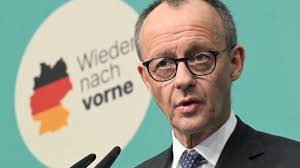
On April 9, 2025, the leader of the CDU/CSU, Friedrich Merz, announced the agreement between both parties to secure the required majority in the Bundestag (German Parliament). He expressed confidence that the coalition would complete its full term in office. The new government is expected to take charge in the first week of May.
While the talks were underway, the new alliance demonstrated its camaraderie by pushing forward a plan to increase defence spending and establish a major infrastructure fund to boost the state’s economy. The incoming Chancellor, Merz, is confident that the far-right party in the house will not pose any disruption. He stated, “Germany is getting a government that is capable of acting decisively. We will move the European Union forward.”
Merz, a 69-year-old leader, remained the frontrunner during the election. Known as a man of principles, he had stepped down from a party post in 2021 following differences with then-Chancellor Angela Merkel. He was later elected as the leader of the Christian Democratic Union (CDU).
In the Bundestag, this time, the Alternative for Germany (AfD) has secured a strong presence with a significant number of elected representatives. The party’s leader, Alice Weidel—only 44 years old—is making her debut as an elected representative of a far-right party. A staunch anti-immigration activist, Weidel enjoys the backing of American conservatives such as Donald Trump and J.D. Vance. She has expressed doubts about whether the new government will be able to survive.
For the first time, this far-right party has managed to garner such widespread support within Germany, including gaining a notable foothold among the youth. Its electoral performance surprised many, as it mesmerised citizens with its impressive victory. Yet, despite this surge, the leaders of other parties did not involve Alice Weidel in the formation of the new government, largely due to the party’s controversial past.
During the election campaign, J.D. Vance visited Munich to attend the Security Conference, which was also attended by top leadership from European Union nations. In a hard-hitting speech, Vance lambasted European leaders and accused Germany’s mainstream parties of creating a “firewall” against the far-right AfD. He charged them with straying from fundamental values—values, he claimed, that are shared with the United States. Later, Vance also visited Alice Weidel.
German Chancellor Olaf Scholz publicly denounced Vance’s remarks, saying it was not for others to dictate what Germany or Europe should do. He firmly rejected any cooperation with the AfD, citing its Nazi legacy. “Never again fascism, never again racism, never again aggressive war,” Scholz declared.
Few believed the outcome when the German election results were announced. AfD emerged as the largest opposition bloc, winning 152 seats in the Bundestag. Yet, despite these numbers, no other party or leader found it appropriate to engage or align with the AfD. However, there now appear to be chances of the party gaining even greater ground in the next term.
Next month, the new government under the leadership of Friedrich Merz will be sworn in. The incoming administration faces numerous challenges—both on the national front and in the international arena. At present, the European Union is in urgent need of a new security framework in the wake of Russia’s invasion of Ukraine. France and Britain have offered their support in the event of mounting strategic pressures.
It has become increasingly evident that NATO is no longer reliable, having failed to respond decisively to Ukraine’s repeated appeals to the United States for help. This growing uncertainty has compelled European nations to initiate fresh debates on continental security and to consider the development of their own nuclear deterrent, as the broader security order appears to have shifted.
Germany’s new government will have to shoulder greater security responsibilities, especially given NATO’s structure under U.S. command. Hoping for outside intervention now seems unrealistic. In anticipation of this, the incoming coalition had earlier approved a substantial fund to bolster its defence forces.
Known for its robust industrial base and strong economy, Germany will now have to assume a broader role within the European Union. Merz—an economist by training who once worked at the World Bank, later became a seasoned advocate, and is now taking the reins as a statesman—appears aware of the scale of the challenge ahead.
Though some have questioned his administrative experience, his party includes several capable administrators who served in earlier coalitions under Chancellor Angela Merkel, as well as among the ranks of the centre-left Social Democrats. With their support, Merz is expected to navigate the complexities of governance effectively.