By Jamshed
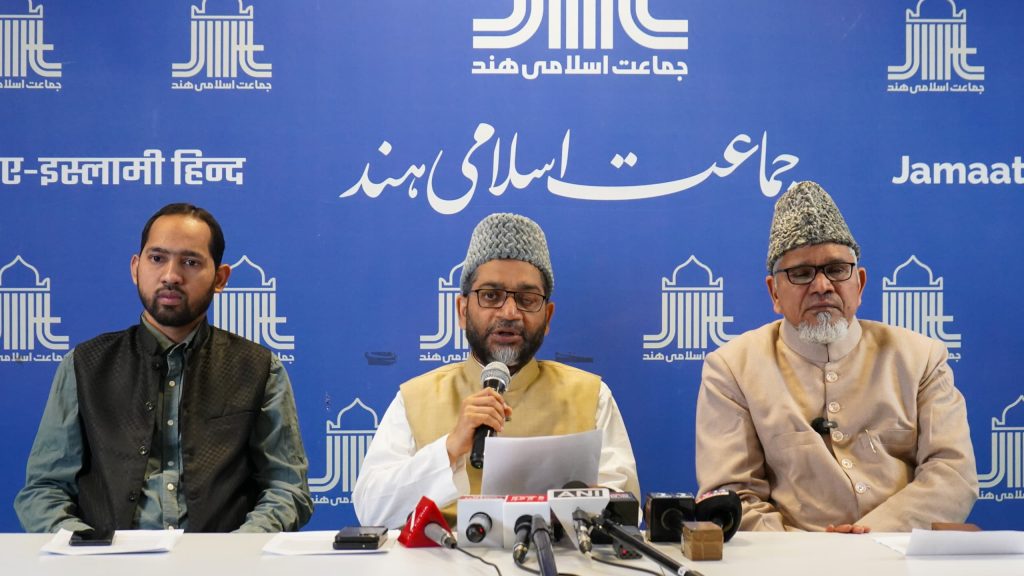
The President of Jamaat-e-Islami Hind (JIH), Syed Sadatullah Husaini, have expressed serious concern over the challenges related to women’s dignity, rising economic distress, and the escalating military conflict in West Asia.
Speaking on the occasion of the upcoming International Women’s Day, Syed Sadatullah Husaini said that while the day is meant to celebrate the achievements and contributions of women, the continuing rise in crimes against women reminds us that the struggle for safety, dignity, and equal opportunity remains far from complete.
According to the National Crime Records Bureau (NCRB), more than 4.45 lakh cases of crimes against women were registered in India in 2022 alone. These include cases of rape, sexual assault, domestic violence, harassment, trafficking, and cruelty by husbands or relatives. The NCRB recorded over 31,000 rape cases in the same year, which means that on average nearly 85 rape cases were reported every day.
Cases of domestic cruelty alone accounted for more than one-third of all crimes against women, showing how violence often occurs within homes and families. He further observed that within this broader picture, the problem of missing women is also alarming. NCRB data shows that every year, several lakh women and girls are reported missing across India, with a large number still remaining untraced. Women and adolescent girls remain particularly vulnerable to trafficking, forced labour, exploitation, and sexual violence.
He also pointed out that the problem of sexual exploitation reflects a deeper moral crisis in society. The revelations surrounding the Epstein trafficking network, which exposed the systematic exploitation of vulnerable young women and minors by powerful individuals, have shaken public conscience across the world. Jamaat-e-Islami Hind believes that protecting women’s dignity requires not only strict laws and swift justice but also a strong moral and ethical framework based on respect, modesty, and accountability.
Turning to economic issues, the JIH President said that recent developments after the presentation of the Union Budget 2026–27 have reinforced concerns about rising economic distress. The budget placed overwhelming emphasis on supply-side incentives while paying insufficient attention to income distribution, employment generation, and social protection. As global uncertainties deepen and domestic pressures rise, the benefits of growth continue to remain unevenly distributed while large sections of ordinary households struggle with stagnant incomes, rising living costs, and limited social security.
He noted that the ongoing war in West Asia is already exposing India’s economic vulnerability. With crude oil prices rising sharply and the rupee coming under pressure, India’s import bill and inflation risks are likely to increase. For an economy that imports more than four-fifths of its crude oil, such geopolitical shocks translate directly into higher fuel costs, transport inflation, and fiscal strain. These pressures will inevitably affect household budgets and small businesses. Syed Sadatullah Husaini said that the labour market situation also remains deeply troubling. A significant portion of India’s workforce continues to be trapped in informal and precarious employment. The rapid expansion of the gig economy has further intensified this trend, with millions of young workers engaged in platform-based work without adequate job security, fair wages, or social protection. Studies indicate that a large share of gig workers earn less than Rs15,000 per month and lack access to basic labour safeguards such as health insurance, pension benefits, or legal protection.
Speaking on the war in West Asia, the JIH President reiterated the organisation’s grave concern over the ongoing joint military aggression by the United States and Israel against Iran. These attacks constitute a blatant violation of national sovereignty and a grave breach of international law. He condemned the airstrike on the Shajareh Tayyebeh girls’ school in Minab in southern Iran, in which around 160 to 170 schoolchildren were killed saying it has shocked the conscience of the world and raised serious questions about the protection of civilians during armed conflict.
He warned that the present confrontation must not be allowed to escalate into a wider regional conflict involving the Gulf and the broader Middle East. Iran has the right to defend its sovereignty, yet the situation must not develop into a wider conflict that draws neighbouring countries into direct confrontation and deepens divisions in the Muslim world. Wisdom, prudence, and sound diplomacy are urgently needed to prevent the region from sliding into a prolonged and destructive war. He concluded by stating that lasting peace and stability can only be achieved through dialogue, respect for sovereignty, and a firm commitment to justice and international law.