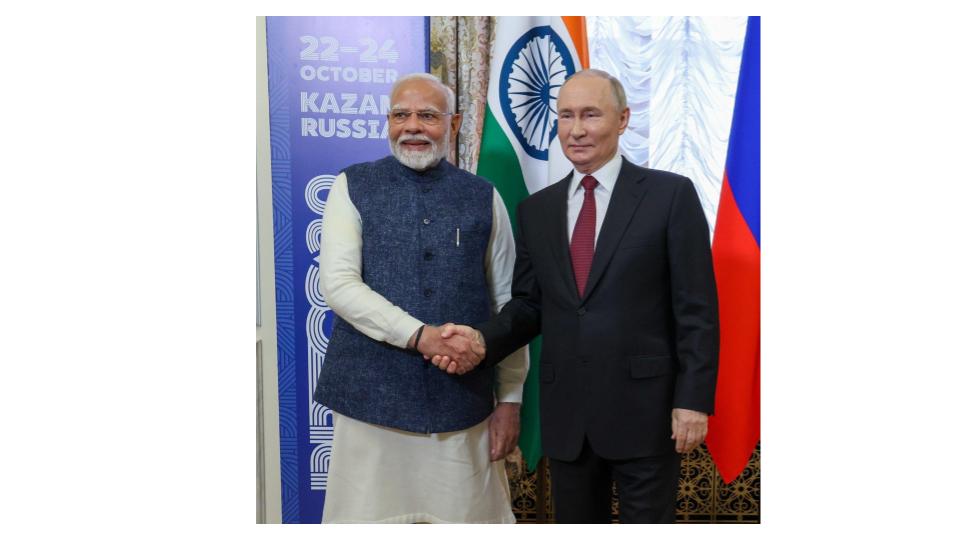
Vladimir Putin’s arrival in India for the annual summit with Prime Minister Narendra Modi signals a defining moment in global diplomacy. As world politics undergoes a profound transformation—with the Ukraine conflict reshaping energy routes, Western sanctions weaponising global finance, and new coalitions like BRICS expanding their influence—the India–Russia partnership stands out as one of the few enduring, interest-driven relationships capable of influencing the broader geopolitical landscape.
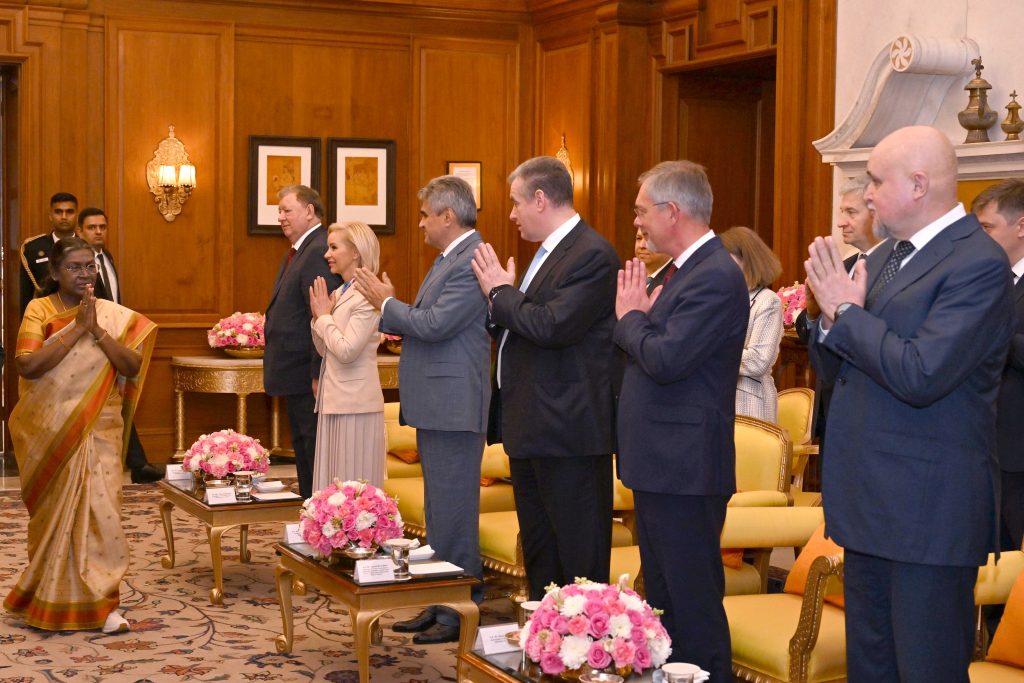
The President of India, Droupadi Murmu, too received Vladimir Putin, President of the Russian Federation, at Rashtrapati Bhavan and also hosted a banquet in his honour. Both leaders expressed confidence that the friendship between our two countries, which has been steadfast for many years, will continue to prosper for many more to come.
Welcoming President Putin and his delegation to Rashtrapati Bhavan, the President said that his visit marks an important milestone: the 25th anniversary of the India-Russia Strategic Partnership, which was established in October 2000 during his first visit to India as President. She appreciated President Putin’s support and personal commitment to the India-Russia Special and Privileged Strategic Partnership. She noted that our partnership is guided by a shared commitment to peace, stability, and mutual socio-economic and technological advancement.
At the heart of this visit is defence cooperation, the long-standing foundation of Indo–Russian ties. For decades, over half of India’s military platforms have been Russian-made, and the relationship has evolved from a simple buyer–seller dynamic to deep co-development. Joint projects like BrahMos have demonstrated the high level of strategic trust between the two nations. With new variants, extended ranges, precision upgrades, and emerging cooperation in hypersonic technologies, the defence partnership is entering a new technological era. Discussions on expanding India’s air defence grid and deeper cooperation in fighter aviation and submarine technologies reflect a commitment to long-term strategic synergy.
By welcoming these defence engagements at the highest level, India reinforces its strategic autonomy. Even as New Delhi builds strong ties with the United States and participates in the QUAD, it has refused to allow any power to dictate its Russia policy. This multi-alignment approach sends a clear global message: India will not be boxed into ideological blocs. Instead, it will maintain diversified defence partnerships that strengthen its national security architecture. For Russia, India’s continued defence interest ensures Moscow retains leverage in Asia and prevents it from becoming overly dependent on China, subtly altering the global power balance.
Yet the true transformation of Indo–Russian relations is unfolding in trade, tariffs, energy flows, and emerging economic systems. Over the past few years, bilateral trade has surged, driven mainly by India’s imports of discounted Russian crude oil, fertilisers, coal, and essential minerals. Russia’s redirection of energy exports toward Asia has created a unique opportunity for India to secure long-term energy supplies at competitive prices. This shift is as much geopolitical as it is economic. By purchasing Russian oil despite Western disapproval, India has asserted its sovereignty and shielded its economy from inflationary pressures.
However, this surge in trade has exposed a persistent imbalance. India exports comparatively little to Russia, resulting in large rupee surpluses in Russian banks. Putin’s visit is expected to address this imbalance through currency settlements, improved logistics, tariff rationalisation, and targeted export promotion. Exploring rupee–rouble or local currency settlements could reduce reliance on the dollar-based system vulnerable to sanctions. Increased market access for Indian pharmaceuticals, machinery, agricultural products, and IT services could also help correct the trade imbalance.
On a broader scale, these shifts suggest a move away from the dollar-centric financial order. India and Russia are exploring new economic pathways that could inspire the wider BRICS and Global South to build alternate payment systems. Such mechanisms will bolster economic sovereignty for both nations, allowing them to navigate Western-led trade politics more effectively.
Cultural cooperation remains the heart of the India–Russia relationship. Long before defence agreements and energy deals, cinema, literature, and music formed the foundation of their bond. Raj Kapoor’s films once packed Soviet theatres; Russian classics like Tolstoy and Dostoevsky deeply influenced Indian writers. This cultural bridge persists through festivals, academic exchanges, theatre collaborations, language programmes, and cultural delegations. Putin’s visit presents an opportunity to modernise these engagements, leveraging digital platforms, co-productions, and museum partnerships.
A rapidly expanding pillar of Indo-Russian cooperation is educational and human resource exchange. Russia has opened its universities and labor markets to Indian students and skilled workers, particularly in medicine, engineering, IT, and construction. This human exchange will form the bedrock for long-term cooperation, as India also offers expertise in digital governance, fintech, and cybersecurity.
In conclusion, Putin’s visit is far more than ceremonial; it carries deep strategic significance for both nations. For India, it reaffirms that national interest—not external pressure—will guide its foreign policy. For Russia, it signals that despite the West’s attempts at isolation, Moscow retains strong, sovereign partners across the globe. As both countries navigate a multipolar world, their cooperation will not only strengthen their individual positions but also shape the future of global power dynamics.
*Dr. Anil Singh is Editor, STAR Views & Editorial Advisor, Top Story; Author of “The Prime Minister: Discourses in Indian Polity*