Cloudbursts, landslides and floods—2025 is turning grim for India’s hills and plains alike. As extreme weather surges, failing infrastructure and weak safeguards show how unprepared the country remains in facing climate change and unchecked development. A report by Vibha Sharma
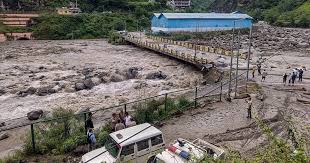
Climatically, 2025 is proving to be yet another challenging year for India, particularly for its mountains and hills, whether in north or eastern parts of the country. Multiple incidents of devastating landslides, cloudbursts, deaths and destruction, were reported from hills in the first month of the annual June-September Southwest Monsoon itself.
And the devastation is not restricted only to the hills.
On July 9, Gambhira Bridge on Mahisagar river collapsed in Gujarat. Whatever was the reason—structural/engineering fault; poor maintenance or material; climate change-induced excessive rains; or corruption—failures at dam sites, sinking of highways and collapse of bridges are all a grim reminder that infrastructure designed a few decades ago is no longer adequate in the challenge of climate change.
Engineering fixes from the era of predictable weather are no longer viable for new weather shifts.
In 2024, as many as 12 bridges collapsed in Bihar over two weeks. “Companies with poor records are awarded new tenders thanks to their political and bureaucratic links. Contractors themselves say the system leaves little room for quality construction,” say those familiar with the working of government departments
Climate change is another reality jeopardising the lives of common Indians.
The big question is: can planners and administration use it as an excuse for India’s crumbling infrastructure?
Frequent natural disasters
Constituting a substantial part of its annual rainfall, replenishing reservoirs, groundwater and two-third of the country’s agricultural tracks, monsoons are the lifeline of the Indian economy.
Bringing as much joy and cheer to the economy as to the common man, every year India eagerly awaits the seasonal rains to arrive to beat the scorching dry heat of April-May-June.
But with climate change, the gaps between seasons are blurring.
Himachal Pradesh reported multiple flash floods, cloudbursts and landslides, leaving many dead and devastated in June-end and beginning of July.
Fact is seasons can no longer be boxed in neat month-wise time zones, heavy rains/cloud bursts can happen anywhere, anytime. Every year the frequency of these “natural calamities” is increasing and are only expected to increase more rapidly in future.
Since the monsoon arrived this year, Assam, Manipur and Mizoram, Himachal Pradesh and Uttarakhand have been badly hit.
After an early onset over Kerala on May 24, the earliest arrival since 2009 and eight days ahead of the June 1 onset date, it reached Mizoram on the same day, 12 days ahead of its normal schedule.
However, whether Himachal and Uttarakhand in north or the northeast region, the glaring lack of plans to tackle climate challenges are discernible
The missing climate plan
Climate change is a recognised fact and so is the story of haphazard development in India’s fragile hills.
The Indian Himalayan Region encompasses a vast range from northwest touching Pakistan to northeast states along the border of countries like Bhutan, Nepal, and Tibet.
But whether it is Assam, Manipur, Arunachal Pradesh, or Mizoram in the Northeast; Himachal, Kashmir, or Uttarakhand in the North; or Kerala in the South—the story is the same everywhere. Construction and development take place with little regard for nature, undermining ecological needs, weather patterns, and seismic sensitivity of fragile ecosystems—highlighting deep flaws in India’s regulatory system.
Himalayas are extremely susceptible to weather conditions, seismic activity and climate change. Despite this, there are hardly many differentiated environmental standards to ensure preparedness to deal with such situations. If they exist, so do the ways and means to circumvent them.
An official who did wish to be identified says that floods in plains and sporadic landslides in hills and mountains are expected during monsoons. The problem is floods are no longer restricted to plains anymore, they are happening in mountains as well
“Manipur was among the first to enact a floodplain zoning act after a Central government mandate, allowing the state government to identify flood zones and regulate development, but did that happen?,” he asks.
“In Himachal there are strict norms for undertaking construction activities along with restoration. Roads and houses cannot be constructed at free will, geological conditions should be scientifically analysed, banks of rivers and drains monitored, but did that happen?,” he questions
Attributing frequent landslides on the Shimla-Kalka highway to 80 to 90 degrees vertical cutting of land, deforestation, and destruction of the natural drainage system of forests, he adds that illegal dumping of debris during construction activities has further exacerbated the situation.
Environmental impacts of the controversial Char Dham project are also there to see. According to environmentalists the widening of roads resulted in doubling of landslides, road blockages, accidents and loss of lives. Landslides are a regular occurrence, especially during pilgrimage seasons, they say.
Adding to the environmental mess are the hydro-power dams and the so-called restoration activities, which too has affected local weather and increased atmospheric instability.
Greed and over-tourism
But can the entire blame be laid at the government’s door?
As fast-growing India rapidly builds in tourist destinations in ecologically fragile Himalayas and Ghats of the west and the east, there has been an increase in the number of cave-ins and landslides.
Deforestation and reckless commercial interventions have destabilised the environment and the biggest example is the deadly Wayanad landslides of 2024.
Fragile ecosystems, extreme rainfall and increasing population were among the reasons behind the catastrophe in north Kerala.
To an extent people are also to blame.
Take for example in the northeast where in large parts, particularly in the Sixth Schedule areas, traditional institutions and associated communities control territories. The rights of local people over lands and resources are a sensitive and political issue and the result has been widespread ecological degradation. Autonomy over land use and management has left the administration with limited jurisdiction and teeth and an unwillingness to interfere, say officials in know of the situation there
Climate change has made the shift in weather patterns more discernible and people have found new ways to control nature.
Global warming is responsible for cloudbursts, flash floods and landslides but can the human hand be ignored?
Shrinking glaciers
Uncontrolled development in Himachal is causing extreme weather conditions, scanty snowfall, shrinking spring season and wet spells even during May and June.
With the warming of climate, glaciers have started to melt and the number and size of glacial lakes is growing.
The glacier retreat has also increased the risks of landslides, rock and debris falls in high mountain areas.
According to the ‘State of the Climate in Asia 2024’, globally 15 million people are vulnerable to potential glacial lake outburst floods. More than half of them live in just four countries—India, Pakistan, Peru, and China.
In 2013, unusually rapid snow melt, ice melt of the Chorabari glacier and intense rain combined to cause a glacial lake outburst flood in Kedarnath. As many as 6,000 persons were killed, 30 hydropower plants destroyed or severely damaged along with many roads and bridges.
In 2023, a catastrophic glacial lake outburst flood in Sikkim caused the Teesta III hydroelectric dam to collapse. More than 100 people went missing or confirmed dead, and thousands others were affected. The South Lhonak glacier that triggered this flood has been shrinking rapidly as a result of climate change.
Of nearly 100,000 glaciers containing approximately 7,000 km of ice in High Mountain Asia, around half are in the Himalaya and Karakoram mountains. Asia’s 19 largest rivers, including the Indus, Brahmaputra, and Ganga, start in the Hindu Kush Himalayas and provide water for a quarter of the world’s population.
In High Mountain Asia, glaciers shrunk between 5 and 21% from 2000-2023 due to human-induced climate change. Some of the biggest declines have been seen in the Himalayas and hazards from glacial lake outburst floods are set to triple by 2100, according to the report.
Flooding is predicted to worsen more with higher emissions scenarios.
“Glacial meltwater from the Himalayas will peak in the next few decades. It will then decline, leaving some of the world’s most populous places, and largest systems of irrigated agriculture, far more vulnerable to floods and droughts,” according to a report.
“In northern India, there will be lower river flows, especially in the dry season, after mid-century; this will impact energy, water, and food security. 52% of hydroelectric power in India is generated on rivers which start in the Himalayas,” he report says.
“The Himalayan region is one of the most vulnerable in the world to glacier-related disasters. Globally, 15 million people are vulnerable to potential glacial lake outburst floods, with more than 3 million of these in India alone,” the report adds.
Is India prepared to deal with this? That is the big question.
BOX
India’s crumbling infrastructure
The collapse of Gambhira Bridge on the Mahisagar river in Gujarat adds to the long list of India’s crumbling infrastructure. The bridge served as a vital route between central Gujarat and Saurashtra region for the past four decades. Local residents had repeatedly raised concerns over its poor condition, pleas that fell on deaf ears, though some repairs were undertaken last year, according to reports.
It was the second major bridge collapse incident in Gujarat in recent years. In October 2022, a pedestrian suspension bridge over the Machchhu river in Morbi collapsed, causing the death of over 141 persons.
Demanding the resignation of Gujarat Chief Minister Bhupendra Patel and Home Minister Harsh Sanghavi, opposition Congress claims 16 bridges have collapsed in the home state of Prime Minister Narendra Modi and Union Home Minister Amit Shah in the past four years. Politicians and bureaucrats are sharing bribes from every contract and project, alleges Congress leader Jignesh Mevani
Due to structural issues, poor maintenance/construction material, alleged corruption, bridge accidents have claimed many lives in India, the most recent being the Indrayani River bridge collapse in Pune in June. Last year, nearly 12 bridges collapsed in Bihar within a span of just 20 days. According to a study, “Analysis of Bridge Failures in India from 1977 to 2017,” in the past four decades “more than 2130 bridges (excluding culverts and pedestrian bridges) have failed to provide intended service or have collapsed during various phases of construction”.