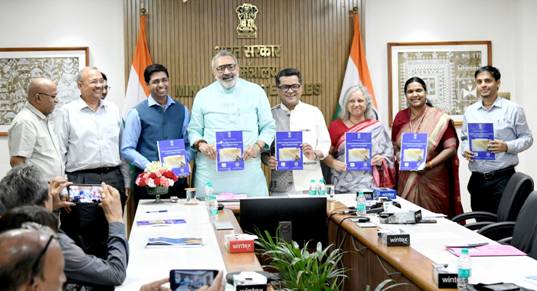
Union Minister of Textiles Giriraj Singh on Wednesday launched the book titled “Carbon Footprint Assessment in the Indian Handloom Sector: Methods and Case Studies”, jointly prepared by Office of Development Commissioner for Handlooms, Ministry of Textiles and Department of Textiles & Fibre Engineering, IIT, Delhi.
This landmark document strengthens the government’s commitment to environmental conscious handloom production and sustainable development by providing clear, practical methodologies to measure and reduce the carbon footprint of the handloom industry—a vital socio-economic sector and a symbol of India’s rich cultural heritage.
The book comprises simple steps to measure carbon footprint through real-world case studies across India, including products viz. cotton bedsheets, floor mats, Ikat sarees, Banarasi sarees, and other iconic handloom items.
It also includes methodologies for low-cost data collection and emission measurement methods designed specifically for the handloom sector to enhance eco-friendly production.
The work involved extensive consultations and close collaboration with experts from the Indian Institute of Handloom Technology, Weavers Service Centres, grassroots weaver groups, Greenstitch Private Limited, and key government agencies.
The book integrates global climate reporting standards while adapting them to India’s unique operational context, thereby empowering the sector to achieve sustainable growth.
The Handloom Sector is an integral part of the rural and semi- rural livelihood engaging over 35 lakh persons. The sector engages over 25 lakh female weavers and allied workers which makes it an important source of economic empowerment of women.
Handloom weaving constitutes one of the richest and most vibrant aspects of the Indian cultural heritage. The sector has the advantage of being less capital intensive, minimal use of power, being eco-friendly, flexibility of small production, openness to innovations and adaptability to market requirements. The uniqueness and its capability to produce small batch size and being eco-friendly, handloom products are in high demand in the international and the domestic market. This book focuses on the vibrant and intricate Indian handloom and its significant role in sustainable fashion and mindful consumption.