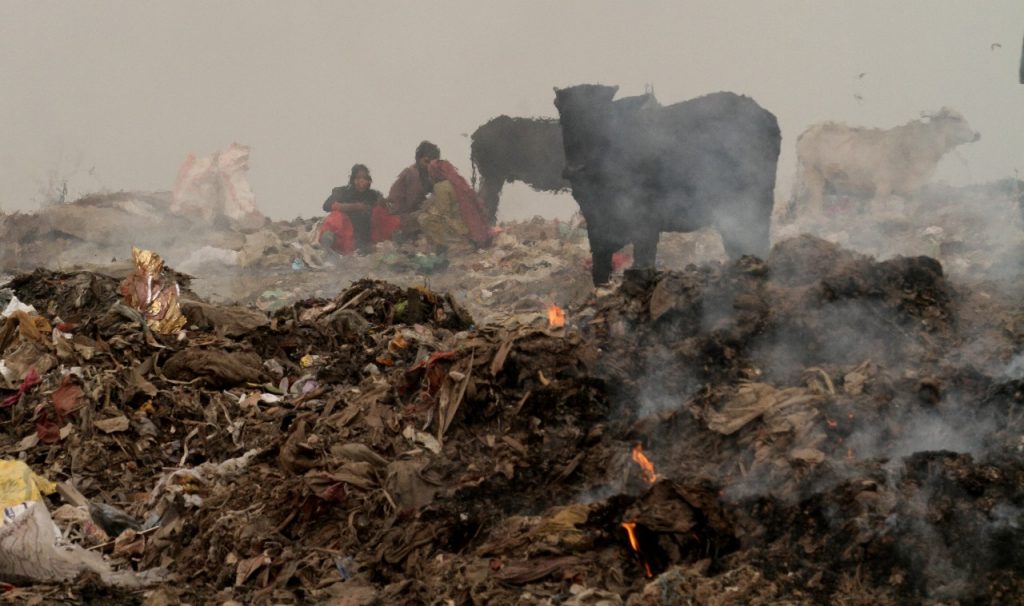
The National Green Tribunal (NGT) has directed the MCD to submit a comprehensive affidavit within six weeks, detailing all resources deployed for biomining, treatment capacity, transportation of leachate, and long-term plans for clearing legacy waste— currently targeted for 2028 in the backdrop of fire at Delhi’s Ghazipur landfill earlier this year.
It has also sought clarification on how mixing of C&D waste affects treatment processes and whether fly ash is tested for toxicity before reuse. The case is scheduled for next hearing on October 16, 2025.
The case, registered suo motu by the NGT following a media report on the April 21 blaze, has become a focal point for examining Delhi’s broader waste management failures.
At the July 10 hearing, chaired by Justice Prakash Shrivastava, with Justice Sudhir Agarwal and expert member Dr. A. Senthil Vel, the tribunal reviewed findings from a court-appointed commissioner’s visit to the site and responses from the Municipal Corporation of Delhi (MCD), Central Pollution Control Board (CPCB), and Delhi Pollution Control Committee (DPCC).
The Ghazipur landfill, situated in a densely populated area flanked by the Hindon River Canal and a slaughterhouse, has grown into a towering environmental hazard. While regulations permit a maximum height of 40 meters, the mound now exceeds 60 meters due to continuous dumping of unprocessed municipal waste.
Despite MCD’s claim of reducing the landfill’s burden from 100 lakh metric tons in 2019 to 85 lakh metric tons, the court commissioner found no documentary proof to support this, raising doubts about the authenticity of progress reported.
The inspection revealed that leachate — the polluted liquid that drains from landfill sites — is not being adequately contained. Although MCD stated that leachate is diverted to tanks and transported to the Okhla Leachate Treatment Plant (LTP), photographs and site observations showed untreated leachate leaking into Drain No. 1 and ultimately flowing into the Yamuna River.
Vertical methane vents have been installed, but without a collection system, the highly flammable gas is being released directly into the atmosphere, posing a continued fire risk — the very threat that ignited the April blaze.
One of the most troubling findings is the absence of boundary walls on both the canal and road (slaughterhouse) sides of the landfill. This not only raises safety concerns — particularly the threat of a landslide impacting nearby populations — but also leaves the site vulnerable to trespassing and arson.