The recurring heavy rains and consequent floods and devastation underscore that the real disaster lies not in the surging waters, but in our failure to learn before the next storm arrives. A report by Tehelka Bureau
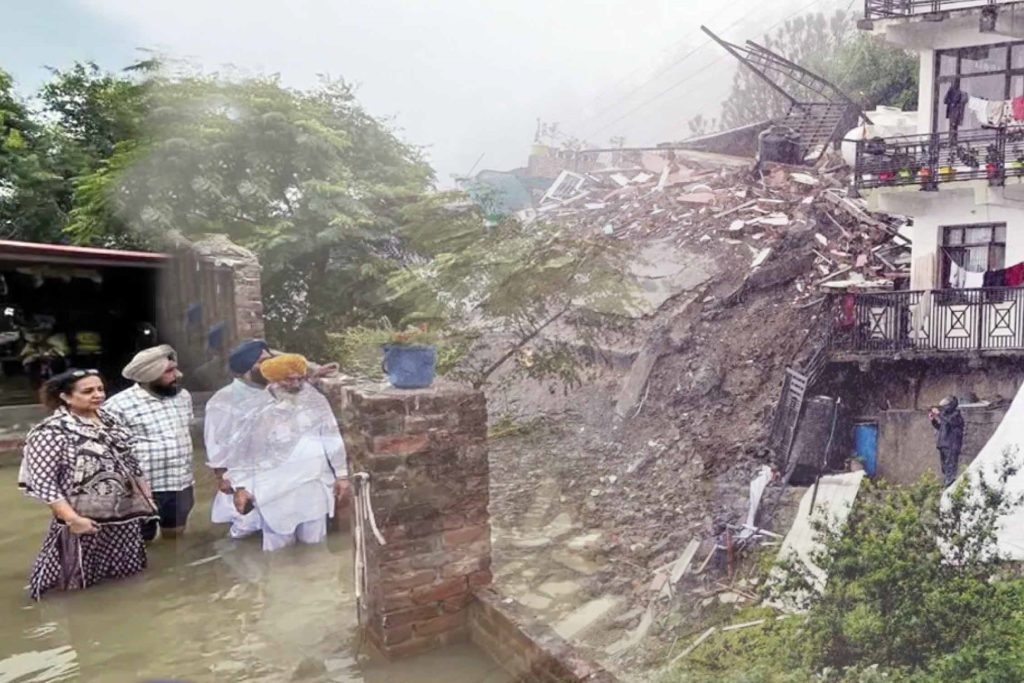
The monsoon is usually welcomed as a season of renewal, when parched fields drink deep and rivers run with fresh life. But this year, the rains turned into a roaring nightmare. Punjab, Himachal Pradesh, Jammu and Kashmir, and Uttarakhand are reeling under one of the most punishing flood crises in living memory. These states have been battling one of the worst flood crisis in decades. What started as seasonal rains has quickly escalated into a massive disaster, with hundreds of lives lost, millions displaced, and entire villages submerged under the swelling waters of rivers and seasonal rivulets.
On July 28, 2025, the Supreme Court Bench of Justices J.B. Pardiwala and R. Mahadevan had observed, “If things proceed the way they are as of date, then the day is not far when the entire State of Himachal Pradesh may vanish in thin air from the map of the country”. Earlier in 2019, the Supreme Court had issued a stark warning regarding the rapid environmental degradation of Himachal Pradesh and other flood-prone areas in the north. The court noted that due to excessive deforestation, unregulated construction, and the rapid urbanization of these states, the very geography of these regions was at risk of disappearing from the map. The court specifically highlighted the need for better disaster management and early warning systems to prevent such catastrophes.
Despite these warnings, the authorities failed to take meaningful action to mitigate the risks posed by such extreme weather events. One is witness to deforestation and concrete jungles in the name of development. Dr. Raghav Sharma argues, “The lack of long-term planning and foresight in the face of these threats is a grave concern. While governments often react with emergency measures, proactive investments in resilience and prevention are missing. We are caught in a cycle of disaster and relief, rather than preparedness and protection.”
This unprecedented flood crisis has brought into sharp focus the intersection of climate change, inadequate infrastructure, and poor urban planning, all of which have made the region vulnerable to such extreme weather events. As the deluge continues to wreak havoc, experts are now asking: what went wrong, who is responsible, and what can be done to ensure that this disaster doesn’t repeat itself? The human suffering, the faces behind the statistics, is what makes this disaster searing. It also raises the uncomfortable question: why does North India keep reliving this cycle of flood and fury?
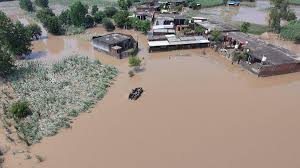
The floods, which have severely impacted all 23 districts of Punjab, have left the state grappling with its worst natural disaster in nearly four decades. Punjab’s economy, primarily based on agriculture, has been decimated, with vast tracts of land submerged under water. The devastating floods have claimed 29 lives so far, with many more feared dead as rescue operations continue. The floodwaters have left more than 2.56 lakh people displaced, forcing them to take shelter in temporary relief camps across the state.
The pride of India’s breadbasket, Punjab, has almost been reduced to waterlogged wastelands. The Sutlej, Beas, and Ravi rivers, swollen by relentless rain upstream, have swallowed villages and cut off towns. The crisis in Punjab is compounded by the inundation of major river systems, such as the Sutlej, Beas, and Ravi rivers, which have been swollen due to incessant rainfall in their catchment areas—particularly in the hills of Himachal Pradesh and Jammu and Kashmir. In addition to the loss of life, there has been extensive damage to property, crops, and infrastructure, as bridges collapse and roads are washed away, leaving communities cut off from essential services.
In the hill states of Himachal Pradesh and Jammu and Kashmir, the situation is equally dire. The hill states tell a similar tale of heartbreak. Himachal Pradesh has been pounded by cloudbursts and landslides, turning scenic valleys into rivers of mud and rocks. Landslides triggered by the torrential rains have blocked roads, and flash floods have left thousands of tourists stranded, including at the Vaishno Devi shrine. In some places, the floodwaters have risen above danger levels in dams and reservoirs, further threatening communities downstream.
In the wake of this massive tragedy, both the central and state governments have announced emergency relief measures. Prime Minister Narendra Modi has authorized the release of funds for the affected states, including financial assistance to flood-hit families, medical aid, and the rebuilding of infrastructure. He visited Himachal Pradesh and Punjab on September 9 and announced relief packages. He announced financial assistance of Rs 1,500 crore for Himachal Pradesh and an aid of Rs 1,600 crore for Punjab.
However, there are concerns about the adequacy of these measures. Immediate relief is essential, but the true test lies in the long-term recovery and rehabilitation efforts. The Prime Minister’s relief package, while helpful in the short run, has been criticized for not addressing the root causes of the flood risk and not providing sufficient funds for the rebuilding of flood-resilient infrastructure.
Additionally, many social organizations and local celebrities have stepped forward to provide aid to the affected people. Popular Punjabi stars such as Diljit Dosanjh, Sonu Sood, Ammy Virk, and Gippy Grewal have donated money and essential goods to flood victims. Singers like Karan Aujla, Satinder Sartaaj, and Jasbir Jassi have been actively involved in raising awareness and supporting the distribution of relief material.
While these efforts are commendable, experts argue that recovery cannot simply be about charity—it needs to be about building resilience. Dr. Meera Singh underscores this, saying, “The focus should not only be on providing immediate relief but also on ensuring that these communities are not as vulnerable to future disasters. We need a comprehensive, long-term strategy that addresses both the causes and consequences of flooding.”
A Perfect Storm of Factors
While flooding due to heavy rainfall is not uncommon, the intensity and scale of the current disaster are unprecedented. Experts are now pointing to a combination of factors that have exacerbated the impact of these floods.
The most obvious factor in this year’s flooding is the erratic weather caused by climate change. India, like many other parts of the world, has been experiencing increasingly severe and unpredictable rainfall events. What used to be seasonal, moderate rains have turned into torrential downpours, with some areas receiving up to 300% more rainfall than normal. According to the India Meteorological Department (IMD), Punjab and the surrounding states have seen an average rainfall increase of over 50% in recent years, making such catastrophic floods more likely.
Dr. Aditi Narayan, an environmental scientist at the Center for Climate Change, explains, “The increasing frequency and intensity of extreme weather events—such as heavy rainfall and flooding—are a direct result of global warming. In the case of Punjab and neighboring states, the situation is worsened by the fact that the rainfall is falling on already saturated ground, making it almost impossible for the land to absorb the excess water.”
Dr. Karan Kapoor, a climatologist, adds, “The changes in monsoon patterns are causing severe rainfall in the catchment areas of rivers like the Sutlej and Beas. This, in turn, has led to a rapid rise in water levels that the existing flood management systems were not designed to handle.”
While heavy rainfall has certainly played a role, human activity has exacerbated the situation. The rapid deforestation of the Himalayas and surrounding regions, combined with unplanned urbanization, has led to the loss of natural buffers that would otherwise absorb rainfall. Rivers that were once able to spread their waters over floodplains now have nowhere to go but into urban centers, where drainage systems are often inadequate.
The region’s agricultural landscapes, too, have been altered by human encroachment. Wetlands, which traditionally acted as natural sponges to absorb excess water, have been drained for development purposes, further increasing the likelihood of flooding.
Dr. Raghav Sharma, an environmental policy expert, says, “Human intervention in natural landscapes has made the region more susceptible to such catastrophic events. Deforestation and urban sprawl have reduced the ability of the land to manage water, making floods more frequent and more damaging.”
In cities like Amritsar, Ludhiana, and Patiala in Punjab, the drainage systems have proven ineffective in handling the unprecedented rainfall. While these cities have been developed rapidly over the past few decades, the infrastructure has not kept pace with the growing population and the increasing intensity of rainfall.
In rural areas, the situation is even worse. Many villages still lack basic flood protection infrastructure such as embankments, proper drainage systems, and flood barriers. In some cases, flood management plans have either not been implemented or have been poorly executed, leaving communities vulnerable to the kind of devastation currently unfolding.
One of the major contributing factors to the severity of the floods in Punjab has been the rising levels of water in its numerous reservoirs and dams. The Bhakra-Nangal Dam, one of the largest in India, was operating at near-full capacity during the peak of the floods, and its excess water was released into the Sutlej River, further aggravating the flooding downstream.
While the release of water from dams is a necessary measure to prevent structural damage, it has added to the already existing floods. The Punjab State Disaster ManagementAuthority has pointed out that the dam management protocols were not adequately updated to account for the intensity of this year’s rainfall, leading to the catastrophic overflow of water into already-saturated rivers.
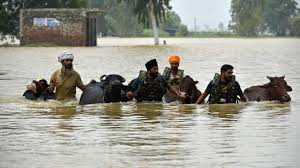
The loss of human life is, of course, the most tragic aspect of this disaster. As of now, 29 people have been confirmed dead, with hundreds more injured or missing. Many of the victims have been swept away by flash floods, while others have perished due to drowning or landslides. The floodwaters have also left over 2.56 lakh people displaced in Punjab alone, with entire villages submerged and crops destroyed. The Indian Army and National Disaster Response Force (NDRF) have been deployed for rescue and relief operations, and temporary shelters have been set up for displaced people.
The human toll is compounded by the destruction of livelihoods. Punjab, the “Granary of India,” has seen massive destruction of crops, including wheat, rice, and vegetables. With irrigation systems washed away and agricultural infrastructure damaged, farmers face the prospect of lost income and food insecurity. In rural areas, many families have lost their livestock—cattle, goats, and poultry—which are vital sources of both food and income.
Dr. Meera Singh, a disaster management expert, emphasizes, “In agricultural communities, the loss of livestock and crops is not just an economic blow but a psychological one as well. For many, their entire livelihood depends on these animals and crops, and losing them in a disaster like this can have long-lasting consequences.”
The floods across North India are not just a natural calamity; they are a wake-up call. If India is to prevent a repeat of such devastation, a multi-pronged, long-term strategy is urgently required. Experts suggest investment in modern forecasting tools, real-time data collection, and community-level alert systems can drastically reduce casualties. They also suggest that roads, bridges, drainage systems, and housing in vulnerable areas must be built to withstand extreme rainfall and flooding. Embankments and riverfront protections must be modernized. Wetlands, forests, and floodplains must be preserved and restored. They act as natural sponges, absorbing excess water and reducing the intensity of floods. States like Punjab and Himachal need stricter land-use policies that prevent construction in ecologically fragile zones and river catchments. Local communities, farmers, and civil society must be trained in disaster preparedness, evacuation drills, and resilient farming practices.
The floods of 2025 will go down as one of the worst humanitarian and ecological disasters in recent decades for North India. The images of stranded families, submerged fields, and collapsing bridges are stark reminders of how fragile human settlements are in the face of nature’s fury when planning and foresight are missing.
At the same time, the crisis also offers an opportunity to rethink India’s approach to climate resilience. Relief and charity provide immediate succour, but only systemic change—rooted in sustainable development, strong governance, and climate-sensitive policies—can prevent such devastation in the future. If there is one message from this catastrophe, it is this: floods may be natural, but the scale of destruction is often man-made. The choice before India is clear—either continue reacting to disasters or start preparing for them.
The floods have stripped away illusions of safety. They remind us that while we cannot control the rain, we can control how prepared we are for its wrath. Relief can mend wounds, but resilience can prevent scars. As the waters recede and the rebuilding begins, North India faces a choice: to continue in the cycle of disaster and despair, or to finally invest in a future where rains bring life, not ruin.