
The IMD has projected a wetter-than-usual end to the monsoon season; Monthly rainfall over the country as a whole during September 2025 is most likely to be above normal (>109% of long period average (LPA)). The LPA of rainfall over the country as a whole during September based on data from 1971-2020 is about 167.9 mm.
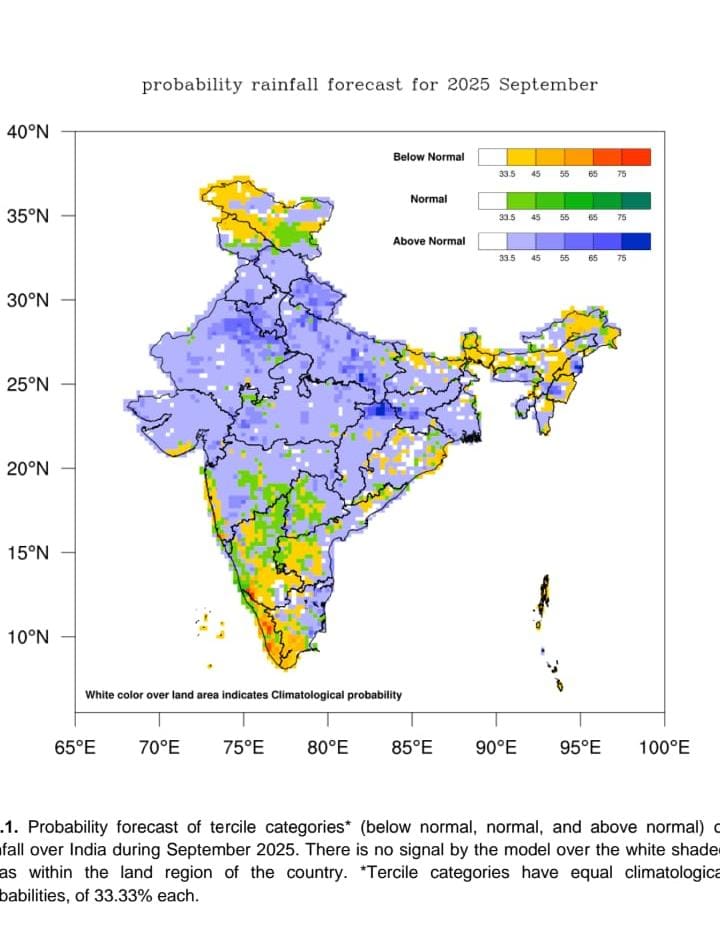
Following an exceptionally wet August, the India Meteorological Department (IMD) has forecast more rainfall for northwest India in September 2025. IMD Director General Mrutyunjay Mohapatra said that many regions, including Uttarakhand, south Haryana, Delhi, and north Rajasthan, may experience heavy rainfall throughout the month.
Monthly average rainfall over the country as a whole in September 2025 is most likely to be above normal (>109% of the Long Period Average (LPA). Geographically, most parts of the country are likely to receive normal to above-normal rainfall. However, some parts of Northeast and East India, many areas of extreme South Peninsular India and some parts of northernmost India, are likely to receive below-normal rainfall, the IMD said
Some areas in the northeast, east, extreme southern peninsular India may see below-normal precipitation.
The meteorological agency has raised concerns over the potential impact of sustained heavy rainfall in hilly regions, particularly Uttarakhand. “Many rivers originate in Uttarakhand. Heavy rainfall in these areas could trigger floods and significantly impact downstream cities and towns,” Mohapatra warned, highlighting the risk of landslides and flash floods, especially in mountainous terrain.
In addition to Uttarakhand, the IMD has indicated the possibility of increased rainfall in the upper catchments of the Mahanadi River in Chhattisgarh, which could pose additional flood risks.
August 2025 proved to be an unusually wet month for the Northwest.
The region recorded 265 mm of rainfall, the highest in August since 2001 and the 13th highest since 1901. Rainfall totals in June and July also surpassed historical averages, with June recording 111 mm (42% above normal) and July 237.4 mm (13% above normal). Cumulatively, the region has received 614.2 mm of rain from June 1 to August 31—about 27% higher than the seasonal average of 484.9 mm.
This excess rainfall has coincided with severe weather events across northern India.
Punjab experienced its worst flooding in decades, displacing lakhs and devastating farmland. Cloudbursts, flash floods, and landslides struck Himachal Pradesh, Uttarakhand, and Jammu and Kashmir, causing widespread damage to infrastructure.
According to the IMD, these extreme events were driven by active monsoon conditions and frequent western disturbances. Meanwhile, South Peninsular India also saw record-breaking rainfall, with 250.6 mm in August—31% above normal—marking its third-highest total since 2001.
As India enters the final phase of the monsoon, the IMD urged for continued vigilance and preparedness, particularly in vulnerable regions.