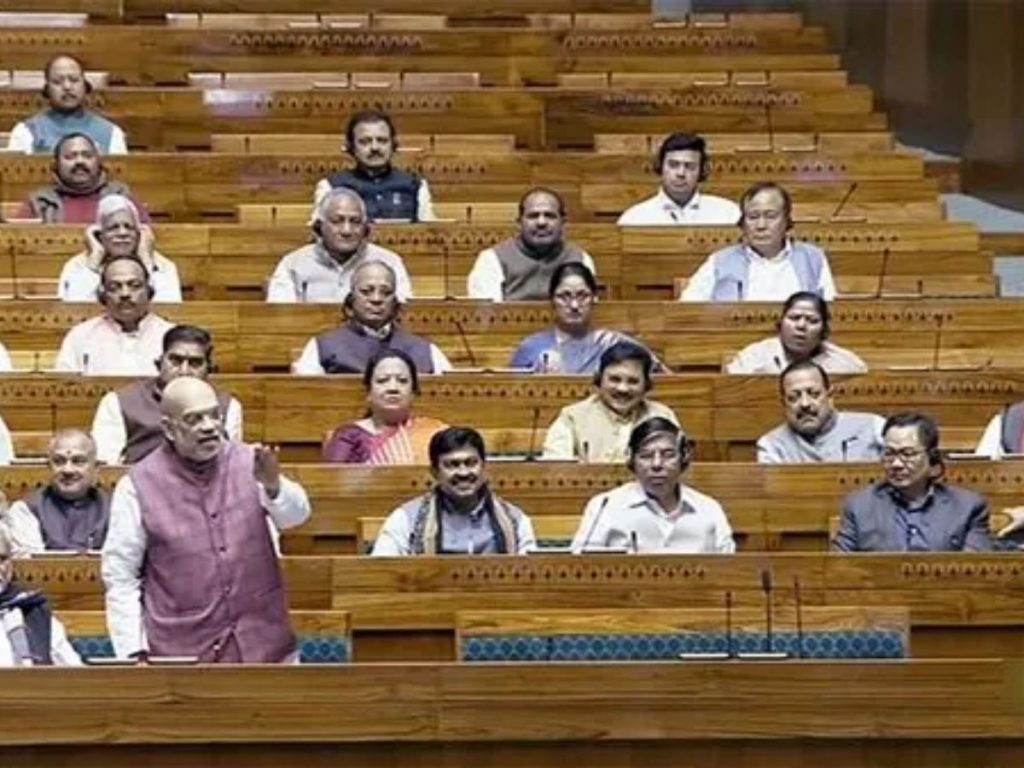
The Union government is set to introduce The Jammu and Kashmir Reorganisation (Amendment) Bill, 2025 in the Lok Sabha today, aiming to create a legal framework for removing a Chief Minister or Minister if arrested in connection with serious criminal offences.
Union Home Minister Amit Shah will present the bill, which will later be referred to a Joint Committee of both Houses for detailed deliberations. The proposal is part of a revised list of government business for August 20–21 that also includes The Constitution (One Hundred and Thirtieth Amendment) Bill, 2025 and The Government of Union Territories (Amendment) Bill, 2025.
According to the Statement of Objects and Reasons, the amendment seeks to address a gap in the Jammu and Kashmir Reorganisation Act, 2019, which currently has no provision for removing an arrested Chief Minister or Minister.
“It is expected that the character and conduct of Ministers holding office should be beyond any ray of suspicion,” the statement notes. “A Minister, who is facing an allegation of serious criminal offences, arrested and detained in custody, may thwart or hinder the canons of constitutional morality and principles of good governance and eventually diminish the constitutional trust reposed by people in him.”
Key provisions of the bill:
- If a Minister is detained for 30 consecutive days for an offence punishable with at least five years in prison, the Lieutenant Governor must remove him on the Chief Minister’s advice. If no advice is given by the 31st day, the Minister automatically ceases to hold office.
- If a Chief Minister is similarly detained, he must tender his resignation within 31 days. If he fails to do so, he automatically ceases to hold office the following day.
- The amendment clarifies that such individuals may be reappointed after release from custody.
The Home Minister emphasized that elected representatives must “rise above political interests and act only in the public interest and for the welfare of people,” and said the bill is designed to “uphold constitutional morality and good governance.”
The amendment will come into effect on a date notified by the Centre in the Official Gazette once passed by Parliament.