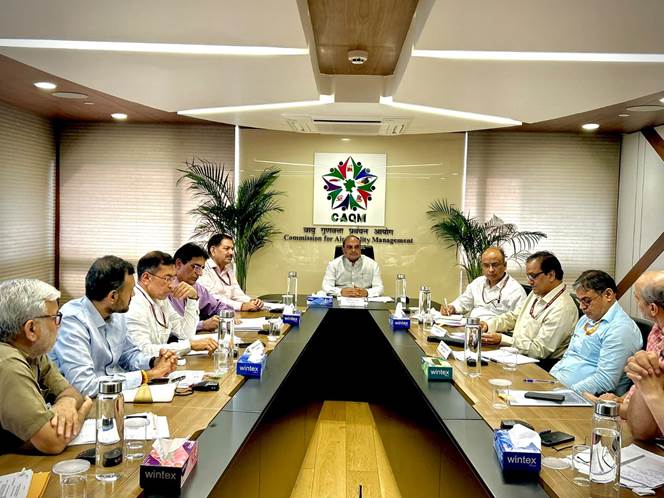
The Commission for Air Quality Management (CAQM) has amended the statutory direction pertaining to denial of fuel and immediate applicable legal action against EoL vehicles, extending the timeline for enforcement of the Direction in NCT of Delhi.
The decision came after the 24th Meeting of the CAQM with an aim to address technological gaps and to enable simultaneous enforcement of Statutory Direction No. 89 across NCT of Delhi and five adjoining High Vehicle Density districts of NCR to November 1, 2025, while in rest of NCR from April 1, 2026.
It is pertinent to mention that while EoL vehicles are deregistered by the concerned authorities in compliance with the orders of the NGT, these vehicles cease to have any legal sanctity for plying on public roads in Delhi-NCR.
“Strict enforcement action is required to be taken against such vehicles in accordance with the orders of the NGT and the Supreme Court, irrespective of the mode of detection, whether such vehicles are identified through ANPR camera systems, manual checks or any other mechanism. It is imperative that all such vehicles, once identified, are subjected to appropriate legal action including impounding,” it stated.
According to the amendment, all EoL vehicles identified through the ANPR cameras system or other such systems installed at the fuel pump stations shall be denied fueling w.e.f. 01.11.2025 in the NCT of Delhi and five high vehicle density districts of Gurugram, Faridabad, Ghaziabad, Gautam Budh Nagar and Sonipat and w.e.f. 01.04.2026 in the rest of NCR.
“Immediate legal action should be taken in respect of such EoL vehicles, including impounding and further disposal in accordance with RVSF Rules, 2021 and other extant policies of the respective State Governments and the GNCTD,” it added.
Further, the Transport Department of GNCTD and the NCR States have been directed to ensure proper installation and operation of the ANPR system. The Transport Departments have also been directed to ensure that trial of the ANPR system are conducted and training of manpower is done in a timely manner. They shall also widely disseminate this direction amongst all stakeholders including fuel stations and ensure its strict compliance through effective enforcement measures.