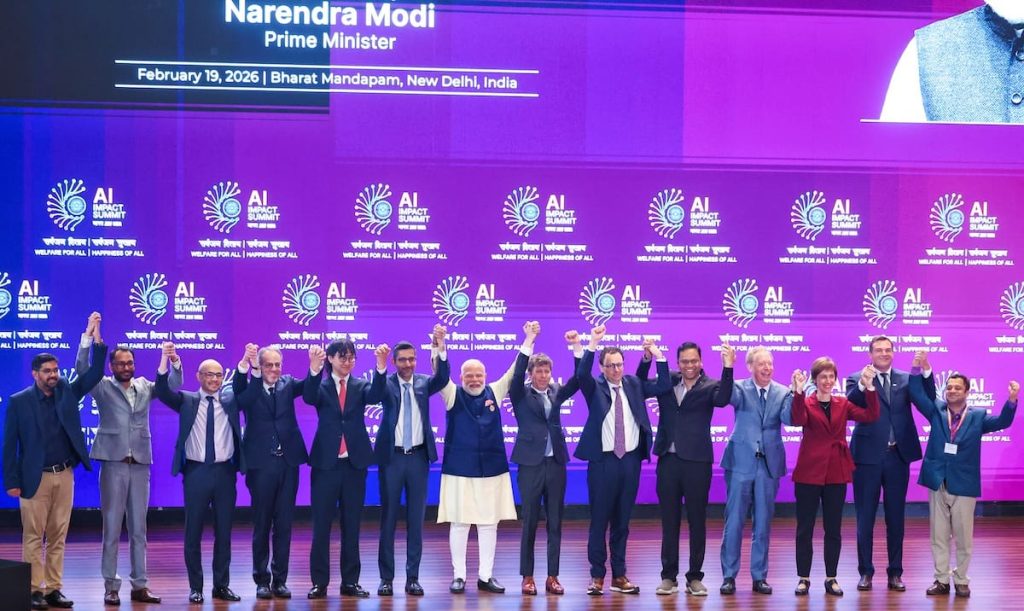
By Charanjit Ahuja
Despite PM Modi pitching India as a global champion of “inclusive Artificial Intelligence,” the AI Impact Summit, which was meant to project India as a rising force in the global AI ecosystem, didn’t measure up to that ambition, though it has succeeded in shaping narrative momentum, writes Charanjit Ahuja
Prime Minister Narendra Modi has pitched India as a global champion of “inclusive Artificial Intelligence,” unveiling before delegates of over 100 countries, the MANAV framework and calling for the democratisation of AI technologies so they become instruments of empowerment rather than exclusion. However, the AI Impact Summit, held in New Delhi, which was meant to project India as a rising force in the global artificial intelligence ecosystem, didn’t measure up to it, though it has succeeded in shaping narrative momentum.
Instead, controversy overshadowed the event after a quadruped “robot dog” showcased at a private university — presented as part of a Rs 350-crore research initiative — was widely alleged to be a commercially available Chinese product rather than an indigenous breakthrough. The episode triggered criticism from sections of academia, the political opposition, and industry observers, who argued that symbolism had overtaken substance. More importantly, it reignited a deeper debate: where does India truly stand in the global AI race — and what structural gaps still hold it back?
AI experts say that key areas where India continues to face serious challenges include modern AI — particularly generative models — which runs on high-performance computing (HPC) infrastructure powered by advanced GPUs and semiconductor fabrication capacity.
India currently imports the majority of its high-end AI chips. The country lacks large-scale domestic semiconductor fabrication ecosystems and has limited access to cutting-edge GPU clusters compared with the U.S. and China. By contrast, American tech giants operate massive AI data centres, while China has built state-supported compute infrastructure at scale. Without affordable and abundant compute capacity, Indian start-ups and research institutions struggle to train frontier models domestically.
India has strong applied IT capabilities but lags in frontier AI research. Challenges include limited funding for long-term, blue-sky AI research, brain drain of top AI talent to Silicon Valley, Europe and Singapore and lower representation in high-impact AI journals and foundational model development. While Indian-origin researchers are prominent globally, much of that innovation occurs outside India’s institutional framework.
AI systems depend on high-quality, well-annotated datasets. India faces several hurdles like fragmented and siloed public datasets, concerns over privacy, consent, and surveillance, and limited availability of structured datasets in regional languages.
Although India has rich linguistic diversity, building large, curated multilingual datasets remains a massive task. The absence of standardised, open, high-quality data slows AI development tailored to Indian realities.
AI is not just software — it is deeply tied to hardware ecosystems. India’s semiconductor manufacturing is still nascent. Compared with the U.S., which leads in chip design, Taiwan and South Korea in fabrication, China in scaling domestic supply chains, and India remains heavily import-dependent. Without a strong hardware base, long-term AI sovereignty remains vulnerable to geopolitical supply disruptions.
While India has articulated ambitions around inclusive and ethical AI, regulatory clarity remains limited. Key concerns include: Liability in cases of AI-driven harm. Standards for algorithmic transparency. Deep fake and misinformation safeguards. Intellectual property treatment of AI-generated content.
Investors and innovators often seek predictable regulatory environments. Uncertainty can dampen large-scale capital commitments.
India produces millions of STEM graduates, yet advanced AI skill depth remains concentrated in elite institutions. Issues include: Limited AI-focused faculty in Tier-2 and Tier-3 colleges. Insufficient integration of AI in vocational and school-level education. There are concerns about job displacement in IT services and back-office industries. While AI promises productivity gains, it also threatens labour-intensive sectors where India has traditionally been competitive.
The controversy surrounding the robot dog exhibition reflects a broader perception problem of showcasing imported technology as domestic innovation risks reputational damage, high-profile announcements without peer-reviewed validation erode credibility, and public-private research claims require transparency and technical scrutiny. India’s global tech credibility depends not on spectacle but on demonstrable breakthroughs — published research, patents, scalable products, and globally competitive start- ups.
While India has a vibrant start-up ecosystem, AI ventures face funding constraints: Frontier AI requires long gestation periods and high capital expenditure. Risk appetite for deep-tech is lower compared with consumer-tech ventures. Dependence on foreign venture capital may complicate strategic autonomy. Scaling AI infrastructure is capital-intensive; without patient funding, many start-ups pivot prematurely to service models.
AI development is increasingly geopolitical. The U.S.–China technology rivalry affects access to advanced chips, cross-border research collaboration and cloud service dependencies. India must navigate this complex terrain carefully to avoid technological isolation while protecting strategic autonomy.
The AI Impact Summit’s controversy may ultimately serve as a useful wake-up call. India possesses a vast talent base, strong digital public infrastructure, a thriving start-up culture and a large domestic market for AI deployment. But ambition must be matched by structural investment, research depth, and institutional credibility.
The path forward requires: Massive expansion of compute infrastructure. Transparent, peer-reviewed research outputs. Strong academia-industry collaboration. Clear regulatory frameworks. Sustained public funding for deep-tech innovation.
If India aspires to be a genuine AI powerhouse, it must move beyond optics and episodic showcases. The real test lies not in exhibition halls, but in laboratories, data centres, and globally competitive products. The AI race is long-term. India’s challenge is to convert potential into proof.
Modi sets AI governance tone
It is said that well begun is half done. Prime Minister Narendra Modi has set the ball rolling. Addressing delegates from nearly 100 countries at the AI Summit, he argued that AI must not deepen the digital divide or concentrate power in a few corporations or nations.
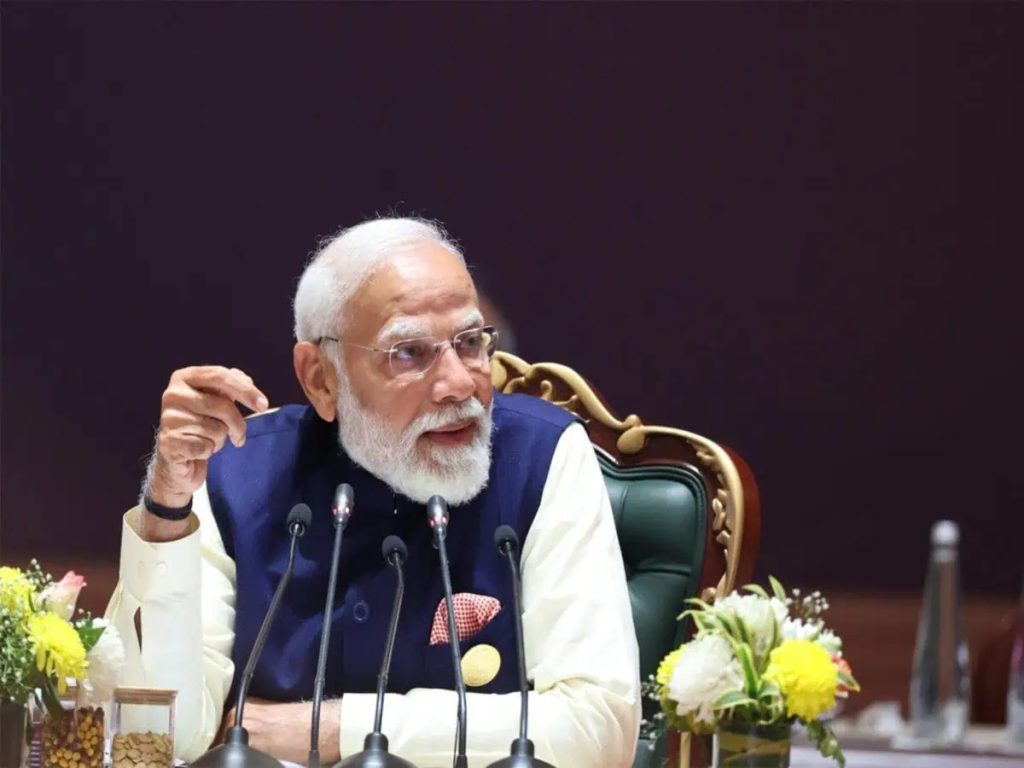
“Artificial Intelligence will benefit the world only when it is shared with young minds,” he said, framing access to computing, data, and education as essential public goods in the 21st century.
The centrepiece of the summit was the unveiling of the MANAV framework, positioned as India’s blueprint for ethical, inclusive, and human-centric AI governance.
Though detailed operational guidelines are expected later, officials outlined their pillars:
- M – Mass access: Democratising AI tools through public digital infrastructure.
- A – Accountability: Embedding transparency and audit mechanisms.
- N – Non-discrimination: Guardrails against bias and algorithmic exclusion.
- A – Augmentation: AI as a complement to human capability, not a replacement.
- V – Value creation for society: Prioritising healthcare, agriculture, education and climate resilience.
Government sources described MANAV as an extension of India’s digital public infrastructure model — similar in philosophy to Aadhaar and UPI — but tailored for AI ecosystems.
Modi framed AI not merely as a technological race but as a development accelerator for the Global South. He proposed: AI-driven crop advisory systems for small farmers, multilingual AI tools for education, public health analytics for disease surveillance, and climate modelling for disaster-prone regions. India positioned itself as a bridge between advanced AI economies and developing nations seeking affordable, ethical solutions.
The Prime Minister urged international collaboration over regulatory fragmentation. He stressed: Interoperable AI standards. Cross-border research partnerships. Shared datasets for non-commercial use and capacity building for youth in developing countries. Delegates from Africa, Southeast Asia, and Latin America welcomed the emphasis on equitable access, while European representatives underscored the importance of aligning with emerging global AI safety norms.
The summit, however, was not without domestic political friction.
The opposition Indian National Congress criticised the government’s approach, raising several concerns. The Congress leaders argued that while the government speaks of democratisation, data governance in India, the country remains highly centralised. They questioned: Who will control the datasets underpinning AI tools? What privacy safeguards will be built into MANAV? Whether independent oversight mechanisms exist.
Opposition voices and trade unions warned that rapid AI deployment could disrupt employment in sectors such as IT services, back-office operations, and manufacturing. They accused the government of underplaying labour transition risks.
Some critics argued that advocating global AI inclusion rings hollow while Rural broadband penetration remains uneven, government schools face digital infrastructure gaps, and funding for higher education research is constrained. Civil society organisations also flagged the absence of detailed safeguards against algorithmic bias, surveillance misuse, and deepfake manipulation.
Despite ambitious rhetoric, observers noted several areas where the summit appeared to falter: While MANAV was presented as a framework, it stopped short of publishing enforceable guidelines, clarifying whether it would become legislation, and defining liability structures for AI harms. Without regulatory specificity, critics argue, the initiative risks being perceived as aspirational rather than operational.
Though India emphasised AI infrastructure expansion, no detailed funding roadmap was disclosed regarding domestic semiconductor capacity, high-performance computing clusters, and public AI research grants. Global investors are likely to watch for fiscal commitments before deepening engagement.
The summit called for cooperative governance, but geopolitical realities complicate consensus. Divergent approaches between the U.S. model emphasising innovation-first growth, the European Union’s regulatory-heavy AI framework, and China’s state-centric model make harmonised global standards difficult.
India’s attempt to carve a middle path — innovation with inclusion — will require sustained diplomatic balancing.
India’s AI Positioning
The summit signals India’s intent to move from a service-oriented IT powerhouse to a policy-shaping AI nation. By foregrounding inclusion, India is aligning its technological narrative with its development diplomacy.
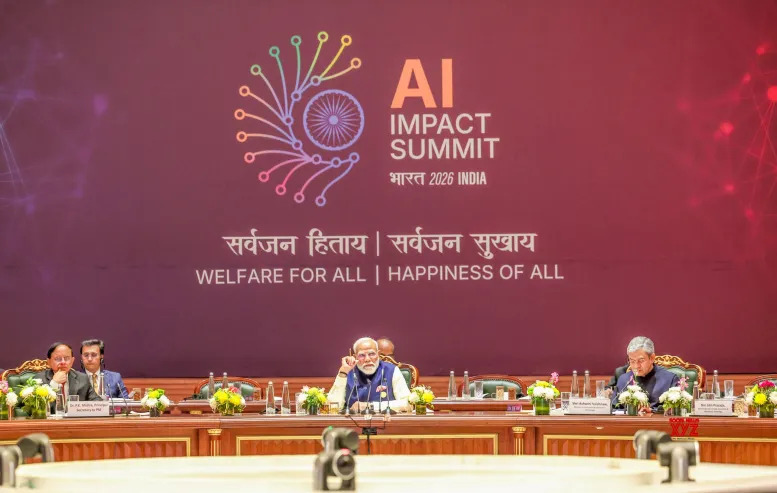
For Modi, the message is clear: AI should not replicate historical inequities. Instead, it should serve as a leveller — empowering youth, farmers, students, and small enterprises.
Whether MANAV evolves into a robust institutional framework or remains a high-level vision will determine how the summit is ultimately judged.
The immediate next steps include: publishing detailed guidelines under the MANAV framework, clarifying regulatory architecture, addressing labour transition policies, and engaging opposition and civil society in structured dialogue.
The AI Summit has succeeded in shaping narrative momentum. The harder task now lies in converting that momentum into measurable outcomes. As India stakes its claim in the AI century, the balance between ambition and accountability will define not only the success of MANAV but also the credibility of its call for inclusive artificial intelligence.
INDUSTRY LEADERS WEIGH INDIA’S AI ROLE
“In India, we can scale personal superintelligence very fast … India has moved from being a technology consumer to a leader in the global AI start-up landscape.” — Alexandr Wang, Chief AI Officer, Meta
“No technology has me dreaming bigger than AI. This hub will house gigawatt-scale compute and a new international subsea cable gateway bringing jobs and cutting-edge AI to people and businesses across India.” — Sundar Pichai, Google CEO, after announcing Google’s full-stack AI hub in Visakhapatnam.
“Technology always disrupts jobs, but we always find better things to do. India, the world’s largest democracy, is well positioned to lead in AI—not just to build it, but to shape it and decide what our future looks like.” — Sam Altman, CEO, OpenAI
“India has an absolutely central role to play in these questions and challenges, both on the side of the opportunities and on the side of the risks.” — Dario Amodei, CEO, Anthropic