


Page 35 - 31OCT2019E
P. 35
One such observation is that many
       people are reluctant to adopt modern
       technology. In a cleverly designed field
       experiment, Duflo, Kremer et al. investi-
       gated why smallholders — particularly
       in subSaharan Africa — do not adopt
       relatively simple innovations, such as
       artificial fertiliser, although they would
       provide great benefits. One explanation
       is present bias — the present takes up
       a great deal of people’s awareness, so
       they tend to delay investment decisions.
       When tomorrow comes, they once again
       face the same decision, and again choose
       to delay the investment. The result can be
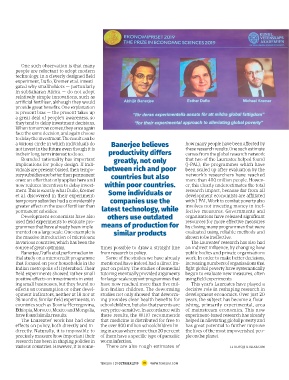
       a vicious circle in which individuals do   Banerjee believes        how many people have been affected by
       not invest in the future even though it is                          these research results. One such estimate
       in their long-term interest to do so.  productivity differs         comes from the global research network
          Bounded rationality has important   greatly, not only            that two of the Laureates helped found
       implications for policy design. If indi-                            (J-PAL); the programmes which have
       viduals are present-biased, then tempo-  between rich and poor      been scaled up after evaluation by the
       rary subsidies are better than permanent   countries but also       network’s researchers have reached
       ones: an offer that only applies here and                           more than 400 million people. Howev-
       now reduces incentives to delay invest-  within poor countries.     er, this clearly underestimates the total
       ment. This is exactly what Duflo, Kremer   Some individuals or      research impact, because far from all
       et al. discovered in their experiment:                              development economists are affiliated
       temporary subsidies had a considerably   companies use the          with J-PAL. Work to combat poverty also
       greater effect on the use of fertiliser than   latest technology, while   involves not investing money in inef-
       permanent subsidies.                                                fective measures. Governments and
          Development economists have also   others use outdated           organisations have released significant
       used field experiments to evaluate pro-                             resources for more effective measures
       grammes that have already been imple- means of production for       by closing many programmes that were
       mented on a large scale. One example is   similar products          evaluated using reliable methods and
       the massive introduction of microloans                              shown to be ineffective.
       in various countries, which has been the                              The Laureates’ research has also had
       source of great optimism.         times possible to draw a straight line   an indirect influence, by changing how
          Banerjee, Duflo et al. performed an in-  from research to policy.  public bodies and private organisations
       itial study on a microcredit programme   Some of the studies we have already   work. In order to make better decisions,
       that focused on poor households in the   mentioned have indeed had a direct im-  increasing numbers of organisations that
       Indian metropolis of Hyderabad. Their   pact on policy. The studies of remedial   fight global poverty have systematically
       field experiments showed rather small   tutoring eventually provided arguments   begun to evaluate new measures, often
       positive effects on investments in exist-  for large-scale support programmes that   using field experiments.
       ing small businesses, but they found no   have now reached more than five mil-  This year’s Laureates have played a
       effects on consumption or other devel-  lion Indian children. The deworming   decisive role in reshaping research in
       opment indicators, neither at 18 nor at   studies not only showed that deworm-  development economics. Over just 20
       36 months. Similar field experiments, in   ing provides clear health benefits for   years, the subject has become a flour-
       countries such as Bosnia-Herzegovina,   schoolchildren, but also that parents are   ishing,  primarily  experimental,  area
       Ethiopia, Morocco, Mexico and Mongolia,   very price-sensitive. In accordance with   of mainstream economics. This new
       have found similar results.       these results, the WHO recommends   experiment-based research has already
          The Laureates’ work has had clear   that medicine is distributed for free to   helped in alleviating global poverty and
       effects on policy, both directly and in-  the over 800 million schoolchildren liv-  has great potential to further improve
       directly. Naturally, it is impossible to   ing in areas where more than 20 per cent   the lives of the most impoverished peo-
       precisely measure how important their   of them have a specific type of parasitic   ple on the planet.
       research has been in shaping policies in   worm infection.
       various countries. However, it is some-  There are also rough estimates of            letters@tehelka.com


                                         Tehelka / 31 october 2019  35  www.Tehelka.com

