


Page 59 - Tehelka Issue 14E
P. 59
BOOK REVIEW


 Jholawala and the art of   first-hand.  Dreze’s  instead                        believes that like many other

         uses insights from his field
                                                                                 programmes in India, NREGA,
                                                                                 too, has to work on the ac -
         surveys conducted by student
 social policy planning  volunteers. What is interest-                           countability factor if the inter-
         ing about these surveys is that
                                                                                 ests mentioned in the plan are
         most of the student volun-
                                                                                 to be achieved. The scheme
         teers working for Dreze and
                                                                                 ing to the volition of workers’
         Dr. Reetika Khera were either                                           is plagued by issues pertain-
         paid very low or were not paid                                          entitlements. The problems,
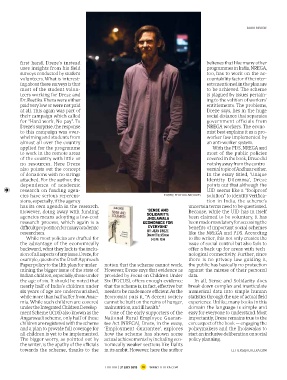
 ight from the onset of   In the book Sense and Solidarity, development economist   at all. This again was part of   Dreze says, lies in the huge
 Sense  and  Solidarity-  their campaign which called                            social distance that separates
 Jholawala  Economics  Jean Dreze, captures the complex statistical data set in simple   for “Hard work, No pay”. To   government  officials  from
 for  Everyone,  author   field experiments to present the human impact of the    Dreze’s surprise, the response   NREGA workers. The econo-
 R Jean Dreze sets the tone   to this campaign was over-                         mist best explains it as a pro-
 for the whole book, which is to un-  economic policies active in the country. Further, the author   whelming and students from   worker law implemented by
 ravel the simple human facets of the  attempts to start a discussion between the policymakers and   almost all over the country   an anti-worker system.
 mammoth statistics affecting our   the Jholawala activist, of which he too is known to be    applied for the programme   With the PDS, NREGA and
 lives. Revered as one of the finest de-  to work in the remote areas            most of the public policies
 velopment economists of the world,  a part, writes BEDASREE DAS  of the country with little or   covered in the book, Dreze did
 Jean Dreze dissects the relationship   no  resources.  Here  Dreze              not shy away from the contro-
 of the Indian economy with that of   what they repeatedly focus on is the   fallout of the development policies   also points out the concept   versial topic of Aadhaar either.
 the millions still in need of the basic   concept of research-oriented action   in areas where they are most re-  of donations with no strings   In the essay titled, ‘Unique
 amenities, promised by a developing  or as Dreze calls it ‘Research for Ac-  quired. Dreze points out three basic   attached. For the author, the   Identity  Dilemma’,  Dreze
 country. Dreze, himself an activist-  tion’. In the words of Dreze, the con-  reasons for these failures- inefficien-  dependence  of  academic    points out that although the
 economist, attempts to enumerate   cept reflects on how ‘research can   cy, corruption and exploitation. The   research on funding agen-  UID seems like a “foolproof
 the factors impacting our perspec-  help with arguments and evidence   toll of these issues in the mental and   cies have serious repercus-  PHOTO: TEHELKA ARCHIVES  solution” to identity verifica-
 tive of a socially impaired society;   that contribute to more effective   physical health of the population lies   sions, especially, if the agency   tion in India, the scheme’s
 factors that are considered ‘unfash-  action’. It also calls out the existing   unattended. As far as Dreze’s field   has its own agenda in the research.    uncertain terms need to be questioned.
                                                          ‘SENSE AND
 ionable’ but nevertheless offer a view  norm of using excessive verbose   research goes, corruption has ham-  However, doing away with funding   SOLIDARITY:    Because, while the UID has in itself
 of a changing society.  phraseology  among  economists   pered even the basic functioning of   agencies means adopting a low-cost   JHOLAWALA   been claimed to be voluntary, it has
 Sense and Solidarity is a collec-  which make their papers difficult   the Public Distribution System(PDS)   research process, which again is a    ECONOMICS FOR   been made mandatory for accessing the
 tion  of  essays  co-authored  with   for the masses to comprehend and   in inaccessible areas of the country, a   difficult proposition for many academic   EVERYONE’  benefits of important social schemes
                                                          BY: JEAN DREZE
 some  of  Dreze’s  colleagues  and   hence creates a wall in the contribu-  subject that he explores throughout   researchers.  Orient BlackSwan  like the NREGA and PDS. According
 friends. The essays, written over   tion to action.  the book. In addition to that, while   While most policies are drafted for   343 PP;  395  to the writer, this not only creates the
 a period of time, is divided into 10   Some of the observations made   the traditional methods of liveli-  the advantage of the economically   issue of social control but also fails to
 chapters- ‘Drought and Hunger’,   by Dreze and his co-authors reveal a  hoods are collapsing there is a lack of   backward, what they lack is the inclu-  offer a back-up for areas with tech -
 ‘Poverty’, ‘School Meals’, ‘Health Care’,   suitable alternatives for the people   sion of all aspects of any issue. Dreze, for   nological connectivity. Further, since
 ‘Child Development and Elementary   coming out of these means of living.   example, questions the Draft Approach   there  is  no  privacy  law  guiding  it,
 Education’, ‘Employment Guaran-  Some of the   In the essay, ‘Fragile Lifelines, Robust   Paper policy to the 11th plan for under-  notion that the scheme cannot work.   the public has basically no protection
 tee’, ‘Food Security and Public Dis-  Oppression’, Dreze talks about his   mining the bigger issue of the state of   However, Dreze says that evidence as   against the misuse of their personal
 tribution System’, ‘Corporate Power   observations   experience across the Kalahandi-  Indian children, especially, those under  provided by Focus on Children Under   data.
 and Technocracy’, ‘War and Peace’   made in the book   Bolangir-Korapur region of Odisha.   the age of six. It should be noted that   Six (FOCUS), offers enough evidence   In all, Sense and Solidarity does
 and ‘Top-Up’. Each chapter includes   While, the region’s economic back-  nearly half of India’s children under   that the scheme is, in fact, effective but   break down complex and inarticulate
 essays most relevant to the theme.   reveal a fallout of   wardness had many contributing   six years of age are undernourished,   needs to be made more efficient. As the  numerical data into simple human
 Most of the essays have been previ-  the development   factors, it was a less observed fac-  while more than half suffer from Anae-  Economist puts it, “A decent society   statistics through the use of actual field
 ously published in the ‘The Hindu’.   tor which was taking a toll on its   mia. While such children are covered    cannot be built on the ruins of hunger,   experience. Unlike, many books in this
 The author had previously co-au-  policies in areas   inhabitants. That of declining land   under the Integrated Children Develop-  malnutrition, and ill health.”   domain the language is simple and
 thored books like Hunger and Public   where they are   productivity and lack of economic   ment Scheme (ICDS) also known as the    One of the early supporters of the   easy for everyone to understand. Most
 Action and An Uncertain Glory: In-  diversification.  Anganwadi scheme, only half of these   National  Rural  Employee  Guaran -  importantly, Dreze remains true to the
 dia and its Contradictions with Nobel   most required due   Throughout the book, the author   children are registered with the scheme  tee Act (NREGA), Dreze, in the essay,    core aspect of the book — engaging the
 Prize-winning economist, Amartya   to inefficiency,   calls out the inconsistencies in sta-  and a plan to provide full coverage for   ‘Employment  Guarantee’,  explores   policymakers and the Jholawalas to
 Sen, among others.  tistical inferences because of the fact   all children is yet to be implemented.   how  the  scheme  has  shown  some    start an inclusive deliberation on social
 While the essays reflect mainly   corruption and   that undermines real human prob-  The bigger worry, as pointed out by   actual achievements by including eco-  policy planning.
 on the social policy changes that the   lems that can only be experienced   the writer, is the apathy of the officials    nomically weaker sections like Dalits
 given topic has witnessed over time,   exploitation  by visiting and talking to the subjects   towards the scheme, thanks to the    in its ambit. However, here the author    LETTERS@TEHELKA.COM


 TEHELKA / 31 JULY 2018  58  WWW.TEHELKA.COM  TEHELKA / 31 JULY 2018  59  WWW.TEHELKA.COM


 58-59 Book Review.indd   2  7/17/2018   8:54:38 PM  58-59 Book Review.indd   3                    7/17/2018   8:54:46 PM

