


Page 62 - 30SEPT18E
P. 62
LITERATURE
as we see today. of Partition badly shattered the young Pritam produced poetry, fiction, biogra-
Amrita’s identity began with what Amrita. She depicted the sorrows, the phies, essays, a collection of Punjabi folk
she called ‘one of nature’s secrets.’ Be- pains and the helplessness of the times songs and two autobiographical works
fore her birth, two little girl students in her most famous poem ‘Aj aakhaan that were translated into several Indian
of her father prayed publicly in a gu- Waris Shah nu.’ She found a way out of and foreign languages.
rudwara wishing for a girl child in the her haunting reality by invoking the Amrita Pritam’s love-life and un-
house of their Masterji. She was an Sufi poet Waris Shah, calling on him to conventional life choices always cap-
only child of Kartar Singh and Raj Kaur, rise from his grave and give voice to the tured and rattled popular culture at
born on 31st August, 1919, in Gujran- macabre horrors of a divided land. She the same time. Married at sixteen, Am-
wala, in erstwhile undivided Punjab, wrote the poem on a train journey from rita endured an unhappy marriage for
now Pakistan. Her father was a school Lahore to Dehradun in the aftermath of twenty-five years. While still married,
teacher and a Pracharak/Sikh religious Partition. She also spoke of the women Pritam nurtured an affection for noted
preacher. The environment in her early abducted during Partition and of the lyricist Sahir Ludhianvi, an unrequited
home was deeply spiritual. While the children they bore to unknown fathers. love which became as iconic as folklore.
religious constraints perplexed her, In her book ‘Pinjar’, she created the The relationship bore the iconic poem
she inherited her love for literature memorable character of Puro, a collec- Sunehe, which won her the Sahitya
from her father, a small-time poet who tive symbol of violence against women, Akademy Award in 1956, making her
wrote under the pen name Piyush and loss of humanity and the ultimate sur- the first woman to receive the honour.
also edited a Punjabi magazine. Bereft Even after her divorce, still considered
by her mother’s demise at an early age a taboo in certain sections, she equal-
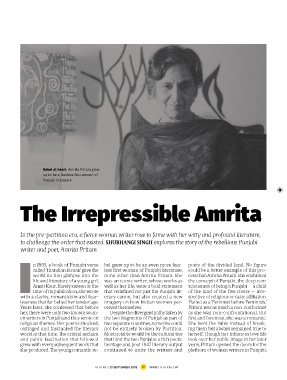
Rebel at heart Amrita Pritam grew of eleven, she turned agnostic after wit- Amrita’s poems ly celebrated her relationship with
up to be a fearless first woman of nessing the futility of prayer through shocked, outraged painter/artist Imroz. It is mirrored in
Punjabi literature her mother’s illness. Isolated by a disci- her famous last poem ‘Main Tenu Phir
plinarian father, Amrita found solace in and fascinated Milangi.’ She revered every relation-
her poems, each ‘a forbidden desire.’ the literary world ship in her life and the famous letters
The girl, wished for by two girls, grew at that time. The she wrote to Ludhianvi, Sajjad and Im-
The Irrepressible Amrita desires and silent emotions of her ilk, critical acclaim that ary finesse. Pritam was conferred with
up to give expression to the repressed
roz are little gems known for their liter-
countless awards and honours, includ-
countless women weighed down un-
der the veil of exalted feminine virtues
revered at that time. Her initial work followed grew with ing Bhartiya Jnanpith Award in 1982 for
‘Kagaj Te Canvas’ (Paper and Canvas).
every subsequent
consisted mainly of romantic poems The ever sceptical Khushwant Singh
In the pre-partition era, a fierce woman writer rose to fame with her witty and profound literature, though she gradually gravitated to- work that she himself confessed to translating Pri-
wards the Progressive Writers’ Move-
tam’s novel ‘Pinjar’ to English, in the
to challenge the order that existed. SHUBHANGI SINGH explores the story of the rebellious Punjabi ment. In 1944, in a poetry collection produced hope of getting ‘a candid account of her
writer and poet, Amrita Pritam titled ‘Lok Peed’ (Anguish Of The Pub- love-life.’ Disappointed by her abstract
lic), Amrita’s first social poetry emerged loves, he dismissively remarked that
and she criticised the economy being render to existential fate. the story of her life and love could fit
n 1935, a book of Punjabi verse bel grew up to be an even more fear- poets of the divided land. No figure depleted by the Second World War and After the Partition, Pritam moved to on a postage stamp. In her signature ir-
called ‘Thandian Kirnan’ gave the less first woman of Punjabi literature, could be a better example of this pro- the disastrous Bengal famine of 1943. Delhi and started working for All India reverent style, she named her memoir
world its first glimpse into the none other than Amrita Pritam. She cess than Amrita Pritam. She enshrined Her increased involvement in social Radio for a period. She also presented ‘Raseedi Ticket’ (Postage Stamp). Amrita
life and literature of a young girl, was an iconic writer, whose works as the concept of Punjabi, the deep con- work in the mid-1940s, her working a program called ‘Darpan’ on television. Pritam was the woman who taught us
Amrit Kaur. Barely sixteen at the well as her life, were a bold statement sciousness of being a Punjabi — a child with the Lahore Radio Station for a But her pet and most notable venture to celebrate women as imperfect mor-
I time of its publication, she wrote that redefined not just the Punjabi lit- of the land of the five rivers — irre - brief period and her angst at the help- was Nagmani, a literary monthly. The tals rather than put them on unrealis-
with a clarity, romanticism and fear- erary canon, but also created a new spective of religious or caste affiliation. lessness of the commoners, especially magazine was a hallmark of Punjabi tic pedestals. Through her writing, she
lessness that far belied her tender age. imagery on how Indian women per- Hailed as a ‘Feminist before Feminists,’ women, made her works around that literature, a gateway that introduced has become the friend and confidante
Years later, she confessed that before ceived themselves. Pritam was as much a non-conformist time become more rebellious and many new voices and was known for of women across continents. She stood
her, there were only two known wom- Despite the divergent paths taken by as she was non-confrontational. But socio-political in nature its distinctive design, developed by her for a humanity devoid of the barriers
en writers in Punjabi and they wrote on the two fragments of Punjab as part of first and foremost, she was a romantic. Pritam not only read history but long-time companion Imroz. It ran for of caste, creed, boundaries or gender.
religious themes. Her poems shocked, two separate countries, some ties could She bent the rules instead of break- also she witnessed history in the mak- over three decades (1966-2003) and had Born ninety-nine years ago, Amrita Pri-
outraged and fascinated the literary not be entirely broken by Partition. ing them but always remained true to ing. She became the part of that history a cult following. It was hailed for mak- tam is a classic modern woman and still
world at that time. The critical acclaim Most notable would be the cultural ties herself. Though her infamous love life during the partition of India in 1947, ing authors out amateurs, be it a truck the poster-girl for equality in today’s
and public fascination that followed that bind the two Punjabs: a rich poetic took over her public image in her later witnessing the killing of thousands of driver, a Dalit labourer or an army-man. fragmented society.
grew with every subsequent work that heritage and post-1947 literary output years, Pritam opened the doors for the people, be it Hindus, Muslims or Sikhs. The author of more than 100 books and
she produced. The young romantic re- continued to unite the writers and plethora of women writers in Punjabi, The events that happened at the time later a Rajya Sabha member, Amrita LETTERS@TEHELKA.COM
TEHELKA / 30 SEPTEMBER 2018 62 WWW.TEHELKA.COM TEHELKA / 30 SEPTEMBER 2018 63 WWW.TEHELKA.COM
62-63 Subhangi Singh.indd 2 9/17/2018 8:50:58 PM 62-63 Subhangi Singh.indd 3 9/17/2018 8:51:41 PM

