


Page 39 - 29NOV2019E-4
P. 39
DIGITISATION


      never enrolled, 42.5 per cent ever en-  In rural areas,            received scholarship/ stipend/ reim-
      rolled but currently not attending while                           bursement. Nearly 54.2 per cent of the
      43.9 per cent were currently attending.  among persons of age      students in rural and 23.7 per cent in
        In rural areas, 15.7 per cent never en-  five years and above,   urban areas received free/ subsidized
      rolled, 40.7 per cent ever enrolled but                            textbooks. Close to 10.0 per cent of the
      currently not attending while 43.5 per   9.9% are able to          students in rural and 7.2 per cent in
      cent were currently attending. In urban   operate a computer,      urban areas received free/subsidized
      areas, 8.3 per cent never enrolled, 46.9                           stationery.
      per cent ever enrolled but currently not   13% are able to use       In rural areas, average expenditure
      attending while 44.8 per cent were cur-                            per student pursuing general course in
      rently attending.                 Internet and 10.8% use           the current academic year was  5,240
        Among males, 11.0 per cent never   Internet in a month, the      while in urban areas it was  16,308. In
      enrolled, 42.7 per cent ever enrolled but                          rural areas, average expenditure per
      currently not attending while 46.2 per   latest NSSO data          student pursuing technical/professional
      cent were currently attending. Among       point out               course in the current academic year
      females, 16.6 per cent never enrolled,                             was  32,137 while in urban areas it was
      42.2 per cent ever enrolled but currently                           64,763.
      not attending while 41.2 per cent were   professional courses. Among students   Nearly 4.4 per cent of the rural house-
      currently attending.             pursuing general courses, nearly 55.8   holds and 23.4 per cent of the urban
        Net Attendance Ratio (NAR) at prima-  per cent were male students and 44.2   households had computer. Nearly 14.9
      ry level was 86.1 per cent. The figure was   per cent were female students. Among   per cent of the rural households and 42.0
      72.2 per cent at ‘upper primary / middle   students pursuing technical/professional   per cent of the urban households had
      level’ and 89.0 per cent at ‘primary and   courses, nearly 65.2 per cent were male   Internet facility. (c) In rural areas, among
      upper primary /middle level’. Nearly 96.1   students and 34.8 per cent were female   persons of age 5 years and above, 9.9 per
      per cent of the students[1] were pursuing   students.              cent were able to operate a computer, 13
      general courses and 3.9 per cent were   The indicators relating to free educa-  per cent were able to use Internet and
      pursuing technical/professional courses.    tion, free or subsidized textbooks and   10.8 per cent used Internet during last 30
      Among male students, nearly 95.5 per   stationery to students of age 3 to 35 years   days. In urban areas, among persons of
      cent were pursuing general courses and   currently attending at pre-primary and   age 5 years and above, 32.4 per cent were
      4.5 per cent were pursuing technical/  above level found that about 57.0 per cent   able to operate a computer, 37.1 per cent
      professional courses.            of the students in rural and 23.4 per cent   were able to use Internet and 33.8 per
        Among female students, nearly 96.9   in urban areas received free education.    cent used Internet during last 30 days.
      per cent were pursuing general courses   About 15.7 per cent of the students
      and 3.1 per cent were pursuing technical/  in rural and 9.1 per cent in urban areas    LETTERS@TEHELKA.COM


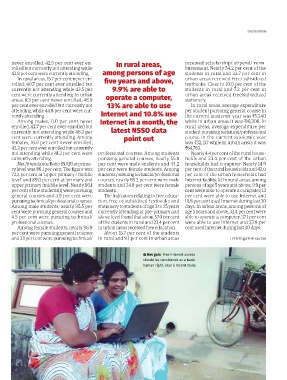
                                                         • Net gain  Free internet access
                                                         should be considered as a basic
                                                         human right, says a recent study

