A day after Saudi Arabia and Pakistan signed a formal mutual defence pact, India said it will “study the implications” of this development for its “national security as well as for regional and global stability” and is committed to “protecting India’s national interests”
India’s immediate neighbourhood is witnessing a whole lot of strategic geopolitical action. Two developments this week — Pakistan’s elevation of defence ties with Saudi Arabia and the presence of US military aircraft in Bangladesh — is an indication how alliances in West and South Asia are being reshaped, leaving New Delhi in carefully cautious position
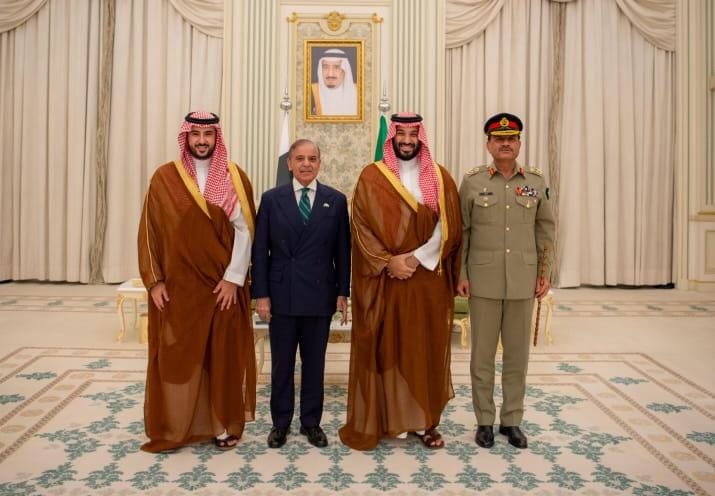
A day after Pakistani Prime Minister Shehbaz Sharif and Crown Prince Mohammed bin Salman signed the Strategic Mutual Defence Agreement (SMDA), India on Thursday said it will “study the implications” of this development for its “national security as well as for regional and global stability”, and is committed to “protecting India’s national interests.
Official Spokesperson Randhir Jaiswal said: “We have seen reports of the signing of a strategic mutual defence pact between Saudi Arabia and Pakistan. The Government was aware that this development, which formalises a long-standing arrangement between the two countries, had been under consideration. We will study the implications of this development for our national security as well as for regional and global stability. The Government remains committed to protecting India’s national interests and ensuring comprehensive national security in all domains.”
The pact is being read as a response to Washington’s retrenchment from the region, Israel’s attack on Hamas leaders in Qatar’s capital Doha and its geopolitical ramifications across the region, being described as ‘Islamic NATO’
In Riyadh, Sharif was escorted by Saudi F-15 fighter jets and received with full protocol. Saudi cities lit up their skylines with the flags of Saudi Arabia and Pakistan to mark the signing of the new agreement, according to reports. The pact binds both nations to treat an attack on one as an attack on both, effectively institutionalising what had long been an informal security understanding.
Though the agreement avoids explicit reference to nuclear weapons, its symbolism is powerful. Pakistan remains the Muslim world’s only nuclear-armed state, while Riyadh has often been suspected of leaning on Islamabad’s deterrence in the face of Iran’s ambitions. Coming days after Israel’s strike on Hamas leaders in Qatar, the timing suggests Saudi Arabia is signalling strategic resolve to both adversaries and allies. The pact also reflects Riyadh’s recalibrating of its security posture. Historically reliant on American protection, it seems to be now diversifying its defence architecture
For India, which has built deep economic and strategic ties with Saudi Arabia, the agreement has more than one significance. Riyadh’s growing closeness enhances Pakistan’s standing but Saudi Arabia also values India as a vital energy partner and rising power. How this unfolds, remains to be seen.
Meanwhile reports of US military aircraft in Bangladesh also created substantial flutter and chatter. Officially linked to joint drills and logistical cooperation, the move aligns with Washington’s Indo-Pacific strategy to counter China’s presence in the Bay of Bengal. Dhaka, meanwhile, seems to be balancing Beijing and Washington
For India it may be an opportunity as well as a challenge. American engagement tempers Chinese dominance, but a stronger US role may constrain India’s influence in its immediate neighbourhood.