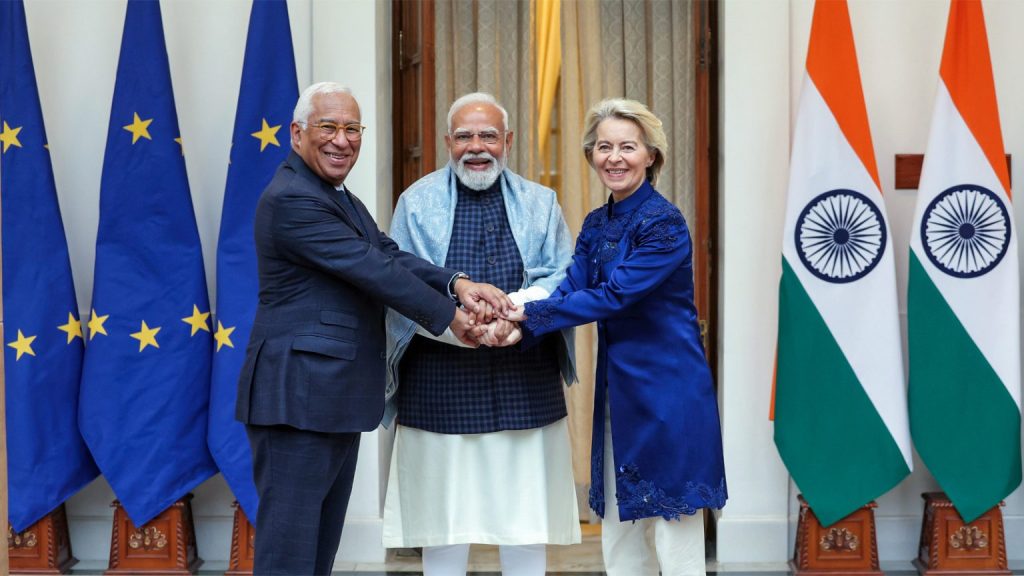
The conclusion of the long-pending India–European Union trade agreement — described as the “mother of all deals” — is less a sudden diplomatic triumph than a reflection of how deeply geopolitics has reshaped global trade. After nearly two decades of negotiations, the deal has materialised at a moment when pragmatism, not free-trade idealism, defines international economic engagement.
A key trigger for this shift was the tariff-driven disruption of global trade norms during Donald Trump’s presidency. By weaponising tariffs and openly prioritising economic nationalism, the United States shattered the post-war assumption that trade liberalisation was inevitable and rules-based. That assumption has not returned. Instead, trade is now viewed as an instrument of strategic leverage, supply-chain security and political alignment.
For the European Union, Trump-era tariffs were a wake-up call. Once shielded by transatlantic consensus, Europe found itself exposed to American unpredictability on the one hand and excessive dependence on Chinese manufacturing on the other. The result was a search for diversification — partners that offered scale, stability and strategic trust without undermining Europe’s industrial base.
India, too, absorbed the lessons of this turbulent period. Its decision to exit the Regional Comprehensive Economic Partnership (RCEP) signalled a shift towards selective globalisation and why openness would be calibrated, not unconditional, and aligned with domestic economic resilience and strategic autonomy.
It is in this altered landscape that India and the EU found common ground. A central reason the agreement became politically viable is that the two economies do not compete directly. The EU’s export strengths lie in capital- and technology-intensive sectors — high-end machinery, automobiles, chemicals, medical devices and green technologies. India’s strengths, by contrast, are in labour-intensive manufacturing, pharmaceuticals, engineering goods and services, particularly IT.
This structural complementarity matters. Indian exports do not threaten Europe’s core industrial employment. At the same time, European technology and investment are essential for India’s ambition to move up global value chains. The agreement also reflects a shared turn towards pragmatism. Negotiations that once stalled over rigid positions on standards, data governance and market access have been resolved through phased commitments and safeguards. This is not unfettered free trade, but managed openness — liberalisation where gains are mutual, protection where vulnerabilities remain.
More broadly, the deal is an expression of strategic autonomy. For Europe, it supports de-risking from China and insulating itself from U.S. trade volatility. For India, it diversifies partnerships while strengthening export-led growth in manufacturing and services.
The agreement underscores a deeper truth: the world had to change before the deal became possible. The India–EU trade pact is therefore not just a commercial milestone, but a marker of how geopolitics has rewritten the logic of global trade.
This fortnight, Tehelka’s Special Investigation Team has come out with an exposé, “Inside Agra Nigam bribe racket”. Tehelka SIT investigates rampant corruption at Agra Municipal Corporation as brokers and outsourced employees are caught extracting bribes for issuing death certificates, birth certificates, and Non-Availability Birth Certificates (NABC).