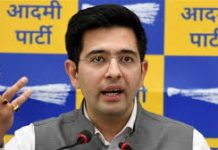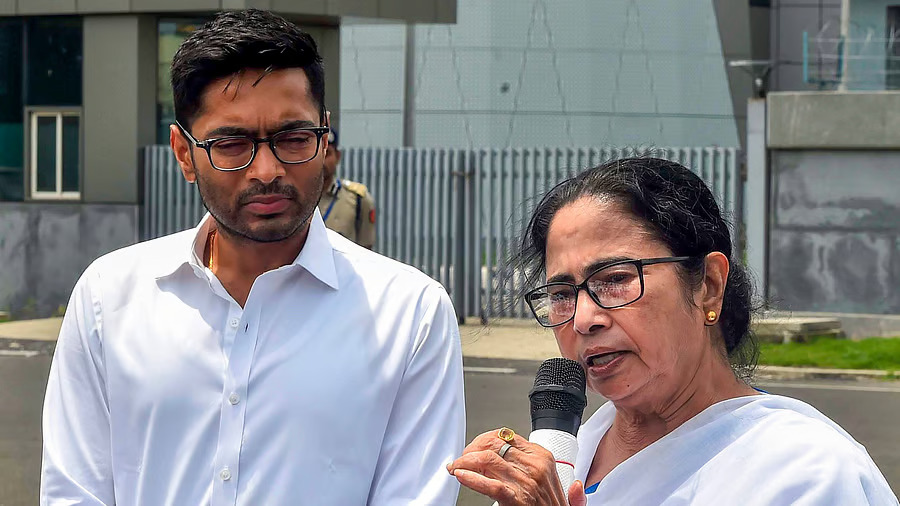
WB CM Mamata Banerjee and her nephew Abhishek Banerjee
By Jayanta Ghosal
In a unique electoral contest, West Bengal’s 2026 Assembly polls are being shaped by a fierce battle over voter lists, with the BJP pushing deletions and the TMC alleging politically driven exclusions, the ruling party apparently holding a slight edge. A report by Jayanta Ghosal
The 2026 West Bengal Assembly Election stands out as a unique political contest. It is perhaps the only election where the main opposition party, the Bharatiya Janata Party (BJP), wants to win by removing certain names from the voter list, while the ruling party, the Trinamool Congress (TMC), is insisting that all categories of voters should remain on the rolls, including those who are allegedly dead or suspected to be illegal immigrants.
The opposition asserts that its demand is simple: remove the names of deceased voters and illegal immigrants from the electoral list. The ruling party, however, counters this argument by accusing the Election Commission of deleting the names of genuine voters. In essence, the opposition believes that cleaning the voter list will expand its electoral prospects, while the ruling party claims that the process itself is politically motivated. For the first time in India’s electoral history, the principal opposition party is openly discussing the arithmetic of reducing the voter list as a factor in winning elections. The BJP refers to the alleged manipulation system as “scientific rigging” by the Trinamool Congress and insists on halting such practices. This raises an interesting historical comparison: earlier, the CPI(M) was often accused of maintaining similar election-time organisational machinery during its long years in power.
Recently, Chief Election Commissioner Gyanesh Kumar held a meeting with the top brass of the West Bengal administration. During that meeting, he made it clear that he wants to improve the image of West Bengal elections, particularly with regard to the state’s long-standing reputation for electoral violence. Despite this push for administrative reform, however, the Special Intensive Revision (SIR) of the voter list does not necessarily guarantee an electoral victory for the BJP. On the contrary, Mamata Banerjee has responded to the issue with considerable political tact. She has portrayed the SIR exercise as an act of injustice imposed by Delhi. There have even been reports of Booth Level Officers (BLOs) facing extreme stress during the process, with some allegedly dying by suicide due to the pressure of their responsibilities.
The Trinamool Congress asserts that this exercise’s consequences extend beyond Muslim voters. They argue that several general Hindu voters, middle-class members, and communities like the Nathuwas and Rajbanshis have also experienced the impact. The matter has now reached the Supreme Court, bringing the issue under the judicial system’s scrutiny. Meanwhile, supplementary voter lists are also being prepared as part of the revision process.
People often compare this situation to Bihar, where a similar voter list revision reportedly succeeded. However, the political circumstances there were different. In Bihar, the ruling alliance included Nitish Kumar and the BJP, while opposition leaders like Tejashwi Yadav and Rahul Gandhi were leading the resistance. Many observers argue that their political experience and organisational capabilities are not comparable to Mamata Banerjee’s political acumen. Mamata Banerjee has used the controversy to buy time and reshape the political narrative in West Bengal. Almost every day, she raises fresh questions about the Election Commission’s role, turning the issue into a major campaign theme.
When one examines the broader electoral calculus of West Bengal, it becomes clear that the BJP—especially the Leader of the Opposition, Suvendu Adhikari—is pushing a strongly assertive form of Hindutva politics. His political messaging frequently emphasises the idea that Hindus are under threat in West Bengal. He often refers to communal disturbances in districts such as Murshidabad to reinforce this argument. Recently, Union Home Minister Amit Shah also mentioned communal violence in Murshidabad during his remarks on Ram Navami. However, such aggressive Hindutva politics may not necessarily work in West Bengal. While it could potentially unify Hindu voters in states like Uttar Pradesh, Madhya Pradesh, or Bihar, Bengal’s political and social structure is different.
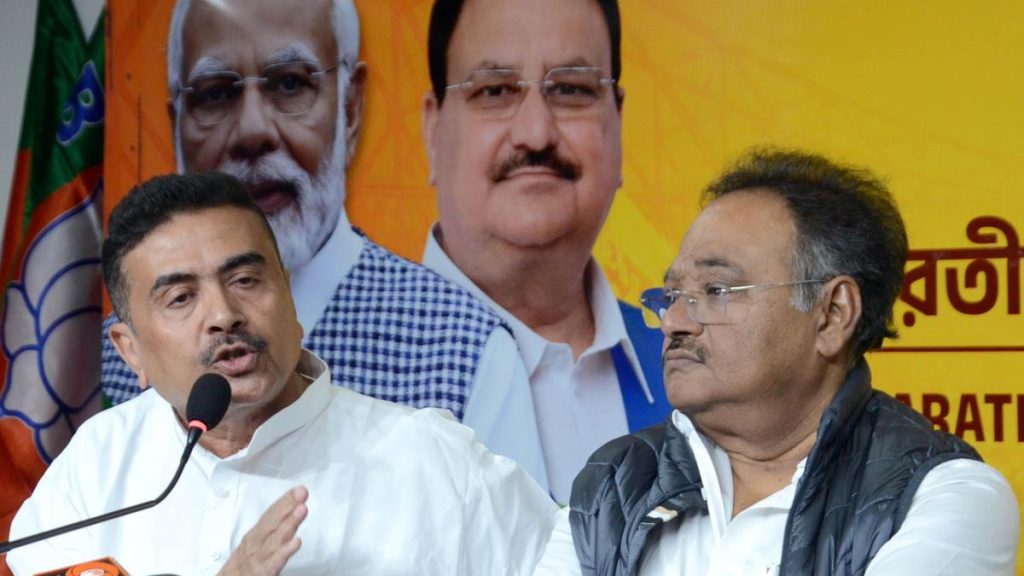
LoP Suvendu Adhikari and state BJP president Samik Bhattacharya
Another factor working against the BJP is that it has not fulfilled some of the promises it made to certain Hindu subsects. For instance, in 2021, the party promised to form a Narayani Sena battalion for the Koch-Rajbanshi community, but the promise was never implemented. In 2024, the BJP subsequently lost the politically significant Cooch Behar Lok Sabha seat. Some analysts believe that if the BJP had focused more on governance issues rather than religious polarisation, it might have been in a stronger position today. Recognising this, the party has now begun to adjust its strategy. It has revived the slogan of “Parivartan”—change in Bengal for the sake of development. However, internal differences in messaging are visible. Suvendu Adhikari continues to emphasise a more assertive Hindutva narrative, while state BJP president Samik Bhattacharya is focusing more on issues of governance and administrative reform. Many observers believe that excessive political polarisation may not ultimately benefit the BJP.
For the past two decades, identity politics has played an important part in shaping West Bengal’s electoral landscape. Beyond the broad Hindu–Muslim divide, sub-identity groups within the Hindu community are becoming increasingly important. Communities such as the Matua, Rajbanshi, and Namasudra are demanding distinct political recognition rather than being subsumed under a broader Hindu identity.
A similar transformation is taking place within the Muslim community. An educated urban Muslim middle class has emerged, and it is now seeking its own political voice and organisational representation.
In this complex social landscape, the welfare programmes introduced by Mamata Banerjee’s government—such as Yuvashree, Swasthya Sathi, and Lakshmir Bhandar—are playing an important role. The government has designed these schemes to reach different sections of the population and address the needs of various social groups across the state. Political analysts often use an intriguing metaphor to explain the electoral situation. When the Trinamool Congress enters the examination hall, it attempts to answer 100% of the question paper. The BJP, on the other hand, attempts roughly 65% of the paper because it has limited electoral access to Muslim voters, who constitute around 35% of the population in many constituencies.
According to the well-known Bengali psephologist Biswanath Chakraborty, this arithmetic creates a structural disadvantage for the BJP. In an interview, he pointed out that 145 out of 294 Assembly seats have a Muslim population ranging between 20% and 96%. This means the BJP must concentrate its efforts primarily on the remaining 149 seats. To form the government, the party would need an exceptionally high strike rate of over 80 per cent in those constituencies.
For the Trinamool Congress, the situation is comparatively easier. If the party manages to win around 60% of the Muslim-dominated seats and about 30% of the remaining constituencies, it could still secure a majority.
Thus, purely in terms of electoral math, the numbers do not appear to favor the BJP. However, if the BJP were to reach around 120 seats, it would indicate that a powerful wave for political change had emerged in the state—even if it ultimately fell short of forming the government. Such a scenario might suggest that the opposition gained momentum but could not fully convert it into victory because Muslim voters did not find a viable alternative to the Trinamool Congress.
Currently, political observers believe that parties like Humayun Kabir’s outfit or the Indian Secular Front (ISF) are unlikely to significantly disrupt the Muslim vote bank in the 2026 election.
As a result, the electoral battle remains intensely competitive and politically fascinating. Mamata Banerjee and Abhishek Banerjee are now working closely together, implementing a joint campaign strategy and conducting district-wise election tours across the state.
On the other hand, the BJP, meanwhile, does not have a single chief ministerial face in West Bengal. Consequently, Prime Minister Narendra Modi and Home Minister Amit Shah are attempting to occupy the political space of leadership and represent the promise of change.
Even so, when one assesses the overall political landscape, the possibility of Mamata Banerjee returning to power still appears more visible than the BJP forming the government in West Bengal.