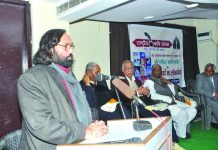
“Are you a Bengali from Kolkata and West Bengal? Or are you a Bengali living away from Bengal, a permanent resident of Delhi’s Chittaranjan Park?” These are questions Swapan Dasgupta, the Finance Minister, still has to answer. He was asked the same questions during the election as well.
His usual response is that his family home has been in Kolkata since 1930 and that his family roots are firmly connected to this city. At the same time, there is no doubt that after living in Delhi for many years, he has developed a deep sense of belonging to Delhi and has become closely connected with the city in every possible way.
When Swapan Dasgupta came to Chittaranjan Bhavan and spoke before members of the Bengali expatriate civil society, he said, “Since March, I have never stayed in Delhi for more than two nights at a stretch.”
One thing, however, came through very clearly in his speech: he is thinking deeply about the economic future of Bengal. It is undeniable that Bengal has gone through an economic decline over the last 50 years. In Swapan Babu’s words, it has been a “mode of depression”. And because of this, questions have repeatedly been raised about Bengal’s relevance.
Is West Bengal gradually moving outside the Indian economic map? Will no major industrial project come to West Bengal? In short, is Bengal, or West Bengal, becoming disconnected from what is considered the national mainstream?
It was on this issue that Swapan Babu presented his views. He spoke in simple, fluent language, mixing Bengali and English, although Bengali dominated his speech. He acknowledged that after coming to Kolkata to do politics and contest elections, and now even after becoming the Finance Minister, he has seen a great deal of development in Bengal. (It is worth remembering that he delivered this year’s Budget speech in Bengali as well. Many of his friends have even joked that perhaps Swapan has never spoken this much Bengali in his entire life.) Anyway, let us leave the humour aside.
Swapan Babu recalled that during the election, when he used to visit Rajbihari, an affluent Bengali neighbourhood, his wife Reshmi would tell him about the elderly people who stood on their balconies, folded their hands and greeted him. They would bless him from their balconies because many of them could not come downstairs, especially in apartment buildings. Reshmi had given these elderly residents a name: the “balcony people”.
While speaking to these “balcony people”, Swapan Babu realised that their children had moved away. Some were working in Noida, some in Gurgaon, some in Bengaluru, some in Hyderabad, and many had gone abroad for work. These younger generations were no longer living with their parents. Grandparents were speaking to their grandchildren over video calls.
A huge generation has moved out of Bengal because they did not find adequate opportunities here. Swapan Babu pointed out that many people even say that Kolkata has become a very good “old-age home”. If that is the case, then a productive population has left Bengal.
The truth is that Bengalis are talented. Do Bengalis not possess national-level talent and skills? The same Bengalis are going to other states and countries and achieving tremendous success.
Therefore, Swapan Babu said that the biggest challenge is to bring back those talented Bengalis who have moved away. Somehow, they have to be brought back. But they cannot be brought back simply through words. West Bengal has to be turned into an alternative and suitable place for employment, business and the use of their skills and abilities.
The second major challenge Swapan Babu spoke about is equally serious. A negative perception about Bengalis has developed across the country. There is a perception that a Bengali means agitation, a Bengali means syndicate, a Bengali means “nahi chalega”. The departure of the Tatas from Singur and the Nano factory moving to Gujarat have had a deeply negative impact. Swapan Babu said that the extent of this impact is now becoming clear. Whenever he speaks to businesspeople, they tell him, “If even the Tatas could not do it, what are we supposed to do?”
This has created a negative perception. Bengal and Bengalis have to come out of this negative image as well. Bengal should not remain merely a place of nostalgia and memories of the past. That, perhaps, should no longer be the case.
Swapan Babu says Kolkata cannot remain merely a city of memories. Many of you sitting here in Chittaranjan Park have spent time in Kolkata and have seen how things have changed. If the Bengali mindset is to be changed, people cannot simply say that they will not work or that they do not want to work. The work culture has to be brought back. A proper work culture and a healthy work environment have to be restored.
According to Swapan Babu, this brings us to another important issue related to industrialisation in West Bengal: the problem of land. Land acquisition is extremely difficult because land reforms have made landholdings highly fragmented. Land has been divided into very small plots, and this fragmented land is not transferable. As a result, land can effectively be used only for cultivation, and it becomes difficult to use it for anything else.
There had been talk of creating a land bank, but there were objections to the idea because it was seen as being against the interests of farmers. Therefore, a mechanism has to be created to resolve the conflict between agriculture and industry.
West Bengal also has less capital. And this is not only about start-ups; it applies to almost every business sector.
As a result, what we are seeing is that several large business families are moving away from Kolkata towards places such as Mumbai. Their younger generations are leaving traditional family businesses and moving into larger businesses elsewhere. Meanwhile, some people continue to believe that setting up an industry in Kolkata, painting a picture or pursuing other forms of business is somehow a bad thing.
Bengalis have to come out of this mindset. There has to be a sense of corporate management and an understanding of the realities of running a modern business. This is also necessary for Bengalis.
There is another mindset among Bengalis that, as I understand it, has developed over the years. Many people repeatedly say, “Nothing will happen to Bengalis.” I hope nobody interprets this as a sexist comment. After years of seeing so many things happen around them, many women also end up saying the same thing: “Nothing will happen to Bengalis.”
We have to move away from this kind of thinking and towards greater civic consciousness. Civic awareness is extremely important. The issue of citizens walking on the roads is not merely a matter concerning hawkers. A change in mindset is necessary in every aspect.
We are beginning a journey with a debt burden running into lakhs and crores of rupees. Civic consciousness has to accompany this journey. If civic awareness improves and, for instance, only 25 per cent of the revenue comes from people paying taxes, then should we simply say that Bengalis should pay more taxes? If increasing tax collection helps raise revenue, it can also create the necessary safeguards.
Singur has become a curse. That episode has caused tremendous mental and other kinds of damage to many people. The place has effectively become a symbol of the controversy and everything that went wrong there. The issue of land acquisition, the protection of farmers and all these questions are interconnected. Therefore, changing the industrial mindset among Bengalis cannot be achieved merely by passing a law. It is a long-term process.
There has to be peace and stability. The environment must be freed from what is perceived as “jungle raj” and syndicate politics. At the same time, another thing needs to happen: an environment conducive to industry has to be created in such a way that Bengalis themselves develop a sense of pride in industrialisation.
Every Bengali can become an ambassador for Bengal.
Speaking to the people of Chittaranjan Park in Delhi, and to Bengalis in both Kolkata and Delhi, Swapan Babu has, in a way, revealed several important and perhaps lesser-known aspects of the problem. This is not merely about politics; it is about Bengal’s economic future.
After the Tatas left Singur, West Bengal needs an iconic industrial project to come back. Such a project would have a major impact. After 50 years, a new BJP government has come to power, and there is an effort to create such an impact and to bring back industrial investment.
There has also been an effort to bring the Tatas back, or at least to encourage them to return, and several things have already progressed in that direction. These are all developments, but Swapan Babu does not want to reduce the issue to a single industrial project.
What Swapan Babu is trying to convey is that he wants to rise above party politics and take Bengalis towards a path of industrialisation and development. That, ultimately, is the larger commitment he is making.