Maharashtra transport minister Pratap Sarnaik on Tuesday criticised his own government over the denial of permission for a Marathi rally on Mira Road and joined the protest, also daring the police to arrest him, according to reports
“The Marathi Ekikaran Samiti and several other organisations had applied for the rally, but were denied permission. I am going—if the police dare, let them arrest me,” Sarnaik was quoted as saying
Sarnaik was, however, forcefully driven away by the agitated Thackeray loyalists, calling him a “traitor”. Notably, the Maharashtra minister had broken ranks with his government to reach the MNS protest site.
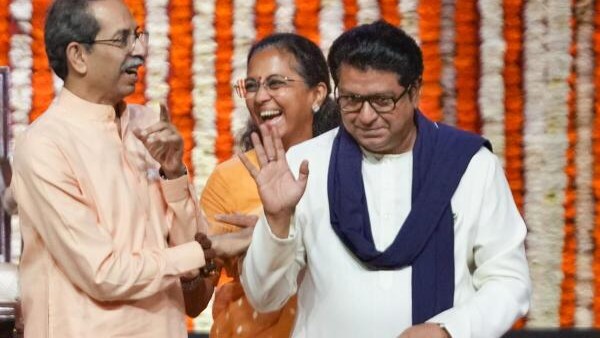
MNS supremo Raj Thackeray and estranged cousin Uddhav Thackeray (Shiv Sena UBT) recently reunited after 20 years at a public rally in Worli, Mumbai, for an event called ‘Awaj Marathicha’—the Voice of the Marathi.
The event had been jointly organised by Shiv Sena (UBT) and MNS to mark the withdrawal of government resolutions related to the three-language policy in primary schools.
The Marathi issue has already become a major political issue, giving jitters to the ruling BJP-Shiv Sena-NCP Mahayuti as also Uddhav’s supporter Congress.
Language an emotive issue
Language is often a strong marker of identity and any perceived threat can trigger strong emotional responses, thereby making it a great political tool
After Tamil and Kannada, Marathi is at the centre-stage, one of the reasons could be the upcoming local bodies elections
Due to its close connection with identity and the cultural heritage in Maharashtra, Marathi is an emotive issue. Historical and political factors, including debates over language policy and the place of Marathi in education and public life, have only added.
But this is not the first time language has been a source of discontent
Earlier it was Tamil with Tamil Nadu Chief Minister MK Stalin objecting to the implementation of the National Education Policy (NEP) 2020. A section of the policy recommends that students learn three languages.
Stalin cited a number of reasons for not implementing the NEP, including that the three-language policy will lead to the imposition of Hindi
Then has also been this long-standing Karnataka-Maharashtra border dispute escalated by language issue.
Recently, tensions between Karnataka and Maharashtra escalated after a Karnataka state transport bus conductor in Belagavi was assaulted for not responding in Marathi. This resulted in Maharashtra bus driver’s being blackened in Karnataka’s Chitradurga.