As residents in parts of the Valley mobilise donations for people affected by the ongoing conflict in Iran, historians say the response is also rooted in centuries of cultural, religious and intellectual connections between Kashmir and the Persian world.
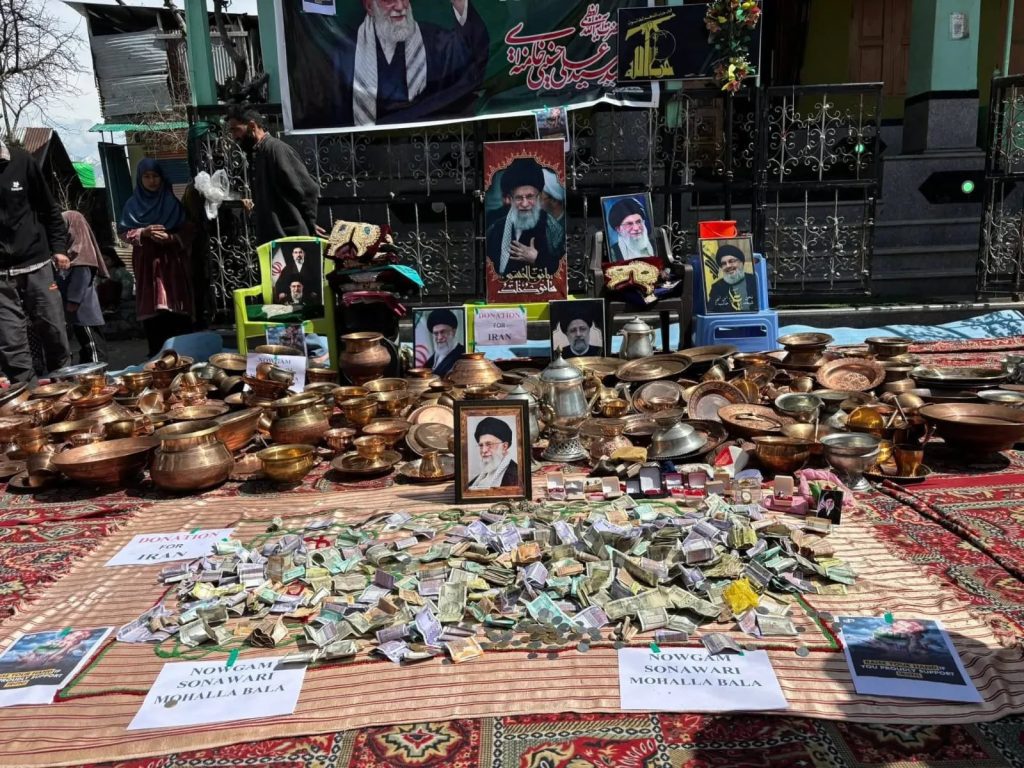
In recent days, residents in districts such as Budgam and Baramulla have organised door-to-door campaigns to collect cash, gold, silver jewellery, livestock and traditional copper utensils as humanitarian aid for those affected by military strikes in Iran.
The Embassy of Iran in India acknowledged the effort publicly, sharing images and messages of gratitude on social media.
“With hearts full of gratitude, we sincerely thank the kind people of Kashmir for standing with the people of Iran through their humanitarian support and heartfelt solidarity; this kindness will never be forgotten. Thank you, India,” the embassy wrote.
According to reports, the campaign drew participation from all sections of society, including men, women and children. Many women donated personal jewellery and household valuables, reflecting the emotional resonance of the appeal.
“A respected sister from Kashmir donated the gold kept as a memento of her husband, who passed away 28 years ago, with a heart full of love and solidarity for the people of Iran. Your tears and pure emotions are the greatest source of comfort for the people of Iran and will never be forgotten,” another embassy message said.
Children also contributed their savings and Eid money, while local political representatives joined the effort. Budgam MLA Muntazir Mehdi pledged one month’s salary toward relief efforts.
The donations began shortly after the Iranian embassy shared bank account details to facilitate humanitarian contributions. Officials indicated the relief would be routed through formal channels to reach affected communities.
While the current humanitarian response is tied to the present crisis, scholars argue it also reflects a much deeper historical connection between Kashmir and Iran that dates back centuries.
Geographically, Kashmir historically sat at a crossroads linking Central Asia, Persia and the Indian subcontinent through trade and scholarly networks. Long before the arrival of Islam, cultural influences from the Persian civilizational sphere travelled through these routes, bringing artistic traditions, ideas and administrative practices.
Historian Prof. M. Ashraf Wani notes that these interactions left early imprints on Kashmiri society.
“From the double burial tradition to the Zoroastrian traditions, Kashmir has historically remained hugely impacted by Iran,” he observed, adding that even early political consolidation in the region may have been influenced by contacts with the ancient Persian world.
These connections deepened significantly during the medieval period, particularly through the spread of Islam via Sufi networks rather than maritime trade, as seen in other parts of India.
Among the most influential figures were the Persian Sufi saints Mir Sayyid Ali Hamadani, popularly known as Amir-i-Kabir, and Bulbul Shah, whose missions helped shape Kashmir’s religious and social landscape. Later, Mir Shams-ud-Din Araqi played a key role in strengthening Shia traditions in parts of the Valley.
Persian gradually became the language of administration, scholarship and literature in Kashmir, particularly during the rule of the Shahmiri dynasty and later under the Mughal Empire. Over time, it replaced Sanskrit in official use and shaped Kashmir’s literary culture for centuries.
Architectural influences also followed. Landmarks such as the Khanqah-e-Moula and the Jamia Masjid Srinagar display clear Persian design elements, including courtyard planning and spatial concepts derived from Iranian traditions.
The exchange was not limited to religion and architecture. Trade also reinforced the relationship. Kashmiri shawls were highly valued in Iranian courts, where they symbolised prestige and political authority. Historical accounts suggest hundreds of Iranian traders were present in Srinagar during the 19th century to procure the prized textiles.
Even in modern times, educational links have continued the connection. Iranian universities, particularly medical institutions, have attracted large numbers of Kashmiri students due to relatively affordable tuition and cultural familiarity.
Recent tensions in the region have again brought these ties into focus, with families of Kashmiri students in Iran closely monitoring the security situation.
The recent donation drives, therefore, are being seen not merely as acts of charity but as expressions of a long-standing civilizational connection.