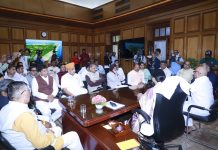

Punjab’s 2027 Assembly election has already acquired an unusual Rajasthan connection. Two of India’s principal national parties have entrusted their Punjab campaigns to leaders from the neighbouring desert state—Congress has brought in Sachin Pilot, while the BJP has handed charge to Satish Poonia.
The choice may be geographically curious, but politically it is revealing. Both parties appear to believe that their Punjab problems require outsiders who can look at entrenched factional battles without being consumed by them. That, however, may be easier said than done.
Pilot has been appointed General Secretary in-charge of Punjab Congress after Bhupesh Baghel’s tenure became increasingly contentious. The appearance of “Go Back Baghel” posters at party programmes was a visible sign of the resistance he encountered. Baghel has now been shifted to Assam, leaving Pilot to inherit a state unit already weakened by internal distrust and competing ambitions.
The BJP, meanwhile, had brought in Poonia earlier as its Punjab in-charge after elevating him to the post of National General Secretary. His credentials are built largely on organisation and electoral management. As Haryana in-charge, Poonia was credited with helping the BJP overcome considerable odds in the 2024 Assembly election, when the party secured 48 of the state’s 90 seats despite the political headwinds created by a decade in power and a disappointing Lok Sabha performance.
The lesson from Haryana was straightforward: disciplined organisation, careful candidate selection, booth-level mobilisation and relentless campaign management can rescue a party that appears vulnerable. Punjab, though, is another political animal.
Pilot’s political appeal lies elsewhere. Younger than many of the Congress leaders he has been asked to manage, articulate and comfortable with contemporary communication platforms, he has experience across several levels of government and the party organisation. He has served as a Union minister, Rajasthan Congress president, Deputy Chief Minister and AICC General Secretary in-charge of Chhattisgarh.
But perhaps his most relevant qualification for Punjab is not listed on a conventional political résumé. Pilot knows factional warfare.
His long-running political confrontation with former Rajasthan Chief Minister Ashok Gehlot exposed him to the destructive possibilities of internal rivalry. He has experienced first-hand how personal ambitions, competing camps and leadership battles can consume a political organisation even when an election is approaching. In Punjab, he may find a familiar illness in a different patient.
The Congress’s immediate headache revolves around state president Amarinder Singh Raja Warring. Within the party, there have been competing demands over his continuation, with senior leaders including Charanjit Singh Channi and Sukhjinder Singh Randhawa among those who have opposed retaining him. Baghel, instead of resolving the dispute, was accused by sections of the party of becoming aligned with Warring.
Pilot therefore arrives not merely as an election strategist but as an internal referee. His first challenge will be to persuade Punjab Congress leaders that the 2027 election cannot be fought as a collection of personal campaigns. The party has no shortage of recognisable faces. Its problem is that too many of those faces appear to be looking in different directions.
Every faction seems to have its own calculation, its own constituency and, eventually, its own claimant to the top chair. Pilot’s real test will be whether he can convert this abundance of leadership into a functioning election machine.
The BJP’s internal troubles are of a different nature, but they lead to the same destination. The appointment of Kewal Singh Dhillon as Punjab BJP president, followed by organisational changes, triggered discontent among sections of the old cadre. Resignations and open criticism exposed a familiar complaint: that long-serving BJP workers were being sidelined while a new political culture was taking root.
The irony was difficult to miss. A party that has traditionally prided itself on cadre discipline was suddenly being accused by its own workers of behaving like the Congress.
For Poonia, therefore, the challenge is not simply to expand the BJP’s vote. It is first to rebuild confidence within the organisation. And here the contrast between the two parties becomes important.
The Congress enters the race with something the BJP still lacks in Punjab: a broad social and geographical footprint. It has organisational memories stretching across rural and urban Punjab, experienced politicians and established connections with multiple communities. Its weakness is fragmentation.
The BJP possesses almost the reverse combination. Its national organisation is formidable, its cadre remains committed and its urban support base is significant. The Narendra Modi factor gives it a national political identity that few other parties can match.
But Punjab cannot be won from Delhi or Chandigarh alone. The BJP’s rural presence remains limited. The wounds left by the farm-law confrontation have not completely disappeared, and the party continues to face a shortage of credible Sikh faces with enough political weight to carry its message into rural Punjab.
Announcing an intention to contest all 117 Assembly seats is one thing. Finding 117 candidates capable of fighting credible political battles is quite another. That is why alliances or understandings with credible Panthic forces could become strategically significant. Such a relationship could potentially give the BJP greater access to rural constituencies while helping it overcome some of the emotional and political distance that still exists between the party and sections of Sikh society.
Poonia’s Haryana experience can provide a blueprint—but not a script. Punjab has its own political vocabulary. Farmers, religious institutions, unemployment, drugs, migration, indebtedness, industrial decline and the future of agriculture carry emotional weight that cannot be addressed through organisational arithmetic alone.
The BJP will have to rediscover Punjab at the village level. That means spending time with farmers, rebuilding relationships with old workers, engaging village institutions and finding local leaders who understand the state’s social and religious sensitivities. Rural distrust cannot be erased through press conferences in Chandigarh.
Then comes the common adversary: the Aam Aadmi Party. The Bhagwant Mann government remains in a strong position, aided by a welfare politics that supporters describe as social protection and opponents dismiss as freebies. Recent opinion polling has also continued to place Mann ahead of his principal rivals as the preferred choice for Chief Minister.
That does not mean the AAP government is invulnerable. Drugs, law and order, employment, governance and the wider economic condition of Punjab offer the Opposition plenty of ammunition. But ammunition is not the same as an electoral weapon.
Neither Congress nor BJP can assume that public dissatisfaction with AAP will automatically translate into votes for them. They will have to build a sustained political narrative around these issues, take them into villages and towns, keep them alive between election cycles and convince voters that they have credible answers rather than merely sharper criticism.
This is where Pilot and Poonia face their biggest common challenge. Before either Rajasthan leader can defeat AAP, each must defeat the enemy within. For Pilot, that means persuading Congress leaders to subordinate factional ambitions to a common electoral strategy. For Poonia, it means convincing the BJP’s old guard that expansion does not have to come at the cost of those who built the organisation.
Punjab has seen outsiders arrive with ambitious plans before. It has also seen political parties collapse under the weight of their own internal contradictions. The 2027 contest may ultimately be decided not by who attacks AAP most aggressively, but by who manages to put their own house in order first.
Two Rajasthanis have been handed the keys to two troubled Punjab organisations. Their first job is not to open the door to power. It is to stop the house from fighting itself.