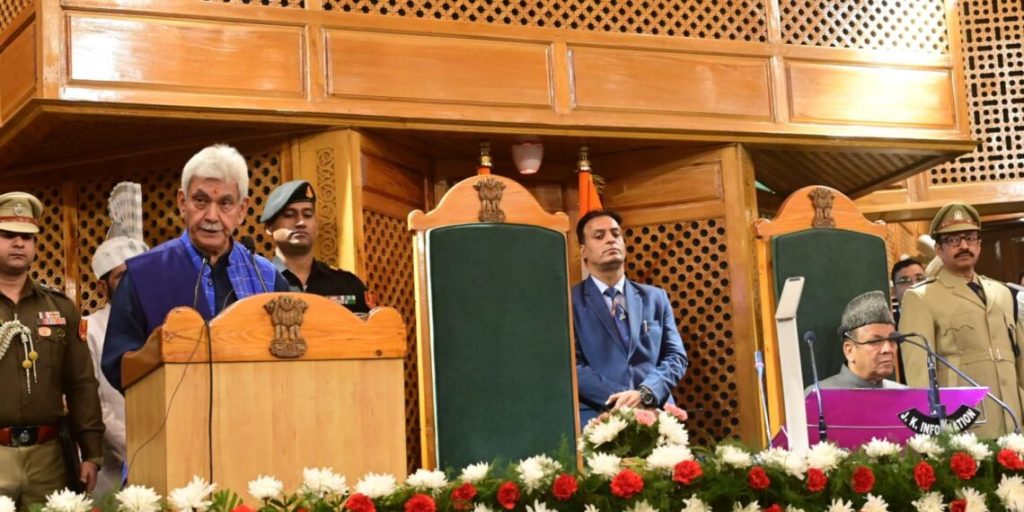
The absence of a single word, ‘statehood’ from Lieutenant Governor Manoj Sinha’s recent address to the Jammu and Kashmir Assembly reignited one of the most emotive political questions in the Union Territory. It is now more than six years after the revocation of Article 370 that granted J&K its special constitutional status, and the region was downgraded from a state.
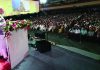
Sinha’s speech, delivered at the start of the budget session, projected optimism and institutional normalcy, describing the past year as a “significant milestone in the democratic journey of Jammu and Kashmir with the formation of an elected government after a gap of several years”. But for opposition parties and even for the ruling National Conference (NC), the address symbolised a deeper contradiction: an elected Assembly functioning without the constitutional status that gives it full authority.
What stood out was the omission of any reference to the restoration of statehood, a commitment repeatedly articulated by the Centre since August 2019 and reiterated by Prime Minister Narendra Modi and Home Minister Amit Shah on multiple occasions.
Opposition parties were quick to point out that the Lieutenant Governor’s address is not merely ceremonial but vetted by the elected government and functions as a vision document for the year ahead. The silence on statehood, therefore, was interpreted not as an oversight but as a political signal.
“The LG address omits statehood. The vision document is drafted and vetted by our elected J&K government,” PDP legislator Waheed Para said on X.
The criticism came even as key ministers in Chief Minister Omar Abdullah’s government publicly questioned the Centre’s commitment to Jammu and Kashmir, particularly on funding and employment. Education minister Sakina Itoo said allocations in the Union budget were insufficient to meet urgent needs, highlighting rising unemployment in the region, now the second highest in the country. She warned that the lack of jobs was pushing young people towards drug abuse.
Deputy Chief Minister Surinder Choudhary echoed the concern, citing the blow to tourism after the Pahalgam terror attack, the impact of repeated calamities, and economic stress across sectors. He called for a “very big package” from the Centre to stabilise the Union Territory’s economy.
Against this backdrop, Sinha’s speech leaned heavily on growth metrics and institutional claims. He said Jammu and Kashmir had recorded “an annual nominal growth rate of around 11 per cent (2024-25)”, adding that the Union Territory had emerged as “one of the fastest-growing states/ UTs”. The economy, he argued, was benefiting from policy reforms, infrastructure development and investment facilitation.
“This transition to popular governance has strengthened public faith in democratic institutions,” the LG said. “My government has focused on restoring participatory governance, rebuilding public confidence, and ensuring that the voice of every region and community finds expression in policy-making.”
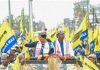
Yet for many legislators, the language of participation rang hollow without the restoration of constitutional status. NC MLAs staged a dharna outside the Assembly complex, carrying placards reading “Restore Statehood and Constitutional guarantees” and “Stop harassing Kashmiris outside J&K”.
“This was promised to us… It is now time to restore it,” NC MLA Tanvir Sadiq told reporters, adding that all party members were participating in the protest.
The demonstration highlighted a rare moment where the ruling party found itself publicly aligned with opposition demands — a reflection of the political bind facing the Omar Abdullah government. While in office, it must function within the limits of Union Territory status, yet its core constituency continues to demand the reversal of that very framework.
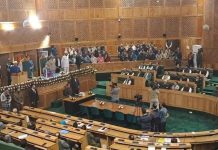
Inside the House, however, institutional constraints became starkly visible. Assembly Speaker Abdul Rahim Rather rejected an amendment moved by Peoples Conference president Sajad Gani Lone on Article 370, Article 35A, statehood and rationalisation of reservation. He also disallowed an adjournment motion by Waheed Para on the alleged harassment of Kashmiris outside the Union Territory.
“The issue of Statehood is out of purview of this Government. Only those issues can be taken up on which the Government can give a reply,” Rather said, citing Assembly rules.
Lone challenged the ruling, arguing that he was not seeking legislation but merely expressing intent. The Speaker, however, maintained that matters already decided or beyond the Assembly’s competence could not be debated.
The episode laid bare the paradox of Jammu and Kashmir’s current political arrangement: an elected Assembly with limited authority, operating under a constitutional structure that explicitly restricts its scope on the most politically consequential question confronting the region.
Congress leader and Jammu and Kashmir Pradesh Congress Committee president Tariq Hameed Karra said his party harboured no illusions about the present dispensation’s ability to deliver statehood but would continue its agitation regardless.
“We do not have any hope from this government—whether it is about statehood or any other issue—but that does not mean we will remain silent. Our silence should not be mistaken for weakness,” Karra told reporters outside the Assembly complex.
He pointed to sustained street-level mobilisation, including marches from Srinagar to Delhi, arguing that pressure from within and outside the Assembly was necessary to keep the issue alive. Even the NC’s protest, he said, was a welcome acknowledgment of public sentiment.
Karra also questioned the Centre’s repeated assertions of normalcy, particularly in light of ongoing security operations. “It is unclear on what basis the Centre is claiming that everything is under control. For the past 13 days, an encounter has been going on and security forces have not been able to conclude it,” he said, adding that continuous encounters across districts contradicted claims of stability.
Referring to post-2019 assurances, Karra said public trust depends on governments honouring their commitments. “We were told that terrorism would be eliminated after 2019 and even claims were made that rivers of milk and honey would flow,” he said. “Today, Jammu and Kashmir is in a situation where even 12-day-long encounters are not being brought under control.”
Beyond party politics, the prolonged delay in restoring statehood has become a symbolic marker of uncertainty for ordinary residents. For many, it represents not just administrative status but dignity, political agency and a sense of closure after years of upheaval.
The Centre has repeatedly stated that statehood will be restored “at an appropriate time”, often linking it to improvements in the security situation and the completion of delimitation and elections — benchmarks that have largely been met. Yet no timeline has been offered, reinforcing scepticism across the political spectrum.
In this context, the budget session has functioned less as a forum for fiscal planning and more as a referendum on unfinished promises. The LG’s emphasis on growth figures and democratic milestones has failed to bridge the trust deficit created by prolonged silence on statehood, even as economic distress, unemployment and security anxieties persist.
This has led to Jammu and Kashmir’s elected representatives finding themselves trapped in a paradox: entrusted with governance but denied the authority that, for decades, defined it.