The return of Arvind Khanna to the Shiromani Akali Dal (SAD) is more than a routine party switch. In Punjab’s fluid political landscape, such movements often signal deeper undercurrents — ideological repositioning, cadre dissatisfaction, and early groundwork for future electoral battles.
Khanna’s political journey itself mirrors Punjab’s shifting alliances. A former Congress MLA from Dhuri and later vice-president of the Punjab unit of the Bharatiya Janata Party (BJP), he had contested recent elections from Sangrur but failed to convert candidature into victory. His return to the Akali fold — which he calls a “homecoming” — suggests both strategic recalibration and recognition of political realities on the ground.
A two-time legislator and close relative of former Punjab Chief Minister Captain Amarinder Singh, Khanna had earlier stepped away from active politics in 2014 and resigned from the Congress in 2015. He was elected as an MLA from the Dhuri constituency in the 2012 Punjab Assembly elections. Khanna had joined the BJP in 2022 and was later appointed vice-president of the party’s Punjab unit.
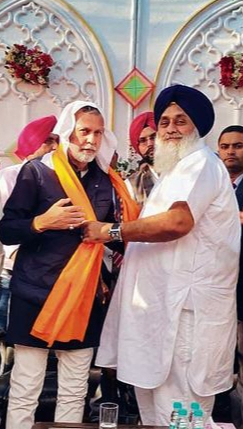
Sources indicated that Khanna had been dissatisfied with sections of the state BJP leadership for the past few months and was in touch with the SAD. His move is being seen as a boost for the Akali Dal in the politically significant Sangrur district — the home turf of Punjab Chief Minister Bhagwant Mann. Welcoming him into the fold, SAD president Sukhbir Singh Badal announced Khanna’s appointment as halqa incharge of the constituency. “The storm which will throw out Delhi parties from Punjab has started today,” Badal declared, praising Khanna as a leader known for selfless service and dedication to the people of Sangrur.
Addressing party workers, Khanna described his return to the Akali Dal as a “homecoming,” recalling that he began his political journey with the party. He said the people of Punjab still remember the “unprecedented development” carried out during successive Akali governments and are eager to see a return to those days. Khanna’s switch marks another key shift in Punjab’s evolving political landscape ahead of upcoming electoral battles.
Why This Move Matters
Sangrur is not just another district — it is the home turf of Chief Minister Bhagwant Mann. For SAD, which has struggled to regain its traditional rural Sikh vote base after the farm laws controversy, Khanna’s entry provides organisational muscle and financial heft in a politically sensitive zone. His local network and long-standing presence could help the Akalis re-energise cadre morale.
The BJP has been attempting to expand independently in Punjab after its split with SAD in 2020. However, despite aggressive outreach, it has yet to build a robust grassroots structure capable of delivering seats consistently. Khanna’s exit — especially as a state-level office-bearer — subtly underscores internal dissatisfaction and the party’s ongoing structural challenges in rural constituencies.
Under the leadership of Sukhbir Singh Badal, SAD is attempting a calibrated revival. By inducting leaders with electoral experience and cross-party appeal, the party appears to be rebuilding its second-rung leadership. The symbolism of Khanna joining with his entire team amplifies the optics of momentum — something SAD has been keen to project after recent electoral setbacks.
Party-switching in Punjab politics is rarely driven purely by ideology. Khanna’s shift appears rooted in political viability and local equations rather than sharp ideological divergence. His electoral defeats on the BJP ticket may have reinforced the limits of the party’s standalone prospects in certain constituencies.
For SAD, however, this is an opportunity to reclaim narrative space — particularly the argument that “Delhi parties” lack deep Punjab roots. Sukhbir Badal’s remark about a “storm” against Delhi-based parties aligns with this framing, positioning SAD as the regional alternative.
Khanna’s move may not shift vote shares overnight, but it strengthens SAD’s organisational depth in a high-profile district. More importantly, it signals that realignments are already underway well before the next major electoral contest.
In Punjab, such early tremors often precede larger political shifts.