PM Modi’s Japan visit advanced India’s strategic and economic agenda. With tangible outcomes in defence, technology, and industrial cooperation, the partnership is set to play a central role in shaping a secure and prosperous Indo-Pacific
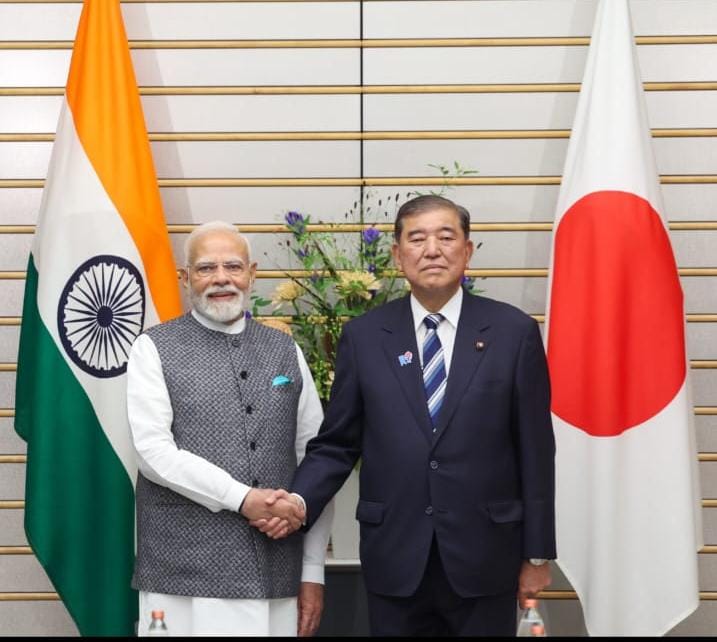
apan on Friday set an investment target of 10 trillion yen in India over a decade and the two sides firmed up a mega roadmap to boost cooperation in several key areas—critical minerals, defence and technology. Coming amid economic turbulence by US President Donald Trump administration’s policies on trade and tariffs, the announcements on expanding India-Japan special strategic and global partnership following summit talks between Prime Minister Narendra Modi and his Japanese counterpart Shigeru Ishiba are significant
“We have set a target of 10 trillion-yen investment in India from Japan in the next 10 years,” PM Modi, flanked by Ishiba, said in his media statement. PM Modi said the India-Japan cooperation is crucial for global peace and stability, and both sides have laid a strong foundation for a “new and golden chapter” in the partnership. “We have formulate a roadmap for the future with a focus on areas such as investment, technology, healthcare, mobility, human-to-human interactions, and partnerships between states and prefectures,” he wrote on X
Tangible outcomes
PM Modi’s recent visit to Japan has boosted India-Japan relations with the two nations deepening both strategic and economic cooperation through a wide-ranging set of agreements and initiatives.
At the heart of the visit was the adoption of a Joint Declaration on Security Cooperation, reaffirming the importance of the India-Japan Special Strategic and Global Partnership, built on shared democratic values and mutual trust.
The declaration emphasises collective action for a free, open and rules-based Indo-Pacific, while laying the groundwork for deeper collaboration in defence, maritime security, advanced technologies, and multilateral forums, according to a PMO statement.
The visit also marked a milestone in economic security cooperation, with both governments committing to build resilient supply chains, safeguard strategic sectors, and promote innovation through public-private partnerships.
The two sides agreed to conduct more complex joint military exercises, enhance logistics interoperability, and collaborate on cybersecurity, counter-terrorism, and tri-service humanitarian operations. India will benefit from access to Japan’s advanced defence logistics and joint research opportunities with agencies like Japan’s ATLA and India’s DRDO, it added Maritime cooperation also received a push with commitments for coast guard coordination, shared maritime awareness, and joint action on piracy and regional disaster resilience — bolstering India’s Indo-Pacific strategy.
Economic Security
One of the key highlights was the India-Japan Dialogue on Economic Security, which included strategic trade and technology talks. Both countries agreed to strengthen cooperation in critical sectors such as semiconductors, critical minerals, pharmaceuticals, clean energy, and ICT.
Notably, Japan’s Renesas Electronics partnered with CG Power to establish a semiconductor assembly facility in Gujarat, while also signing MoUs with IIT Hyderabad and CDAC to support India’s Make in India and Chips to Startup initiatives. Another key partnership involves Tokyo Electron and Tata Electronics, aimed at building a robust semiconductor ecosystem in India.
India and Japan signed a Joint Declaration on Clean Hydrogen and Ammonia, alongside initiatives in biofuels, battery supply chains, and renewable energy. A standout deal includes a bamboo-based bioethanol project in Assam, backed by a ¥60 billion loan from Japan’s JBIC.
In the critical minerals sector, India and Japan advanced cooperation through bilateral agreements and the Quad’s critical minerals initiative. A joint rare earth project in Andhra Pradesh aims to stabilize essential material supply chains.
The two countries declared 2025 the Year of Science, Technology and Innovation Exchanges, with expanded cooperation in AI, quantum technologies, digital infrastructure, and V2X transport systems. Indian students and researchers will also benefit from Japanese-funded fellowships and internships.
An MoU between NTT Data, Neysa Networks, and the Telangana government will establish a massive AI data center cluster in Hyderabad, with Rs10,500 crore in investment.