
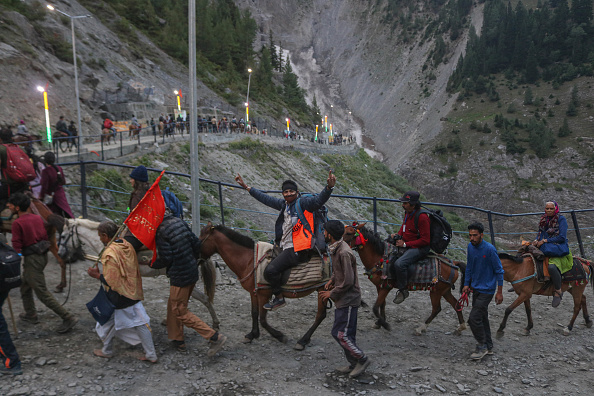
Srinagar: The annual Amarnath Yatra continues to witness a strong turnout, with over 1.28 lakh pilgrims having completed the pilgrimage in the past week. On Thursday, a fresh batch of 7,307 devotees departed from Jammu to join the Yatra in the Kashmir Valley.
According to officials, the pilgrims left from the Bhagwati Nagar Yatri Niwas in two separate, security-escorted convoys. The first convoy, comprising 137 vehicles and carrying 3,081 pilgrims, departed at 3:15 a.m. for the Baltal base camp. The second convoy, consisting of 147 vehicles with 4,226 pilgrims, left at 3:58 a.m. for the Nunwan base camp in Pahalgam.
The Shri Amarnathji Shrine Board (SASB) reported that, apart from those traveling via Jammu, a significant number of pilgrims are heading directly to the Baltal and Nunwan base camps for on-the-spot registration.
The India Meteorological Department has forecast rainfall across Jammu and Kashmir over the next 12 hours, with isolated spells of heavy showers and thunderstorms likely, particularly in parts of the Jammu region.
This year’s Yatra is being held under heightened security in the aftermath of the April 22 terror attack in Pahalgam’s Baisaran area. In response, security has been stepped up across the pilgrimage route, with the deployment of 180 additional companies of Central Armed Police Forces (CAPFs) alongside the Army, BSF, CRPF, SSB, and local police. Transit camps and roads leading to the cave shrine are under strict surveillance.
Local residents have extended their traditional hospitality to the pilgrims. On July 6, several people from Srinagar travelled to Nuner village, about 30 kilometres away, to offer cold drinks and water to returning Yatris, a gesture warmly received by the devotees.
The Yatra began on July 3 and will conclude on August 9, coinciding with Shravan Purnima and Raksha Bandhan. The holy cave shrine, situated at an altitude of 3,888 metres in the Himalayas, is accessible via two routes. The 46-kilometre traditional route from Pahalgam takes about four days on foot, while the shorter 14-kilometre Baltal route allows pilgrims to return the same day.