
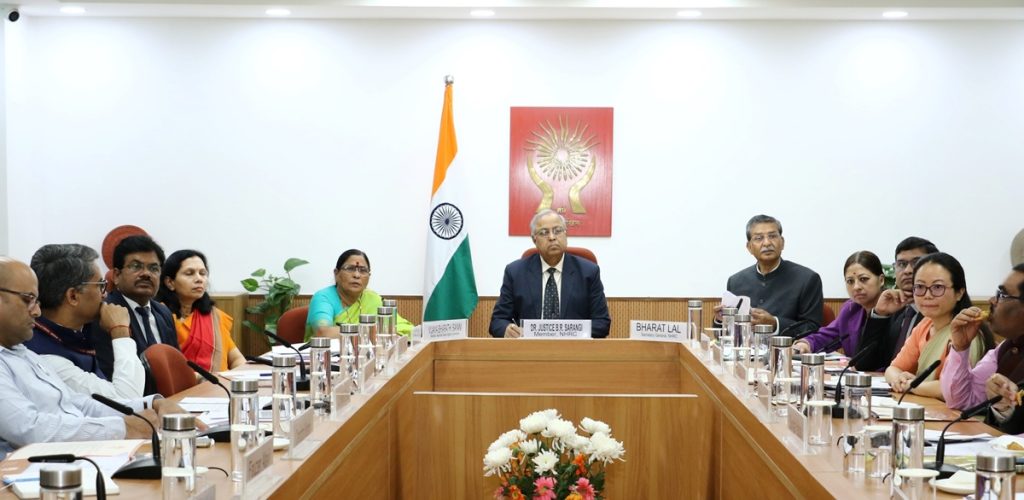
The National Human Rights Commission (NHRC), India today organised an open house discussion in hybrid mode on ‘Rethinking Beggary: Bridging Gaps between Policy, Practice and Dignity.’
Justice Sarangi said that begging is a social evil and continues to remain a serious social concern in the country. He remarked that the persistence of begging, even in a nation that is today among the world’s largest economies, reflects a deeper structural and social challenge that requires urgent and sustained attention. He described begging not merely an economic issue but a social malady that affects the dignity and constitutional rights of vulnerable sections of society.
He emphasised that the Constitutional promise of the Right to Equality before law under Article 14 must be meaningfully realised for all citizens, including those engaged in begging. He said that every individual is entitled to live a safe, secure and dignified life. He noted that several states have enacted legislation addressing begging. However, mere existence of legal provisions is insufficient unless there is an assessment of the actual outcome of such legislations, particularly in terms of rehabilitation, reintegration and measurable improvements on the ground.
Justice Sarangi stressed the need to examine whether the intended objectives of the NHRC Advisory (2024) concerning the protection and rehabilitation of impoverished, uneducated children, women and differently-abled persons engaged in begging and SMILE-B Scheme (Support for Marginalised Individuals for Livelihood and Enterprise) of the Government of India have translated into meaningful change. He emphasised review of the progress of these measures and identifying gaps in execution. He said that reducing and eventually eliminating begging requires a rights-based, rehabilitation-oriented strategy grounded in constitutional values of equality, dignity and social protection.
NHRC, India Member, Vijaya Bharathi Sayani emphasised the urgent need for a coordinated national strategy with clear timelines and accountability mechanisms to address issues related to women, children and labour in the context of beggary. She stressed the importance of developing a national portal and conducting a comprehensive data survey, stating that without reliable data, effective policymaking is not possible. She also called for strict action against beggary mafias and trafficking networks and underlined that long-term rehabilitation must be prioritised over short-term, temporary measures.
In his address, NHRC, India Secretary General, Bharat Lal emphasised that India is known for its strong legal framework and constitutional values, which provide a robust foundation for ensuring dignity and rights for all citizens. However, he underlined that government officials alone cannot achieve this objective and they must work in close collaboration with NGOs and civil society organisations. He further observed that while the government often operates through sectoral programmes, there is a need to adopt a bottom-up approach – addressing issues one sector at a time while keeping the larger objective of social inclusion in focus.
Yogita Swaroop, Senior Economic Advisor, Ministry of Social Justice and Empowerment highlighted the 2011 Census data on persons engaged in begging and outlined key initiatives, including the SMILE Scheme, aimed at their rehabilitation, education and skill development. She also apprised the gathering of the Government’s compliance with the directions of the Supreme Court in cases related to beggary and reiterated the vision of a “Begging-Free India,” focused on dignity and sustainable reintegration.
Shailendra Singh, Deputy Director General, Unique Identification Authority of India (UIDAI), highlighted UIDAI’s initiatives to provide Aadhaar to destitute persons, particularly children and persons with disabilities, enabling them to access government welfare schemes. He informed the participants about two Standard Operating Procedures (SOPs) issued in consultation with the Ministry of Women and Child Development and the Ministry of Social Justice and Empowerment to streamline enrolment. He emphasised the need for wider dissemination of these procedures, along with UIDAI’s outreach camps in shelter homes.
Mohd. Tarique, Founder of Koshish Trust said that there needs to be a change in the perspective of state authorities in dealing with beggars. He stressed the importance of training and capacity-building of officials to ensure a more sensitive and effective approach.
Before this, setting the agenda for the meeting, NHRC, India Joint Secretary, Saidingpuii Chhakchhuak provided an overview of the three technical sessions including ‘Addressing the Scope and Challenges of Beggary,’ ‘Data, Documentation and Ground Realities’ and ‘Rehabilitation, Employment and Long-Term Solutions.’
Some participants suggested undertaking a nationwide survey and hotspot mapping exercise to generate disaggregated, real-time data (gender, age, disability, region); accelerating Aadhaar enrolment through camp-based outreach in shelters and hotspots, ensuring inclusion of children and persons with disabilities; initiating strict action against organised beggary rackets and trafficking networks and formalising partnerships with NGOs for identification, outreach, counselling and last-mile delivery.