For families in India, the Nepal flood disaster is no longer just news from across the border.
As rescue teams in Nepal search through mud, debris and wrecked roads for survivors, Indian families are waiting for news of relatives who were travelling through the Himalayan region when a sudden wall of water swept through Rasuwa district.
At least 95 people have died in Nepal, according to the latest reports citing Nepalese authorities, while hundreds remain unaccounted for. Reuters says 484 foreigners are among those reported missing.

An earlier preliminary list issued by the Nepal Tourism Board had identified 105 Indians among 291 foreign nationals reported missing, out of 384 travellers listed as unaccounted for. The figures are being updated as authorities verify names and locations.
The concern is particularly acute because the affected route is used by travellers heading towards Tibet and Mount Kailash. For relatives back home, the absence of information has become a second ordeal after the flood itself.
India moves quickly
New Delhi has moved to assist both Nepal and Indians caught in the disaster.
Prime Minister Narendra Modi spoke to Nepal Prime Minister Balendra Shah and offered India’s support for rescue and relief operations. India has also begun sending emergency assistance to Nepal, including relief material by an Indian Air Force aircraft.
The Indian Embassy has been coordinating with Nepalese authorities over Indians affected by the floods and has issued helplines for families seeking information.
At the same time, India is preparing for a possible impact at home.
Bihar and Uttar Pradesh have been placed on alert as authorities monitor the possibility of rising water levels in rivers flowing from Nepal. The NDRF has been put on high alert, with teams positioned to respond if water levels rise along the Gandak system and other vulnerable areas.
In Bihar, authorities are particularly watching the Gandak, which carries water from Nepal into the Indian plains. The concern is not that the Nepal disaster has already caused a comparable catastrophe in India, but that a sudden surge downstream could create fresh problems in vulnerable districts.
A disaster that came with little warning
The worst destruction has been reported in Rasuwa, where the Bhote Koshi river surged through areas including Timure and Rasuwagadhi.
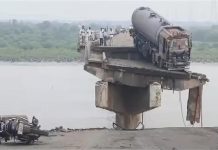
Homes, vehicles, bridges and roads were swept away. Hydropower projects were also damaged, while the important route linking Nepal with Tibet was disrupted.
The flood’s suddenness has left rescuers racing against time. Roads have been destroyed, debris has made access difficult and helicopters face challenging conditions.
There is also a fear that the danger may not be over. Reuters reports that authorities are warning of a possible secondary flood because of an upstream blockage.
What triggered the flood?
The precise sequence is still being investigated. Satellite imagery and preliminary assessments point to an ice-rock avalanche or glacial collapse near the Nepal-Tibet border. A 4.4-magnitude earthquake was recorded shortly before the disaster, raising the possibility that seismic activity contributed to the collapse.
For now, however, the immediate priority is not establishing the final cause but finding those who are still missing.
For Nepal, it is a race to save lives. For India, it is also a race to locate its citizens, support their families and ensure that a disaster that began high in the Himalayas does not become a second emergency downstream.