With the BJP emerging as the single largest party, the 2025 Bihar
Assembly elections appear to have decisively reshaped the state’s
political landscape for times to come. The BJP-led National Democratic
Alliance (NDA) sailed past the 200-seat mark in the 243-member House,
decimating the Mahagathbandhan, leaving its chief ministerial face
Tejashwi Yadav standing isolated, and alone.
Whether or not Nitish Kumar will return for a fifth consecutive term
as chief minister remains to be seen but the NDA’s sweeping win
reaffirmed his enduring influence, reinforcing his status as Bihar’s
longest-serving leader. Congress’ allegations of irregularities in
voters list did not alter the outcome, the NDA’s win was widely seen
as a strong endorsement of its governance and a signal for future
state and national elections. At the end of the counting day, even
BJP’s die-hard critics admitted that the writing was more or less on
the wall, the only surprising part was the “magnitude” of the victory,
which perhaps the saffron leadership also did not anticipate. It must
be mentioned that Union Home Minister Amit Shah had predicted 160 plus
seats for the NDA
These elections saw the opposition’s caste strongholds fragmented and
the NDA consolidating support among EBCs, upper castes, and segments
of the Dalit community. Minority-heavy districts like Kishanganj
witnessed record turnout, but the split in Muslim votes—partly due to
AIMIM—limited the Mahagathbandhan’s consolidation efforts. Driven by
women and strategic clarity, 2025 proved a turning point for Bihar’s
politics. Opposition’s strategic missteps, inconsistent messaging, and
unprecedented voter participation—especially among women—altered the
state’s traditional caste arithmetic.
Women participation reflecting sustained welfare outreach aimed at
cash transfers, free electricity, and incentives for entrepreneurship,
gave the NDA a crucial edge, making women the “kingmakers” in seats
previously dominated by the opposition. For the first time in Bihar’s
history, women outnumbered men at the polling booths, shattering
turnout records. While the overall turnout stood at 66.91 per cent, an
extraordinary 71.6 per cent of women cast their votes, nearly nine per
cent higher than the 62.8 per cent turnout among men.
One of the most talked-about schemes before the election was the Rs
10,000 assistance for women wanting to start small enterprises. The
contrast between the two alliances was simple—the NDA had delivered
the benefit while the Mahagathbandhan’s offer was a campaign promise.
For many women, it was a real benefit already in the bank versus a
promise in future—a bird in hand, you know. And contrary to
opposition’s belief, people were not upset with Nitish’s government
who had consistently introduced policies aimed at women for nearly two
decades now.
The 2025 electoral map reflected shifting voter bases, moving beyond
conventional caste and creed, leaving the opposition’s traditional
caste strongholds fragmented. Driven by unprecedented women’s
participation, the 2025 Bihar elections saw old rules of politics
being rewritten. Analysts can do their number-crunching but these
elections were more than just figures about caste and creed.
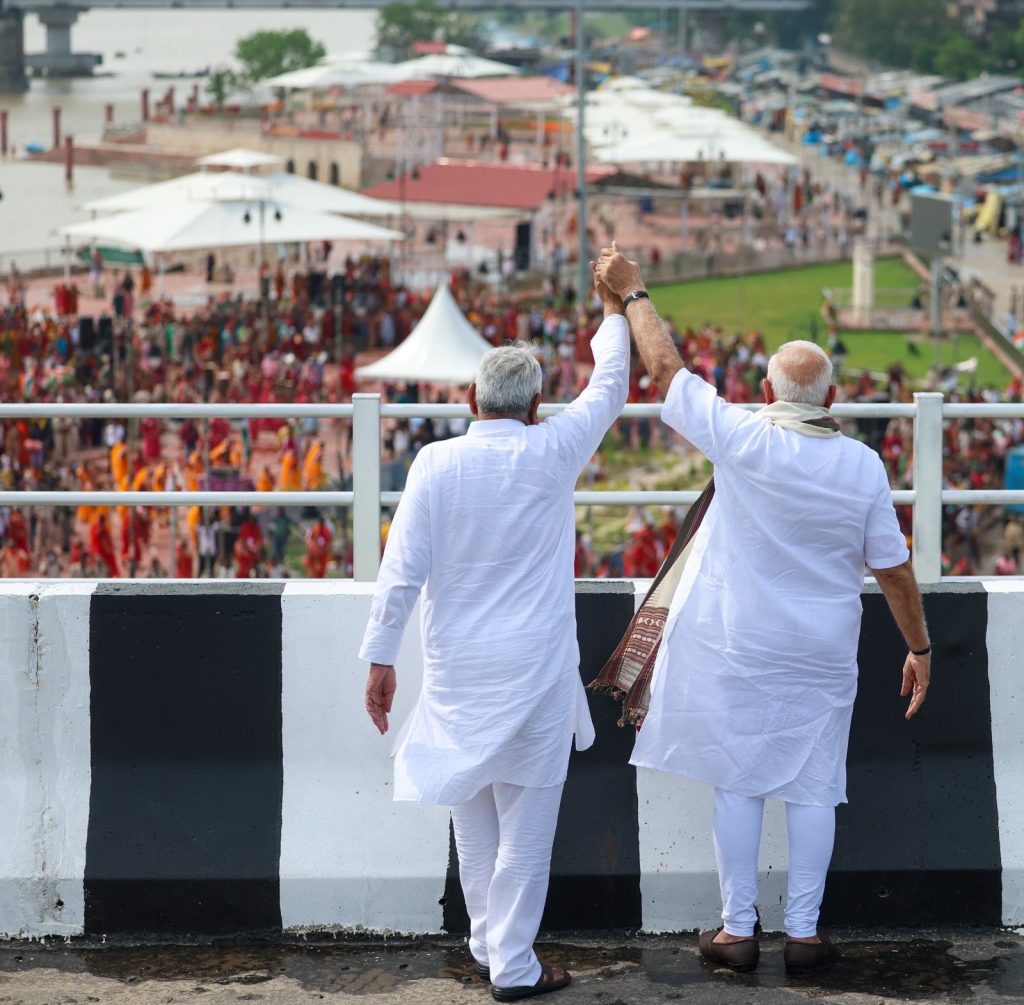
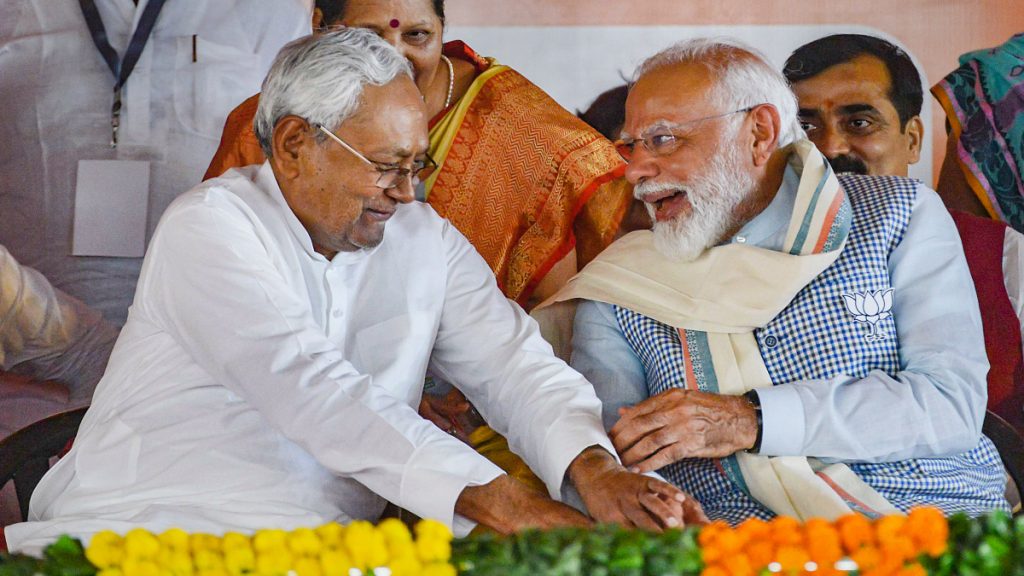
Adding to the rain of freebies was a cohesive campaign and unity among
the NDA constituents—JD(U), BJP, and Lok Janshakti Party (Ram Vilas).
The campaign fused Narendra Modi’s national popularity with Nitish
Kumar’s governance image, underlining the “double-engine government”
model. While benefits and data-driven outreach targeted women and
youth, the “jungle raj” narrative concerning past RJD governance
mopped the swing voters. In the end, the NDA’s messaging around
stability, welfare, and development worked. Prime Minister Narendra
Modi described the mandate for the ruling NDA as a vote for
development over dynasty and a rejection of “negative politics”.
Mahagathbandhan— what went wrong
From the word go, the Mahagathbandhan suffered from leadership issues,
poor strategy, and internal discord. Tejashwi Yadav’s energetic
campaigning was overshadowed by over-reliance on Yadav candidates,
type-casting perceptions of caste exclusivity and alienating EBCs and
upper castes. The public feud between brothers Tejashwi and Tej Pratap
Yadav—who formed the Janshakti Janata Dal projected a fractured
leadership on which the NDA capitalized, turning this image of
instability to its advantage.
Congress’s collapse—winning only about six of the seats it contested
—exposed weak organization. And where was Rahul Gandhi—the leader of
opposition in the Lok Sabha—for most of October? Late campaigning and
ineffective coordination blunted the early gains made during the
anti-SIR Voter Adhikar Yatra. Complaints about voter list
discrepancies failed to shift public perception. Delayed seat-sharing,
muddled candidate selection, and inconsistent messaging further
weakened the alliance. The Mahagathbandhan’s manifesto—promising jobs
for every household, expanded pensions, and reviewing
prohibition—lacked credible funding and implementation details. For
the majority, the promises were impractical. The alliance’s
identity-driven positioning, especially through overt minority-focused
messaging, alienated middle-class and aspirational voters.
‘Jungle Raj’ whammy
Tejashwi’s attempt to balance Lalu Prasad Yadav’s social justice
legacy while distancing himself from the “jungle raj” image did not
work. PM Modi’s attacks on “hiding the sins of the father” gained
traction among voters prioritizing law, and order and ultimately
Bihar’s electorate chose welfare-driven, development-oriented
governance over caste-based/negative campaigns targeting PM Modi.
2025 elections, in fact, exposed deep structural weaknesses—discord,
unclear leadership, confused messaging, and over-dependence on
identity politics. The Congress, in particular, appeared almost
irrelevant, landing first the most difficult seats and then
sleepwalking through the campaign—a direct contrast to the NDA’s
high-voltage, concentrated messaging.
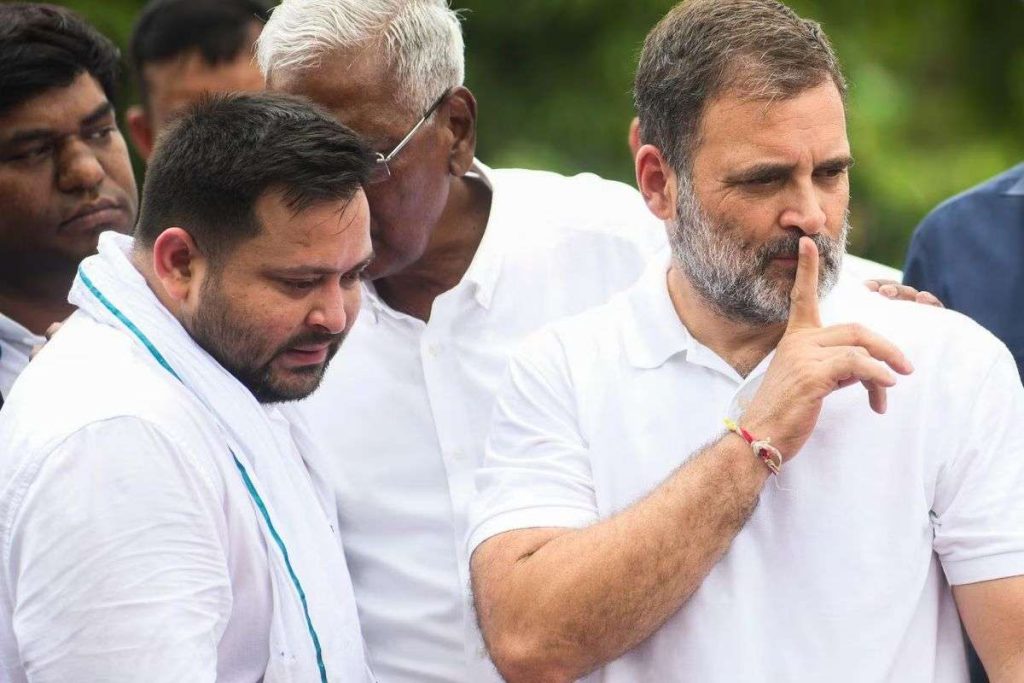
The RJD’s family feud and the Congress’s organizational decline were
major liabilities. Rahul Gandhi’s prolonged absence raised questions
about campaign seriousness—all reflected in Congress’s strike rate,
underscoring its declining influence. While concerns raised by
Congress about voter roll revisions did little to influence outcomes,
smaller partners failed to contribute meaningfully, compounding the
alliance’s weaknesses, rather adding to the confusion.
Along with welfare measures, the NDA emphasized Modi’s popularity and
Nitish’s welfare focus, supported by central schemes in health,
agriculture, and infrastructure. Prashant Kishor’s Jan Suraj campaign
further split opposition votes. Did he help the BJP- led NDA? The
answer to that question is for all to see. Dubbed the ‘X factor’ in
the Bihar election, the former poll strategist failed to open its
account despite contesting 238 seats. Most of the JSP candidates had
their deposits forfeited. The man who helped script several winning
campaigns across states, including that of PM Modi in 2014, failed to
open his party’s account. The results were in sync with his
pre-election predictions – ‘arsh pe ya farsh pe’—for JSP but the rest
of his predictions were wrong. Kishor had predicted that the NDA was
“on its way out”, that Nitish Kumar “would not return as Chief
Minister” and that the JD(U) “would struggle to win even 25 seats.”
Bihar—and beyond
The NDA’s dominant win resets Bihar’s political equation. Women voters
are the decisive bloc—this has been proved time and again in
subsequent elections. Anti-incumbency was no longer a factor and nor
was speculation around Nitish Kumar’s health. For the INDIA alliance,
Bihar offers critical lessons—that unity, credible leadership, and a
coherent narrative are indispensable. To remain relevant, can INDIA
address these structural weaknesses—that is the biggest question. The
opposition coalition needs to redefine itself beyond being merely
anti-BJP, developing a unified vision that appeals to young and
aspirational voters and emerge as a meaningful challenge.
With multiple regional leaders and competing ambitions, the alliance
lacks a unified face, in contrast to Chirag Paswan and LJP—a strong
force in the NDA. By making the BJP the single largest party, the 2025
Bihar Assembly elections have decisively reshaped the state’s
political landscape. Voters’ distaste for inconsistent messaging and
strategic missteps was reflected in the unprecedented voter turnout,
transforming the caste arithmetic and giving the state a new political
perspective.
Can the INDIA Bloc manage this in the coming Assembly elections? With
multiple regional leaders and competing ambitions, the alliance has
been struggling to project a unified face, and Maharashtra — now
followed by Bihar — bears that out. Winning elections no longer
requires a common minimum program, it needs a unified and clear
leadership structure —whether collective or centered on a single
candidate—and positive messaging working towards one common goal.
ANJALI BHATIA adds to the story:
How Grand Alliance misread Bihar
From the moment the Bihar election results began to emerge on a dull,
hazy November morning, it became clear that this wasn’t just a game of
victory and defeat; it was a mirror of the state’s psyche, revealing
all the deceits, promises, and fears of politics without any dust.
Those cold EVM numbers not only captured the future of political
alliances but also the hidden layers of the changing psyche of Bihar’s
voters—layers that the Grand Alliance perhaps failed to grasp and the
NDA quietly read.
When the first trends came in at six in the morning, hope was bubbling
in the air at the RJD office. The crowd gathered outside the yellow
building seemed convinced that Tejashwi’s hard work would pay off. The
echo of his speeches, which spanned towns, cities, and villages, was
still fresh in people’s memories. During the Adhikar Yatra, there was
a sparkle in people’s eyes—indicating that perhaps this time a new
chapter would open. But as the hours passed, this sparkle began to
fade into an uneasy, silent fear.
This was the same fear that had been swirling in the election air
months earlier—a fear that the NDA had slowly carried to the polling
booths. The old, faded phrase of “jungle raj” was once again dusted
off and instilled in the minds of voters. Many young people may not
even remember that era, but the campaign etched a narrative in their
minds—a narrative that if power changed, stability might also be lost.
The Bihar voter isn’t afraid of stability, but trembles at
instability. The struggle of the grand alliance in this election
started from there.
Tejashwi Yadav’s image was that of a young, calm, new-age leader. He
maintained a composed demeanor on stage, challenging his opponents but
avoiding harsh language. His face exuded the kind of clean, political
energy that young people see as a future. But politics isn’t won by
mere faces. The machinery behind those faces must be powerful—one that
can reach every door, be available on every phone, and be present at
every booth from dawn to dusk.
And this was the point where the march of the Grand Alliance was
defeated by the invisible grip of the NDA. The Grand Alliance’s top
strategists believed that after winning 10 Lok Sabha seats, reaching
around 60 in the Assembly shouldn’t be difficult. The electoral
calculations, the mood, the meetings—all indicated that the mood was
in favor of the opposition.
Journalists traveling through Bihar’s villages after the Lok Sabha
elections felt that the public wanted change. There were complaints of
unemployment, the pain of inflation, and women feared for their
safety. This was a combination that would turn against any government.
But in Bihar, the story is never straightforward. Politics here is
like walking a tightrope—the slightest tipping of the balance can
cause the entire structure to collapse. The Grand Alliance made a
mistake in understanding that balance.
Rahul Gandhi’s “Vote Chori Yatra” created a unique resonance in
Bihar. This 1,300-kilometer journey, traversing 25 districts and
touching 110 assembly seats, once again showcased the Congress in
action. Rahul’s rallies drew crowds, young people chanted slogans, and
the number of women attending those rallies also seemed to be on the
rise. But the journey failed to create the impact that an electoral
wave can.
People listened to Rahul, but they didn’t consider him one of their
own. The concern in his voice was genuine, but in politics, even real
things only have an impact when they have continuity. Rahul would
come, speak, and then leave. In a state like Bihar, where half the
impact of an election depends on a “constant presence” with the
public, the Congress failed to provide that presence.
Both the RJD and Congress campaigned within their respective
constituencies, but their coordination was lacking. Seat-sharing
created further rifts. In many areas, Congress got fewer seats than
expected, and in others, RJD leaders felt that Congress was increasing
their burden by taking weaker seats. This tension spread to grassroots
workers, weakening the unity of the common fight.
The NDA, in contrast, maintained perfect restraint. There was no
public outcry over seat-sharing, no poster wars, no
rebellions—everything was unusually calm. This calm atmosphere
signaled “stability” to voters. In many areas, journalists observed
people saying, “If there is no conflict within their family, the
government will also be stable.” These subtle signals matter greatly
in politics.
The Grand Alliance did not understand the seriousness of this signal.
Tejashwi Yadav’s every rally drew huge crowds. Young boys ran after
his cars, women nodded enthusiastically at his speeches, and the
elderly exclaimed, “The boy is fine.” But the problem was that
Tejashwi’s speeches remained largely the same at every
rally—unemployment, education, health, and promises of development. He
spoke clearly on these topics, but never went into detail. The Bihar
voter wanted details. He wanted to know how jobs would be created, how
teachers would be recruited, and how the health system would improve.
Tejashwi would say all this and then move ahead – this haste
irritated the voters. His Adhikar Yatra was impressive in its own
right. During the march, people would cheer him on, some women would
stand in front of him with children in their arms, and many elderly
farmers would try to shake his hand. The march had a “political
sensibility.” But the organizational structure that should have
converted that sensibility into votes after the march was not strong
enough. The internal weakness of the grand alliance clearly came to
fore.
In contrast, the BJP’s work at the booth level was highly organized.
Their “Panna Pramukh” system ensured their presence in every
neighborhood, every hamlet. Who was influencing which family in the
elections, which booth was losing Dalit votes, which area was
experiencing Rajput discontent, which village was experiencing Yadav
discord—the BJP had access to all this information, constantly
updated. This machinery is the real weapon for winning elections.
The Grand Alliance had a weak network of this micro-information. An
interesting phenomenon is observed in many Indian states: no matter
how much crowd the opposition gathers, unless it has booth-level
machinery, those crowds don’t translate into votes. Bihar is a prime
example of this.
Meanwhile, another factor that severely damaged the Grand Alliance
was the behavior of its supporters. Tejashwi spoke in a civilized
tone, but many local-level workers, especially younger leaders, began
behaving in the same old RJD style. Disrespectful behavior during road
shows, threats against opponents, and boastful posts on social
media—all of this justified the NDA’s accusation that “if power is
gained, jungle raj will return.”