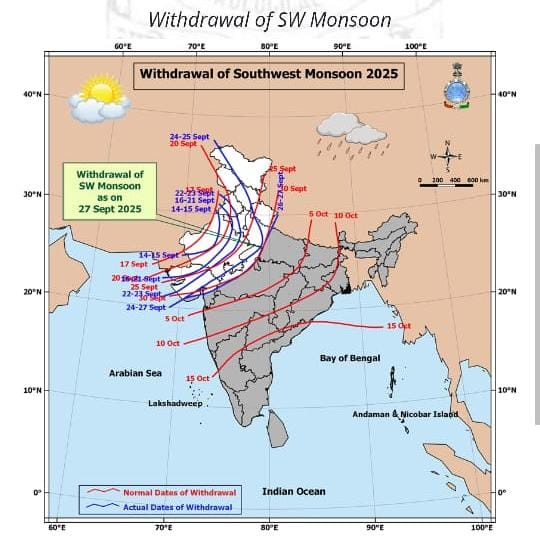
Leaving behind unprecedented inflows in crucial dams and causing devastating floods across Northwest hills and plains, the southwest monsoon may have withdrawn completely from the region but according to the weather office—the IMD—the overall, rainfall activity is likely to be above normal over plains of northwest India, central, east and northeast India during the week between October 2 and 8.
“Under the influence of a low pressure area, fairly widespread to widespread rainfall with isolated heavy to very heavy falls likely over most parts of northeast India, Maharashtra, Madhya Pradesh, Telangana mainly during the first half of the week (October 2 to 8). Isolated extremely heavy rainfall is also likely over Assam and Meghalaya during one or two days of the week. Overall, rainfall activity is likely to be above normal over plains of northwest India, central, east and northeast India and near normal over many parts of south Peninsular India during the week,” the IMD said in its weather status and extended range forecast for the next two weeks (September25 to October 8, 2025)
According to the IMD, currently, neutral El Niño–Southern Oscillation (ENSO) conditions are prevailing over the equatorial Pacific region. Forecasts suggest that these conditions will persist throughout the monsoon season however there is an increased likelihood of La Niña conditions developing during the post-monsoon season.
How will La Niña impact India?
La Niña is a climatic phenomenon characterised by cooler-than-average sea surface temperatures in the central and eastern Pacific Ocean. While it originates far away from India, its influence on the Indian subcontinent’s weather is significant.
Typically, La Niña events are associated with stronger-than-usual monsoon seasons in India. In the post-monsoon season (October to December), La Niña may also contribute to increased rainfall in parts of southern India, particularly Tamil Nadu and Andhra Pradesh, due to a more active northeast monsoon. Besides, temperatures generally tend to be slightly lower than average, especially during winter months.