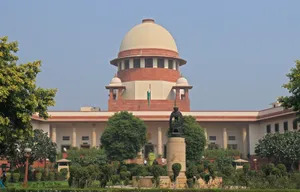
The Supreme Court has issued notice in a Public Interest Litigation (PIL) that challenges the constitutional validity of the immunity granted to the Chief Election Commissioner (CEC) and Election Commissioners (ECs) under the Chief Election Commissioner and Other Election Commissioners (Appointment, Conditions of Service and Term of Office) Act, 2023. The challenge strikes at the heart of the legal framework governing the Election Commission of India (ECI), raising serious questions about accountability, constitutional limits, and the balance between independence and immunity.
A Bench comprising Chief Justice of India Surya Kant and Justice Joymalya Bagchi was hearing the PIL filed by Lok Prahari, a civil society organisation, which has assailed Section 16 of the 2023 Act. The provision grants immunity to the CEC and ECs for acts done or purported to be done in the discharge of their official functions.
Appearing for Lok Prahari, its general secretary, S. N. Shukla, said that Parliament had granted immunity to the CEC and the ECs, which the makers of the Constitution did not grant even to the President, Governors, or judges. The plea said that the provision “gives unprecedented, unbridled power to the CEC and ECs by providing them complete blanket permanent immunity for life from any civil and even criminal proceedings for their wrongdoings in gross misuse of their office …”.As the bench expressed inclination to issue notice, Shukla also urged the court to stay the operation of the provision in the meanwhile in view of the “damage to the process of free and fair elections”.
It said that “the impugned provision disturbs level playing field by giving the CEC and ECs a free hand to misuse their position for or against a political party/candidate or the Government as alleged of late, not entirely without basis…”. The plea said that the “intervention of this Hon’ble Court is essential for ensuring enforcement of the Rule of Law and protecting proper functioning and future of democracy in the country”. The provision says that “notwithstanding anything contained in any other law for the time being in force, no Court shall entertain or continue any civil or criminal proceedings against any person who is or was a Chief Election Commissioner or an Election Commissioner for any act, thing or word, committed, done or spoken by him when, or in the course of acting or purporting to act in the discharge of his official duty or function”.
While declining to stay the operation of the impugned provision at this stage, the Court issued notice to the Union of India on the specific question of whether “this kind of immunity can be granted in terms of our constitutional scheme or not.” A bench of Chief Justice of India Surya Kant and Justice Joymalya Bagchi issued notice to the Centre and the Election Commission of India (ECI) on the plea by NGO Lok Prahari challenging Section 16 of the Chief Election Commissioner and Other Election Commissioners (Appointment, Conditions of Service and Term of Office) Act, 2023. “We would like to examine it. We are issuing notice,” the CJI said.
The matter will now proceed with the Union required to justify the legislative basis and constitutional validity of the immunity clause. The Court will examine whether Parliament can grant sweeping immunity to the Chief Election Commissioner and Election Commissioners under Article 324 of the Constitution.
At the centre of the controversy lies Section 16 of the 2023 Act, which provides immunity to the Chief Election Commissioner and Election Commissioners against legal proceedings for actions taken in good faith while discharging their official duties. According to the petitioner, this provision effectively grants a form of lifelong and unprecedented immunity, shielding the election authorities from accountability even after demitting office.
Appearing for Lok Prahari, Advocate S.N. Shukla argued that the impugned provision fundamentally alters the constitutional position of the Election Commission by elevating it beyond the reach of legal scrutiny. He contended that such sweeping immunity was neither contemplated by the Constitution nor supported by judicial precedent.
“This provision makes the Election Commission a law unto itself,” Shukla submitted, relying heavily on past Constitution Bench jurisprudence. He drew the Court’s attention to the landmark ruling in T.N. Seshan, Chief Election Commissioner v. Union of India and subsequent cases involving former Chief Election Commissioner M.S. Gill, where the Supreme Court had categorically held that Article 324 of the Constitution does not confer absolute or unreviewable powers on the Election Commission.
“In the case of Mr. M.S. Gill, the Constitution Bench ruled that Article 324 does not exalt the ECI to a law unto itself,” Shukla argued. “The impugned provision does precisely that by giving a lifelong, unprecedented immunity to the CEC and the EC—an immunity which the makers of the Constitution did not even grant to the President of India or to Governors.”
The comparison with constitutional functionaries such as the President and Governors was central to the petitioner’s argument. Under the Constitution, while these offices enjoy limited immunity during their term, such protection is neither absolute nor lifelong, and certainly not beyond judicial scrutiny in all circumstances.
According to him, the immunity clause was not part of the original bill and was added at a late stage during the legislative process.
He pointed out that during parliamentary debates, the government had justified the enactment of the law by invoking Article 324(2) of the Constitution. However, Article 324(2), he argued, deals exclusively with the appointment of the Chief Election Commissioner and Election Commissioners, and does not extend to prescribing their service conditions, let alone granting immunity from legal proceedings.
“Article 324(2) has nothing to do with service conditions, much less with immunity,” Shukla submitted. “The provision travels far beyond the scope of the enabling constitutional article under which the law is claimed to have been enacted.”
This argument goes to the root of legislative competence and constitutional authorization. If Parliament has exceeded the scope of Article 324(2), the impugned provision could be struck down as ultra vires the Constitution.
Given what he described as the “grave and continuing irreparable loss” to the democratic process, Advocate Shukla urged the Supreme Court to stay the operation of Section 16 pending adjudication of the PIL.
He contended that free and fair elections—recognized as part of the basic structure of the Constitution—are intrinsically linked to the accountability of the Election Commission. Granting lifelong immunity, he argued, undermines public confidence and weakens constitutional safeguards.
However, the Bench declined to grant interim relief at this stage. While refusing to stay the impugned provision, the Court acknowledged the seriousness of the issue and framed the core constitutional question that now requires examination: whether such a sweeping immunity is compatible with India’s constitutional framework.
Issuing notice to the Union of India, the Bench made it clear that the matter raises important constitutional issues that merit detailed consideration.
The backgrounder
The Chief Election Commissioner and Other Election Commissioners (Appointment, Conditions of Service and Term of Office) Act, 2023 was enacted to replace the earlier regime governing the appointment and service conditions of the Election Commission’s top officials.
The legislation followed a Constitution Bench judgment of the Supreme Court, which had directed that appointments to the posts of CEC and ECs be made by a committee comprising the Prime Minister, the Leader of Opposition, and the Chief Justice of India, until Parliament enacted a law on the subject.
While the 2023 Act addressed appointment procedures and service conditions, it also introduced provisions that have drawn significant criticism from opposition parties, civil society groups, and constitutional scholars. Section 16, which grants immunity, has emerged as one of the most contentious aspects of the law.
Critics argue that instead of strengthening the independence of the Election Commission, the Act risks diluting accountability by insulating its members from legal consequences.
Article 324 of the Constitution vests the superintendence, direction, and control of elections in the Election Commission of India. Over the decades, the Supreme Court has interpreted this provision expansively to empower the ECI to fill legislative gaps and ensure free and fair elections.
However, the Court has consistently held that the powers under Article 324 are not absolute.
In Mohinder Singh Gill v. Chief Election Commissioner and subsequent decisions, Constitution Benches of the Supreme Court emphasized that while the ECI enjoys a high degree of autonomy, it remains subject to constitutional limitations and judicial review.
It is this jurisprudence that Lok Prahari relies upon to argue that granting lifelong immunity contradicts settled constitutional principles.
Immunity vs Accountability
The case foregrounds a long-standing constitutional tension: how to balance the independence of constitutional authorities with the need for accountability.
On one hand, independence is seen as essential to insulate the Election Commission from political pressure. On the other hand, accountability is critical to ensure that such independence is not abused.
The petitioner argues that Section 16 tilts this balance decisively—and dangerously—in favour of unchecked authority.
Importantly, the Constitution itself adopts a calibrated approach to immunity. For instance, Article 361 grants the President and Governors immunity from criminal proceedings during their term of office, but this protection is temporary and subject to post-tenure accountability.
By contrast, the immunity under the CEC Act, 2023, according to Lok Prahari, is broader, more permanent, and lacking in constitutional justification.
Free and fair elections are widely recognized as part of the basic structure of the Constitution. The Supreme Court has repeatedly underscored the central role of the Election Commission in safeguarding democratic processes.
The present challenge raises the question of whether insulating election authorities from legal scrutiny strengthens or weakens democracy.
If accountability mechanisms are diluted, critics argue, public trust in electoral processes could erode—particularly in a political climate where the neutrality of institutions is under intense scrutiny.
What lies ahead
With notice issued, the Union of India will now have to defend Section 16 and explain how such immunity aligns with constitutional principles, past judicial precedents, and the scheme of Article 324.
The Supreme Court’s eventual ruling could have far-reaching implications—not just for the Election Commission, but for the broader question of how far Parliament can go in granting immunity to constitutional authorities.
As the case proceeds, the Court will be called upon to decide whether the independence of the Election Commission can coexist with meaningful accountability, or whether Section 16 has crossed a constitutional red line.
For now, while the immunity provision remains in force, the constitutional debate it has triggered is firmly before the country’s highest court.