Confusion on H1-B: While Washington has clarified that the fee targets only first-time applicants, doubts remain over travel, re-entry rules, and timing, fueling anxiety among professionals and businesses that depend on skilled Indian talent.
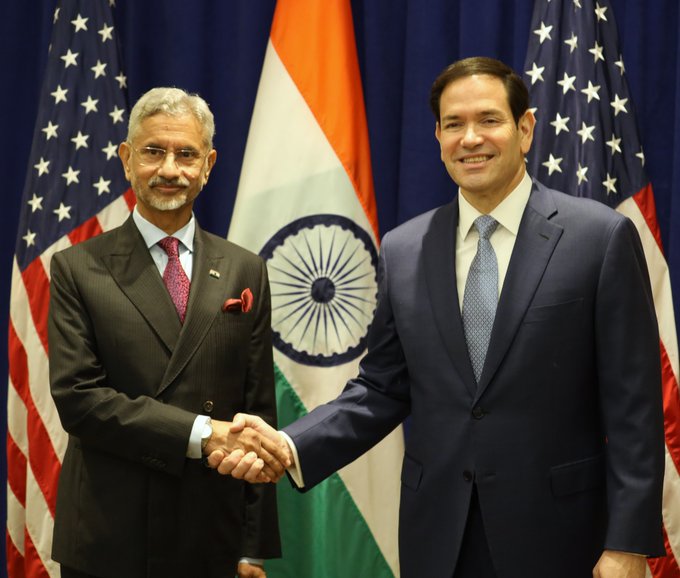
External Affairs Minister S. Jaishankar on Monday met US Secretary of State Marco Rubio in New York on the sidelines of the 80th UN General Assembly—their first interaction since Washington slapped steep tariffs on Indian exports last month. After the meeting he posted on X “Good to meet Secretary Rubio this morning in New York. Our conversation covered a range of bilateral and international issues of current concern Agreed on the importance of sustained engagement to progress on priority areas,” Both leaders committed to remaining in touch.
Both leaders committed to staying in touch.
Commerce and Industry Minister Piyush Goyal is also in the US, leading a business delegation and meeting senior officials, including the U.S. Trade Representative. His visit signals New Delhi’s urgency in defusing the dispute and reviving negotiations on a long-pending trade agreement. Both sides are seeking greater market access and a way to prevent a deeper rupture in economic ties. Just last week, a USTR team held talks in New Delhi, reflecting recognition on both sides that trade frictions must not derail the broader strategic convergence.
Jaishankar also held an informal meeting with EU Foreign Ministers, describing it as an “opportunity to have an open exchange of views on multilateralism, the India-EU partnership, the Ukraine conflict, Gaza, energy, and trade.”
While no breakthrough was announced, Monday’s dialogue underscored both governments’ commitment to maintain active engagement on trade and strategic issues. The talks come at a delicate time, with domestic political pressures mounting.
The Trump administration has toughened its stance on trade and there is utter confusion on the H-1B visa fees. The US recently imposed a 50% duty on key Indian products, citing New Delhi’s energy ties with Moscow and hiked H-1B visa fees to $1,00,000. Domestic benchmark indices witnessed significant fall on Monday, primarily due to drop in IT stocks and overall negative sentiments despite the US clarification on H-1B visa fee and the GST 2.0 boost. Experts attributed it to Donald Trump’s decision to increase the H-1B visa fee to $100,000—a move that raised concerns about higher operational costs for Indian IT companies reliant on these visas.
Amid widespread panic, confusion and concern that gripped Indians in the US on H-1B visas after Trump signed the proclamation there was a clarification by the White House that the $100,000 fee was a “one-time” payment applicable only on new applicants. However, there is confusion on several aspects.
While the move was framed as a protectionist measure to safeguard American jobs in the tech sector, critics warned that it could disrupt global talent mobility and hit India’s IT industry hard. American lawmakers and leaders also termed the move “reckless”. Immigration attorneys and companies sounded the alarm for H-1B visa holders or their family members currently outside the US for work or vacation. Many H-1B visa holders cancelled travel plans at the last minute while waiting to board flights to the homeland and several others already in India scrambling to return. While Washington has clarified that the fee targets only first-time applicants, doubts remain over travel, re-entry rules, and timing, fueling anxiety among professionals and businesses that depend on skilled Indian talent.
India responded saying that the move is likely to have “humanitarian consequences by way of the disruption caused for families.” “This measure is likely to have humanitarian consequences by way of the disruption caused for families. Government hopes that these disruptions can be addressed suitably by the US authorities,” the MEA said, taking note of various reports and developments surrounding the issue.