By Riaz Wani
Jammu and Kashmir’s unemployment rate continues to remain significantly higher than the national average, with the Union Territory recording a jobless rate of 6.7 per cent in 2024–25 compared to 3.5 percent nationally, the government revealed during the recent session of Legislative Assembly.
Responding to a question by legislator Mubarak Gul, Deputy Chief Minister Surinder Choudhary, who also holds the Labour and Employment portfolio, cited data from the Periodic Labour Force Survey (PLFS) of the Ministry of Statistics and Programme Implementation. He said the unemployment rate among persons aged 15 years and above in J&K has remained consistently above the all-India average for the past six years.
“In 2024–25, the unemployment rate in the UT stood at 6.7 percent against the all-India average of 3.5 per cent. The rate was 6.1 per cent in 2023–24 compared to India’s 3.2 per cent, while in 2022–23 it was 4.4 per cent against the national figure of 3.2 per cent,” he said, quoting official figures.
The government said it had undertaken an extensive baseline survey across the Union Territory in January last year in collaboration with district administrations under Mission YUVA to assess the employment landscape.
Stating that tackling unemployment, particularly among youth, was a priority, the government said its strategy extended beyond short-term job provisioning. It emphasised sustainable livelihood creation through entrepreneurship, skilling initiatives and institutional reforms “so that youth become job-creators rather than job seekers”.
“In this context, Mission YUVA has emerged as a transformational initiative, witnessing unprecedented enthusiasm and participation from youth across the Union Territory,” it said.
According to the government, over 1.71 lakh youth have registered on the Mission YUVA platform since its launch, resulting in around 70,000 formal enterprise applications. The scale of participation, it said, reflected growing confidence in the programme.
However, concerns over the cost burden on job aspirants were also raised in the House. In response to a question from Pulwama MLA Waheed ur Rehman Para, the General Administration Department disclosed that the Jammu and Kashmir Public Service Commission (JKPSC) and the Jammu and Kashmir Service Selection Board (JKSSB) together collected Rs 48.88 crore in application fees from candidates between 2023 and 2025. Of this amount, JKPSC collected Rs 17.90 crore, while JKSSB earned Rs 30.98 crore.
Para criticised the fee collection, saying it was “despite the government’s explicit promise that all application forms would be made free”. He alleged that charging high fees from unemployed youth not only contradicted the stated policy but also amounted to “blatant exploitation of unemployed aspirants, who are already under severe economic distress.”
In a separate reply, Education Minister Sakeena Itoo told the Assembly that the de-freezing of teacher posts is under “active consideration” of the government to address staff shortages in schools across J&K.
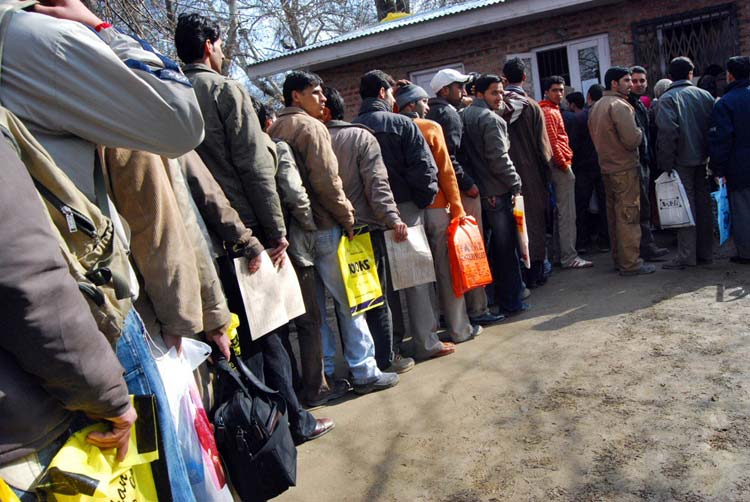
Meanwhile, separate official data placed the number of registered unemployed youth in the Union Territory at 3,57,328 as of November 2025, highlighting the scale of the employment challenge. During November alone, 481 new job seekers were added to the unemployment registers.
A regional breakdown shows that the Kashmir Division accounts for over 2.08 lakh registered unemployed youth, compared to more than 1.50 lakh in the Jammu Division. District-wise figures reveal significant variation, with Anantnag reporting the highest number of registered unemployed youth at 32,298, followed by Pulwama (28,671) and Kathua (26,798). Srinagar has 23,826 registered unemployed youth, while Kulgam stands at 21,446. Kishtwar recorded the lowest figure at 8,870, followed by Reasi at 12,376.
The data also indicates a gender gap in registrations. Of the total registered unemployed youth, 2,33,845 are male and 1,27,301 are female.
Economists and labour experts caution that the registration figures may not fully capture the true extent of unemployment, as they primarily reflect educated youth seeking government jobs. According to earlier PLFS data, J&K’s unemployment rate stood at 6.1 per cent, nearly double the national average of 3.2 per cent, suggesting that many job seekers outside formal registration systems remain unaccounted for.
While the government has reiterated its focus on entrepreneurship and skill development under Mission Youth and Mission YUVA, experts stress that sustained private investment, industrial expansion and economic diversification will be critical to generating stable employment and absorbing the growing number of educated youth entering the labour market each year.