RSS chief’s comments came on the day an additional 25 per cent tariff imposed by US President Donald Trump on India for buying Russian oil came into force
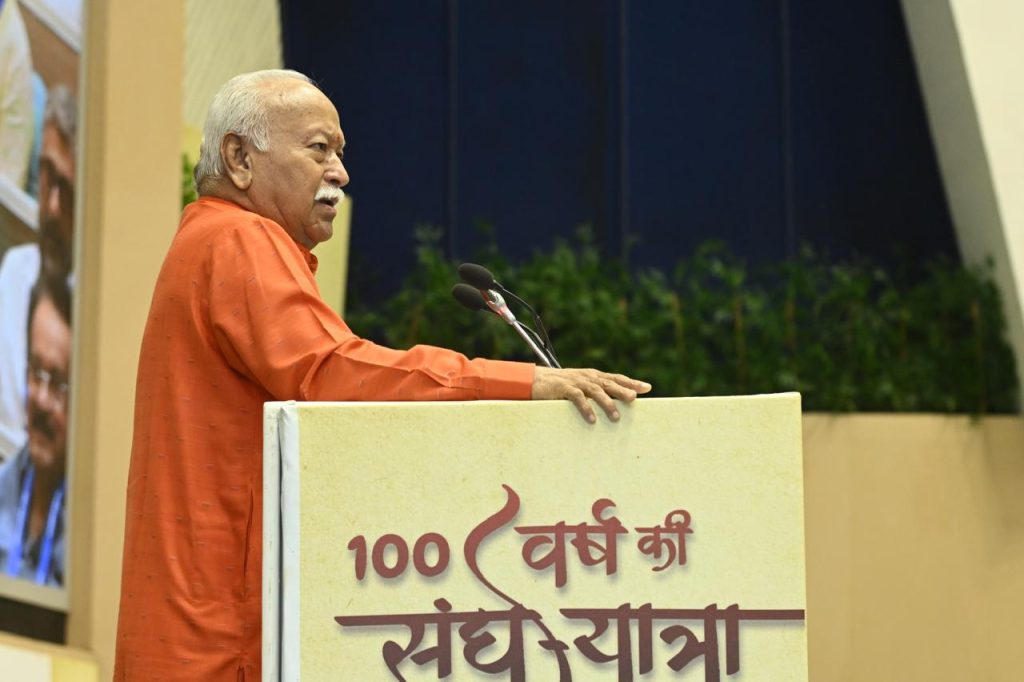
Rashtriya Swayamsevak Sangh (RSS) chief Mohan Bhagwat on Wednesday said international trade should happen voluntarily and not under pressure, making a strong pitch for swadeshi and self-reliance. Speaking at a lecture series to mark the centenary of the RSS, Bhagwat also emphasised on self-reliance and swadesi (indigenous products)
He clarified that swadeshi did not mean blocking imports of goods that the country already produces or can manufacture easily.
“Being atmanirbhar (self-reliant) does not mean halting imports. The world functions because of interdependence. So export-import will continue. But there should be no compulsion in it,” Bhagwat said on the second day of the three-day lecture series “100 Years of RSS – New Horizons” at Vigyan Bhavan in New Delhi.
“Bringing goods from abroad harms local vendors,” he remarked.
Bhagwat said balance in life and society was the essence of dharma, and cautioned against extremes. “India’s tradition has always taught the middle path, and that is what the world needs most today,” he remarked. For this he outlined five focus areas for change—family awareness, social harmony, environmental protection, self-realisation through swadeshi, and fulfilling civic duties.
Bhagwat’s comments came on the day an additional 25 per cent tariff imposed by US President Donald Trump on India for buying Russian oil came into force.
According to official sources, the impact of Donald Trump’s 50 per cent tariff on India is unlikely to be “as severe as feared given the diversified nature of Indian exports.”
There is no need to panic as far as exports are concerned as communication lines are open between India and the US to resolve the issue, they also added. However, it remains to be seen how stock markets react to the tariffs. On Tuesday the equity benchmark indices Sensex and Nifty declined over 1 percent, marking their steepest fall in over three months, after the US issued a draft notice proposing additional tariffs on Indian imports.
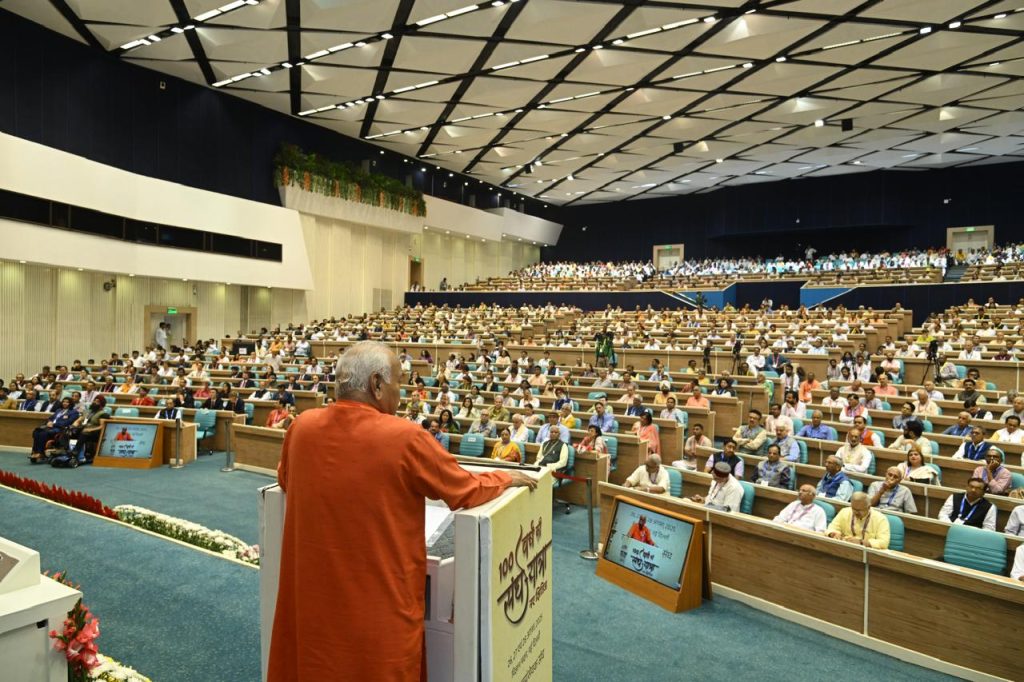
Bhagwat also talked about India’s restraint even in times of loss, noting how the country had extended help even to those who once harmed it. “Ego creates enmity, but India has always risen above ego,” he said, adding that Indian society must set an example for the world through its conduct.
He observed that RSS enjoys credibility today because “society believes the Sangh does what it says.”
On the economic front, Bhagwat argued for a new national development model rooted in self-reliance, swadeshi, and environmental balance. He also underlined the importance of reconnecting with neighbouring countries. “Rivers, mountains, and people remain the same—the only difference is the lines drawn on maps,” he said.
Explaining the ethos of the Sangh, Bhagwat said its work was rooted in “pure love and commitment to society.” Unlike conventional organisations, he said, RSS volunteers expect no personal benefits. “There are no incentives, only disincentives—but the joy of serving society gives meaning to life,” he noted.
He described the core values of the organisation as forming friendships with the virtuous, ignoring the wicked, rejoicing in others’ good deeds, and showing compassion even towards wrongdoers.
Touching upon Hindutva, Bhagwat defined it as “truth, love, and belongingness.” He said India had a role akin to that of an elder brother in guiding the world, drawing on the teachings of sages who emphasised that life is not meant for oneself alone.