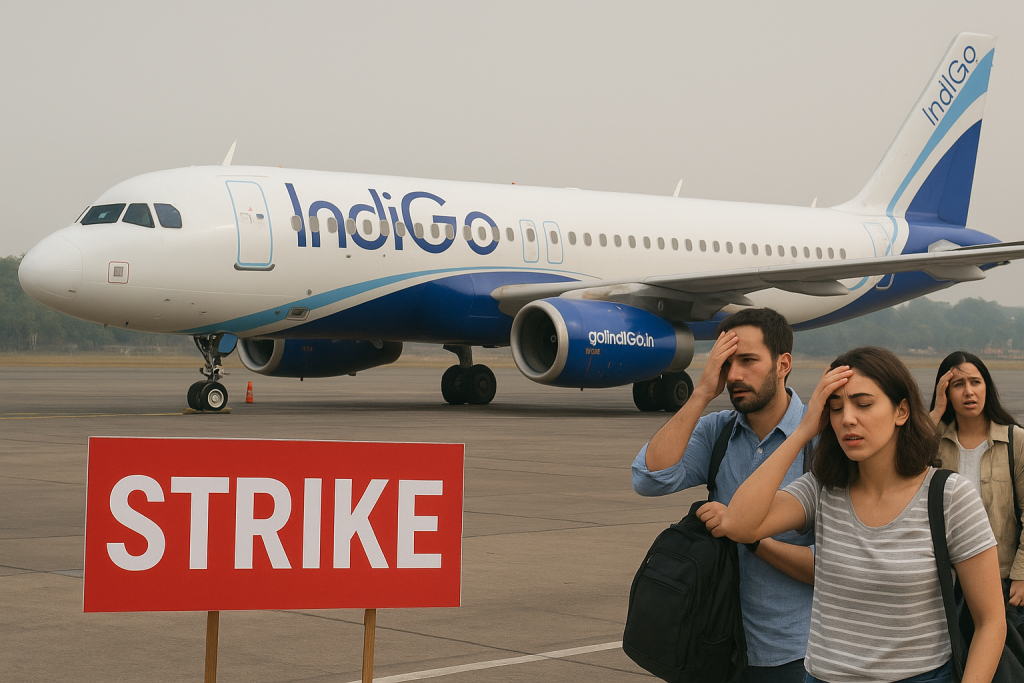
The airline says it hopes to fully stabilise operations by December 10 with the IndiGo CEO Pieter Elbers today in an internal video message to staff disclosing that the airline will operate around 1,650 flights during the day and on Time Performance (OTP) is expected to be around 75 per cent.
The DGCA has given the CEO 24 hours to respond to the show-cause notice. The week-long turbulence in India’s aviation sector intensified after the Directorate General of Civil Aviation (DGCA) issued a show-cause notice to IndiGo CEO Pieter Elbers, demanding an explanation for the massive operational meltdown that has crippled air travel across the country for six consecutive days.
The notice comes amid one of the most severe disruptions India’s domestic skies have witnessed in recent years — a crisis that traces its origins to simmering tensions between IndiGo and its pilots over new flight-duty-time limitations (FDTL) and alleged scheduling overload.
Genesis of crisis
Trouble began late last week when a sizeable section of IndiGo’s pilots reportedly reported sick simultaneously, protesting what they termed an “unsustainable” roster driven by the newly implemented FDTL norms. The updated regulations mandate more rest hours for cockpit crew to prevent fatigue — a global safety requirement that India adopted earlier this year.
While the rules were designed to improve safety, pilots argued that IndiGo’s transitional planning was inadequate, leaving them with compressed schedules and last-minute duty changes. The situation escalated when negotiations between the pilots and the airline failed to make headway, triggering a coordinated “sickout,” which rapidly spread across bases in Delhi, Mumbai, Hyderabad and Bengaluru.
As absences surged, IndiGo began cancelling flights at short notice. With crew assigned to specific aircraft and routes, the sudden shortage triggered a domino effect — grounded aircraft meant lost rotations, which in turn disrupted connecting flights and stranded passengers across the network.
The chain reaction that followed
Within 48 hours, IndiGo had cancelled hundreds of flights, struggling to piece together crew rosters. The cancellations spilled into the third and fourth day, eventually forcing the airline to cut down its schedule drastically. What began as a technical workforce dispute had quickly evolved into a nationwide travel crisis.
As aircraft accumulated at airports without adequate crew to operate them, other departments — ground handling, baggage teams and customer service desks — became overwhelmed. At several airports, passengers waited for hours to retrieve bags from flights that never departed, as luggage had to be manually sorted and re-routed.
Passenger distress grows
By midweek, scenes of crowds gathering at terminal counters became commonplace. Passengers complained of missing luggage, delayed refunds and a lack of real-time communication from the airline. Many were compelled to buy tickets on other carriers, only to discover that fares had surged due to the sudden spike in demand.
Business travellers lost meetings, families were stranded during holiday travel, and some flyers spent nights in lounges after being unable to find alternate options.
DGCA steps in
With frustration mounting, the DGCA summoned IndiGo and issued a strongly worded show-cause notice to CEO Pieter Elbers. The regulator has accused the airline of inadequate contingency planning despite knowing that the FDTL transition was imminent. It has also questioned why reserve crew and backup scheduling systems failed at such scale, and why passengers were left without timely assistance.
The civil aviation ministry, stepping in amid public anger, ordered IndiGo to expedite refunds, clear baggage backlogs and suspend all rescheduling or cancellation fees for affected travellers. Fare caps were temporarily introduced on select routes to prevent price manipulation by other airlines.
Uncertainty persists
IndiGo has stated that it is gradually rebuilding its schedule and expects stability “soon,” though insiders suggest it may take several more days for rotations and rosters to return to normal, even if pilot attendance improves.
Talks with pilot representatives have resumed, and officials close to the discussions indicate that some progress has been made — raising hopes that the crisis may finally be easing.
For now, however, thousands of travellers remain wary as the airline works to restore normalcy. The DGCA’s upcoming decision on IndiGo’s explanation will determine whether further punitive action is taken — and may shape how airlines prepare for regulatory transitions in the future.