By Riyaz Wani
When India and the United States revealed the framework of an interim bilateral trade agreement earlier this month, it was hailed in some quarters as a “landmark step.” But in Kashmir’s orchards and handicraft clusters, the mood is far from celebratory. For many here, the deal has triggered a deeper anxiety: that in the fine print of global geopolitics, a fragile regional economy could be left dangerously unprotected.
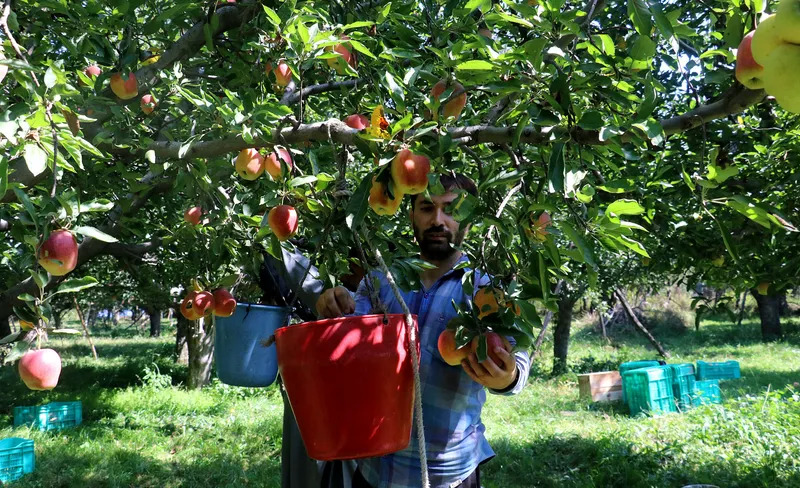
At the heart of the concern lies one commodity that defines Kashmir’s rural economy — the apple.
Kashmir accounts for roughly 78–80 percent of India’s annual apple production, estimated at around 25–28 lakh metric tonnes. The sector employs nearly 3.5 million people directly and indirectly and contributes more than 8 percent to the region’s GSDP. In villages across the Valley, apple orchards are not just farmland; they are generational legacies.
“I’ve spent my life nurturing these trees, just like my father and grandfather did,” said Basharat Ahmad, an orchardist from Budhan in north Kashmir. “But now, with these trade tensions, our entire way of life feels like it’s under attack.”
Tariffs, waivers and a changed equation
Under the evolving trade understanding, India has reportedly agreed to reduce tariffs on a range of American goods, including food and agricultural products. For apple growers in Kashmir and Himachal Pradesh, the possibility of a zero-duty regime on US apples is particularly alarming.
Until 2019, the United States faced a 50 percent duty on apple exports to India. After Washington raised tariffs on Indian steel and aluminium, New Delhi imposed an additional 20 percent retaliatory duty on US apples and walnuts. That move dramatically altered trade flows. Imports of US apples plummeted from 1,27,908 tonnes in 2018-19 to just 4,486 tonnes in 2022-23. Other countries – Turkey, Italy, Chile, Iran and New Zealand – filled the gap.
When India removed the additional 20 percent retaliatory duty in 2023, the government maintained that the original 50 percent Most Favoured Nation (MFN) duty remained intact. It also introduced a Minimum Import Price (MIP) of Rs 50 per kg for apples (excluding Bhutan), arguing this would prevent “flooding” and “predatory pricing.”
Now, growers fear that if tariffs are slashed further, or waived entirely, those protective layers may disappear.
“We think any move to reduce tariffs on imports of American fruit would be detrimental to our horticulture,” warned Bashir Ahmad Basheer, president of the Kashmir Valley Fruit Growers Cum Dealers Union (KVFGU). “When you have American apples available at cheaper rates relative to Kashmiri apples, this will threaten the viability of our horticulture sector.”
An uneven playing field
The structural imbalance between Indian and American apple farming adds to the anxiety. Domestic growers estimate that Indian orchards yield 7–8 tonnes per hectare on average, while growers in the US and other advanced horticulture economies can produce between 40 and 70 tonnes per hectare, thanks to superior mechanisation, high-density planting, and state support.
Former Kashmir Chamber of Commerce and Industry (KCCI) office-bearer Nasir Hamid Khan captured this disparity starkly in a recent article published in a local Kashmir daily: “I do not see how our farmers would compete with the industrialised, advanced farmers of the United States. They are 200 years ahead.”
That comment reflects more than frustration. It highlights a core structural concern: productivity gaps, access to technology, supply chain infrastructure, and cold storage capacities place Kashmiri growers at a significant disadvantage in a free-market scenario.
Even without American competition, the industry has been under strain. Growers already contend with erratic weather, scab and mite infestations, rising pesticide costs, expensive transportation, inadequate cold storage, and periodic market gluts. The devastating floods of 2025, which led to large quantities of apples being dumped along roads and into water bodies due to disrupted transport, remain a painful memory.
According to National Conference spokesperson Imran Nabi Dar, the sector has suffered losses of around Rs 2,000 crore this year due to adverse weather, road closures and floods. “Kashmiri apples are not only superior in taste but are also highly beneficial for health. No foreign apple can compete with the quality of Kashmiri produce,” Dar said, urging the Centre not to grant tax exemptions to imported fruit.
Monopoly fears and market dynamics
Some analysts warn that a complete waiver of duty for US apples, while other countries continue to face MFN tariffs, could distort the market. Nasir Hamid Khan argued that such a scenario could effectively hand the US a dominant position in India’s apple import market, displacing competitors and creating what he described as a de facto monopoly.
While India imports roughly five lakh tonnes of apples annually, projected to rise further, a sudden surge in competitively priced American produce could exert downward pressure on domestic prices. For a sector where margins are already thin, even a modest price crash can ripple across the Valley’s economy.
The KVFGU has gone a step further, demanding not only resistance to tariff reductions but an increase in tariffs to 100 percent on American apples. “Government will have to do this. Without such measures, horticulture will no longer be the mainstay of Kashmir’s economy,” Basheer said.
Carpets and the reciprocity question
The trade deal’s implications extend beyond horticulture. Kashmir’s handicrafts – carpets, shawls, papier mâché and artisanal goods – also face headwinds.
Previously, Indian carpets entering the US reportedly attracted a relatively low duty of around 2.9 percent. Under recent tariff revisions, that figure has surged, first through retaliatory measures and penalties, and now to what is described as an 18 percent “reciprocal tariff rate.”
For exporters already operating on tight margins, an 18 percent duty in a key market like the US is significant. The sector fears paused orders, renegotiated contracts and deferred payments.
Nasir Hamid Khan questioned the logic of calling the new tariff structure reciprocal. In his words, only those who negotiated or welcomed the deal “would be in a position to explain the reciprocity of the deal and how a whopping six-fold increase to 18 percent could be termed as a landmark step.”
Nasir argued that the KCCI, instead of celebrating the deal, should have acknowledged the risks posed by higher tariffs on handicrafts and the waiver of duties on US agricultural products.
“It is time that the Kashmir Chamber of Commerce and Industry understood the fact that the body is the most important watchdog of economic interests of Kashmiris,” he wrote, suggesting that silence on critical economic issues has “irreparably” hurt local interests over the years.
Between geopolitics and ground reality
From New Delhi’s perspective, negotiating tariff adjustments with Washington may be part of a larger strategy to manage escalating global trade tensions. The US has described its tariffs as a response to what it sees as India’s “excessively high” duties on American products. For India, the calculus may involve preserving broader strategic and economic ties with the US, even at the cost of sectoral concessions.
But in Kashmir, where the economy is narrowly concentrated and deeply agrarian, the impact is felt more directly.
The uncertainty itself is damaging. Exporters are reassessing pricing models; orchardists are calculating potential losses; traders are watching for signs of policy clarification on minimum import prices and safeguard mechanisms.
The road ahead
Much remains unclear. Will the Minimum Import Price remain in force? Will safeguards be introduced to prevent predatory pricing? Will negotiations lead to a softening of US tariffs on Indian handicrafts? Or will Kashmir’s growers and artisans have to adapt to a more competitive, less protected marketplace?
For now, the Valley’s apple economy stands at a crossroads. The stakes are not merely commercial.
As Basharat Ahmad looks over his orchard in Budhan, the trees are preparing for another season. But the question looming over Kashmir’s hills is whether global trade diplomacy will allow those trees, and the millions who depend on them, to continue bearing fruit.