This is India’s first official statement on the issue; Trump on Tuesday said imports from India might be hit with a tariff rate of 20 to 25 per cent as the trade agreement between the two nations has not yet been finalised yet. “I think so,” he said when asked if 20-25 percent would be a possible tariff rate for India. Later he announced 25 per cent tariffs beginning August 1
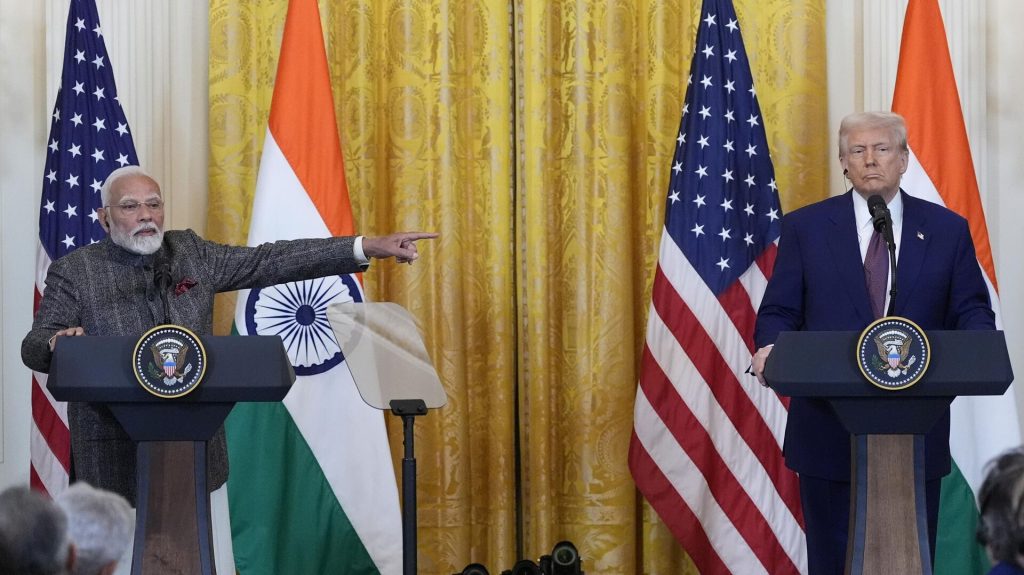
Responding to US President Donald Trump imposing “25 per cent,” tariff on India, the Narendra Modi government today said it will take all “steps necessary” to secure the country’s national interests as it has been the case with other trade agreements including the latest Comprehensive Economic and Trade Agreement with the UK. In a short but clear statement issued late evening, the Ministry of Commerce said that the “Government has taken note of a statement by the US President on bilateral trade. The Government is studying its implications.”
This is India’s first official statement on the issue.
“India and the US have been engaged in negotiations on concluding a fair, balanced and mutually beneficial bilateral trade agreement over the last few months. We remain committed to that objective.
“The Government attaches the utmost importance to protecting and promoting the welfare of our farmers, entrepreneurs, and MSMEs.
“The Government will take all steps necessary to secure our national interest, as has been the case with other trade agreements including the latest Comprehensive Economic and Trade Agreement with the UK,” according to a statement issued by the Ministry of Commerce and Industry headed by Piyush Goyal. Earlier External Affairs Minister S Jaishankar met Goyal after Trump’s initial statement of 20-25 percent tariffs on India on the sidelines of the ongoing Monsoon Session of the Parliament, sources said
August 1 is the deadline for implementation of reciprocal tariffs on various trading partners, including India. The deal remains unfinalised despite several rounds of discussions and any further delays could negatively impact the Indian economy and stock market but sources in know of developments say that for a government which is facing backlash on Trump’s repeated claims on brokering ceasefire between India and Pakistan, it needs to be extra caution while finalising the deal in mind the interests of people, especially the farmers
Recently India and the United Kingdom made history by officially signing the Comprehensive Economic and Trade Agreement (CETA) which is projected to elevate bilateral trade by $34 billion annually. At a time when the India-US trade agreement was facing uncertainties, CETA was described as India’s most ambitious pact with a Western country.
What Trump said
Trump on Tuesday said that imports from India might be hit with a tariff rate of 20 to 25 per cent as the trade agreement between the two nations has not yet been finalised yet. Travelling back to Washington after a five-day visit to Scotland, Trump told reporters on-board the Air Force One “I think so,” when asked if 20-25 per cent would be a possible tariff rate for India.
“…India is my friend. They ended the war with Pakistan at my request… India has been a good friend, but India has charged basically more tariffs than almost any other country. You just can’t do that,” Trump was quoted as saying.
Later he announced 25 per cent tariffs beginning August 1.
August-1 deadline
Coming just ahead of the August-1 deadline for the implementation of reciprocal tariffs on various trading partners, including India, Trump’s comments are significant. Sources familiar with the developments say that Trump may speak with Prime Minister Narendra Modi before the final nod to the long-anticipated deal.
Though Indian equity benchmark indices—Sensex and Nifty—traded higher on Wednesday, there continues to be a lingering uncertainty over the much-delayed agreement. Gold and silver prices also remained bullish in the domestic futures market on the back of persistent uncertainty over the deal, driving investors into safe-haven assets.
The issue
Trump in April announced increased tariffs with an objective to reduce the US’ trade deficit, which he later paused at a reduced 10 % till negotiations.
Agricultural products and genetically modified crops remain some of the main sticking points from the India side. A key point of contention is America’s insistence on greater access to Indian markets for its agricultural, dairy, and GM products, India argues that such access could negatively impact the livelihoods of its farmers.
The US is pushing for reduced tariffs on its industrial goods, electric vehicles, dairy products, wines, apples, etc Some farmer groups are also urging the government to exclude agriculture from the agreement entirely. The tariffs on Indian products could hurt India’s export as the US is India’s top export destination with nearly 20 per cent share in the country’s total outbound shipments.