“Jumla culture enters science,” says Coalition for a GM-Free India, accuses ICAR and Agriculture Ministry of “rigging results to promote an unsafe technology in the form of genome-edited rice varieties”
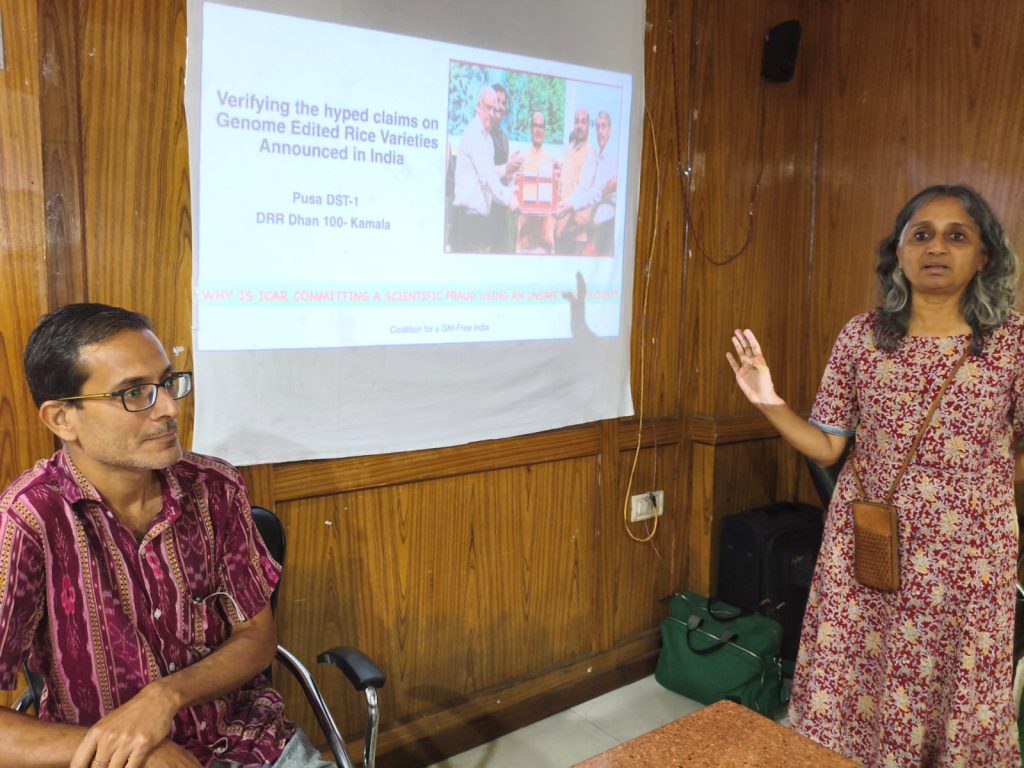
The Coalition for a GM-Free India on Thursday accused India’s premier agricultural research body Indian Council of Agricultural Research (ICAR) and the Union Agriculture Ministry of “fabricating” trial data to promote what it called “unsafe and underperforming” genome-edited rice varieties. Citing ICAR’s own All India Coordinated Research Project on Rice reports for 2023 and 2024, the Coalition alleged that results for two genome-edited rice lines — Pusa DST-1 and DRR Dhan 100 (Kamala) — were manipulated to manufacture success stories that the data itself does not support.
“As has become the habit with biotech lobbies in the country, seen earlier with Bt brinjal and GM mustard, science is yet again being compromised to push some genome-edited varieties as miracle seeds for India, while there is no testing or data to support the hype.
“Such compromised science brings a bad name to India’s scientific establishment and causes serious erosion of the credibility of ICAR and other institutes,” the Coalition said addressing media persons on Thursday
“This is not just bad science — it’s scientific fraud,” its members claimed, adding : “Such compromised research not only misleads farmers and citizens but also drags down the credibility of India’s public science institutions.”
The controversy stems from Union Agriculture Minister Shivraj Singh Chauhan’s announcement in May declaring the two genome-edited rice varieties as “global firsts.” ICAR claimed that Pusa DST-1 was tolerant to saline soils and that Kamala yielded 17% more, matured 20 days earlier and used nitrogen efficiently — claims now being challenged as “scientifically baseless”. The Coalition is accusing the ICAR and the Agriculture Ministry of committing “scientific fraud” in the country’s genome-edited rice programmes to promote “unsafe and underperforming rice varieties”
According to Coalition’s Kavitha Kuruganti, ICAR’s own 2023 data, Pusa DST-1 showed no recorded testing for drought or salinity tolerance due to “limited seed quantity.” Trial results actually showed a –4.8% yield compared to its parent, MTU-1010, and underperformance in 12 of 20 sites. In 2024, the line showed no yield advantage in salinity trials, and only a marginal 1.6% gain in alkaline soils. Yet, ICAR’s report summary claimed a “30% higher yield” — cherry-picking eight locations out of one zone. The same report, she said, even admitted that “no yield superiority was observed under coastal salinity.”
Likewise for DRR Dhan 100 ‘Kamala’, which ICAR projected as “miracle” rice, the Coalition’s analysis found it underperformed in eight of 19 sites in 2023 and had no consistent yield edge across zones. “Doing bad science in agriculture, that too from the public sector, has a direct bearing on millions of farmers. “This becomes a matter of fundamental human rights. How can the jumla culture be allowed to enter the scientific arena?” questioned Kavitha.
Independent researcher Soumik Banerjee added, “If genome editing is truly precise and safe, there should be no hesitation in putting all data in the public domain and following full regulatory oversight, as done for GMOs.”
The Coalition demanded an independent review of ICAR’s trial data and methodology, an immediate withdrawal of promotional claims, and a moratorium on genome-edited crop releases until credible biosafety rules and oversight mechanisms are in place. “This is junk science dressed up as innovation,” the Coalition said. “Hundreds of crores in public funds are being wasted on technologies that neither work nor serve farmers.”
“As has become the habit with biotech lobbies, science is being compromised to push risky genome-edited crops as miracle seeds for India,” the Coalition said. “Such compromised science erodes the credibility of ICAR and damages public trust in Indian research.”