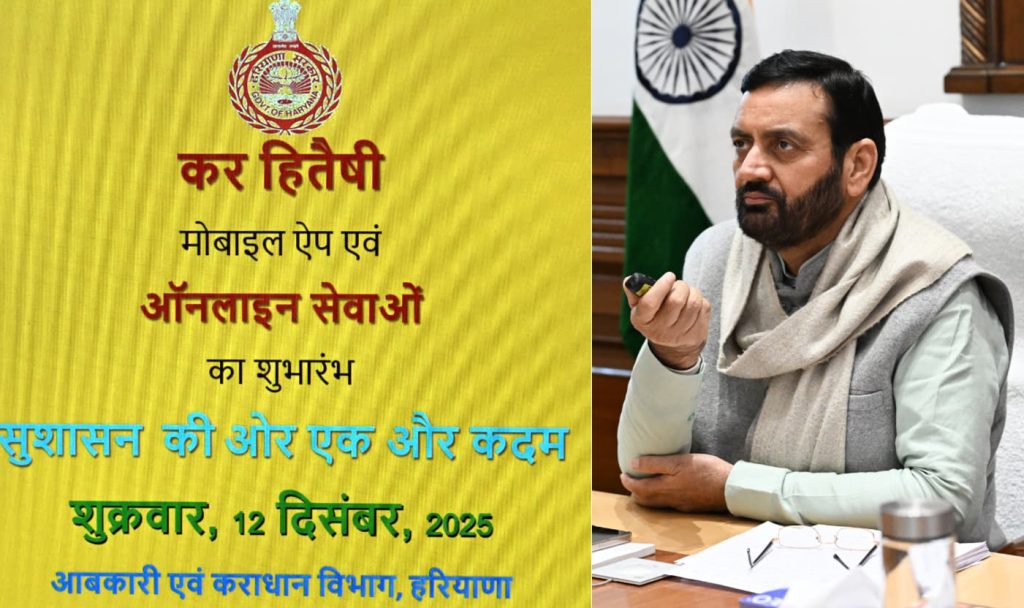
Haryana’s Chief Minister, Nayab Singh Saini, today launched two major digital initiatives by the Excise and Taxation Department, accelerating transparency, efficiency, and ease in governance and administration. The goal of these digital initiatives is to fully tech-enable departmental processes, deliver services to the public in a timely manner, and strengthen revenue management.
The Chief Minister launched the “Kar Hitaishi” mobile application developed by the department. This app provides a simple and confidential way for citizens to report GST evasion. Citizens can upload information regarding irregularities such as fake billing, incorrect input tax credit, unregistered businesses, non-issuance of bills, or hiding transactions, along with photos, videos, or documents. The app ensures that the identity of the informant is not visible to the relevant field officers. Upon receiving the information, departmental officers will carry out necessary investigations and actions.
The Chief Minister appreciated this initiative, stating that it would encourage voluntary reporting and strengthen transparency in GST administration.
Additionally, Nayab Singh Saini inaugurated six new online excise services. These services have been developed for permits related to ethanol, extra neutral alcohol (ENA), and denatured spirits. Now, businesses will be able to apply online for permits regarding the import and export of ethanol, ENA, and denatured spirits. In this system, applicants can track the status of their applications and download digitally signed permit letters.
It was informed during the meeting that, through the real-time dashboard, the movement of goods, the timeline of permits, and compliance will be monitored. This system will reduce paperwork, prevent misuse, and provide faster and more transparent services to industries.
The Chief Minister directed that other excise services, such as brand label registration and licensing modules, be made available online soon to further tech-enable departmental processes.
The Chief Minister also reviewed the functioning of the Excise and Taxation Department. The meeting included a detailed evaluation of the department’s revenue performance, enforcement actions, pending recoveries, and the progress of ongoing digital reforms in the GST, VAT, and excise sectors.
It was reported that Haryana recorded the highest growth in net SGST collection nationwide with a 21% increase, while the national average stands at 6%. In November 2025, the state’s net SGST collection reached ₹3,835 crore, marking a 17% increase compared to November of the previous year. For the current financial year, by November, the total GST collection stood at ₹83,606 crore, 7% more than the previous year, surpassing the national average of 5.8%. Based on increasing revenue, Haryana’s ranking has improved to the fourth position. Officials reported that there are 6,03,389 GST-registered taxpayers in the state, with an annual growth rate of 6.11% between 2018 and 2025.
During the meeting, the Chief Minister also reviewed the value-added tax (VAT) and CST. The Chief Minister was informed that VAT is applicable on six items in Haryana: petrol, diesel, liquor, PAG, CNG, and CST items. There has been a notable increase in VAT collection up to November 2025-26, largely due to the One-Time Settlement (OTS) Scheme-2025. The scheme led to a 60.99% increase in CST collection. After the scheme ended on September 27, 2025, the department launched a special recovery campaign, recovering ₹48.12 crore in October-November 2025.
Officials also reported that the department has developed a VAT monitoring dashboard, which tracks VAT payments in real time. The system automatically alerts field officers in case of delays, helping them take timely action. The Chief Minister instructed that all districts regularly use this dashboard to ensure greater efficiency in the department’s functioning.
It was reported that by November 30, 2025, excise revenue for the financial year 2025-26 had reached ₹9,370.28 crore, compared to ₹8,629.46 crore for the same period last year. The department presented details of district-wise and item-wise license fees, excise fees, bottling fees, permit fees, import duties, and VAT on indigenous liquor. The Chief Minister directed that districts with lower collections should increase monitoring, speed up inspections, and take timely corrective actions.
Additionally, assets worth ₹125 crore were seized, ₹46.66 crore was recovered during the current policy year, and an automatic interest calculation system for delayed license fee payments led to a mandatory recovery of ₹16.46 crore. The department also reported progress in the QR-based track-and-trace system, hologram certification, ANPR cameras and boom barriers at manufacturing units, telemetry-based real-time monitoring in distilleries, and the online licensing module.
The Chief Minister directed that these digital reforms be implemented swiftly, and their impact be regularly reviewed to ensure visible improvements in transparency, compliance, and service delivery. Appreciating the department’s revenue performance and digital reforms, the Chief Minister emphasized the state’s commitment to establishing a transparent, tech-driven, and citizen-friendly tax and excise administration, which will contribute significantly to the state’s economic growth.
The meeting was attended by the Chief Minister’s Principal Secretary Rajesh Khullar, the Commissioner and Secretary of the Excise and Taxation Department Ashima Barad, Commissioner of Excise and Taxation Vinay Pratap Singh, and other officials.