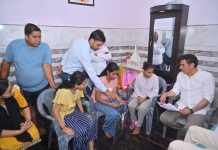
For Akie Abe, the photographs unveiled in Varanasi on Wednesday brought back memories of her late husband, former Japanese Prime Minister Shinzo Abe, and his association with Kashi.
Standing at the Rudraksh International Cooperation and Convention Centre, Akie Abe appeared visibly emotional during the ceremony as a photo gallery dedicated to her husband was unveiled. The gallery features photographs from Abe’s December 2015 visit to Varanasi, including images from the Ganga Aarti.
The Abe Memorial Corridor was inaugurated at the Rudraksh centre in the presence of Akie Abe and Uttar Pradesh Chief Minister Yogi Adityanath. Yogi described it as a “living symbol” of India’s historical, cultural and diplomatic ties with Japan and a tribute to Abe’s contribution to those relations.
For India, however, the memorial’s significance lies not only in the photographs of a former Japanese prime minister. It lies in the place where they are being preserved.
Rudraksh itself is part of the story of India’s relationship with Japan — a relationship in which Abe played a significant role.
The visit that connected Abe to Kashi
Shinzo Abe visited Varanasi with Prime Minister Narendra Modi on December 12, 2015. The visit included the Ganga Aarti at Dashashwamedh Ghat.
Abe later described the ceremony as “tremendously magical and beautiful”, recalling the lights, flowers and music along the Ganges and reflecting on the possibilities of further developing Japan-India relations.
The photographs from that visit now form part of the gallery commemorating Abe at Rudraksh, bringing the story back to the banks of the Ganges where Abe and Modi appeared together more than a decade ago.
But that visit also has another connection with the building in which Abe’s photographs are now displayed.
The Rudraksh connection
When Prime Minister Narendra Modi inaugurated the International Cooperation and Convention Centre — Rudraksh in July 2021, he recalled his conversation with Abe during the Japanese prime minister’s visit to Kashi.
According to Modi’s recollection at the 2021 inauguration, he had discussed the idea of Rudraksh with Abe during that visit and Abe had asked his officials to work on the idea.
That account places Abe in the early history of a project that would eventually become one of the most visible symbols of Japanese assistance and India-Japan cooperation in Varanasi.
Modi inaugurated Rudraksh on July 15, 2021, after it was constructed with Japanese grant assistance through the Japan International Cooperation Agency (JICA).
JICA described the centre as a “Symbol of the Friendship between Japan and India” and said it was intended to promote cultural and people-to-people exchanges, as well as host cultural and academic activities.
The building itself reflects its setting. Its façade incorporates 108 Rudraksh beads, and its design combines a modern convention facility with elements associated with Kashi’s cultural identity.
From Kashi to Kyoto
The cultural relationship between India and Japan around Kashi predates Rudraksh.
In August 2014, Modi and Abe witnessed the signing of a statement of intent to link Kyoto and Varanasi as partner cities. The initiative sought to strengthen cooperation between two cities with deep religious, cultural and historical traditions.
That connection added a cultural dimension to the wider India-Japan relationship.
Rudraksh subsequently gave that relationship a physical presence in Kashi. According to JICA, the centre was intended to serve as a venue for cultural events, academic meetings and activities promoting people-to-people exchanges between India and Japan.
For Varanasi, the project brought together two strands: the city’s centuries-old cultural identity and India’s expanding engagement with Japan.
A personal memory inside a symbol of friendship
For Akie Abe, Wednesday’s ceremony was inevitably personal.
The photographs on display recalled her husband in Kashi — a visit that had become part of his relationship with Modi and, according to Modi’s later account, part of the Rudraksh project’s early history.
For India, the occasion brought together a longer story.
Abe came to Kashi in 2015 and joined Modi for the Ganga Aarti. According to Modi’s recollection, the two leaders discussed the idea of Rudraksh during that visit. The centre was subsequently built with Japanese grant assistance and inaugurated in 2021. Now, in 2026, a memorial corridor dedicated to Abe has been created at the same venue.
The sequence gives the memorial a significance beyond the photographs themselves.
It connects Abe’s visit to Kashi, the creation of Rudraksh and the continuing India-Japan relationship in one place.
The memorial therefore preserves not only the memory of a Japanese leader but also a moment in the history of India-Japan relations — one that began with two leaders in Kashi and eventually found a physical expression in Rudraksh.
For Akie Abe, the photographs brought back a personal memory. For Kashi, they have become part of the city’s continuing relationship with Japan.
And inside a building built with Japanese assistance, Abe’s memory now forms another chapter in the story of how Kashi became a meeting point between India and Japan.