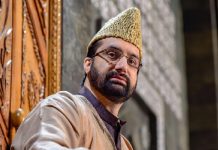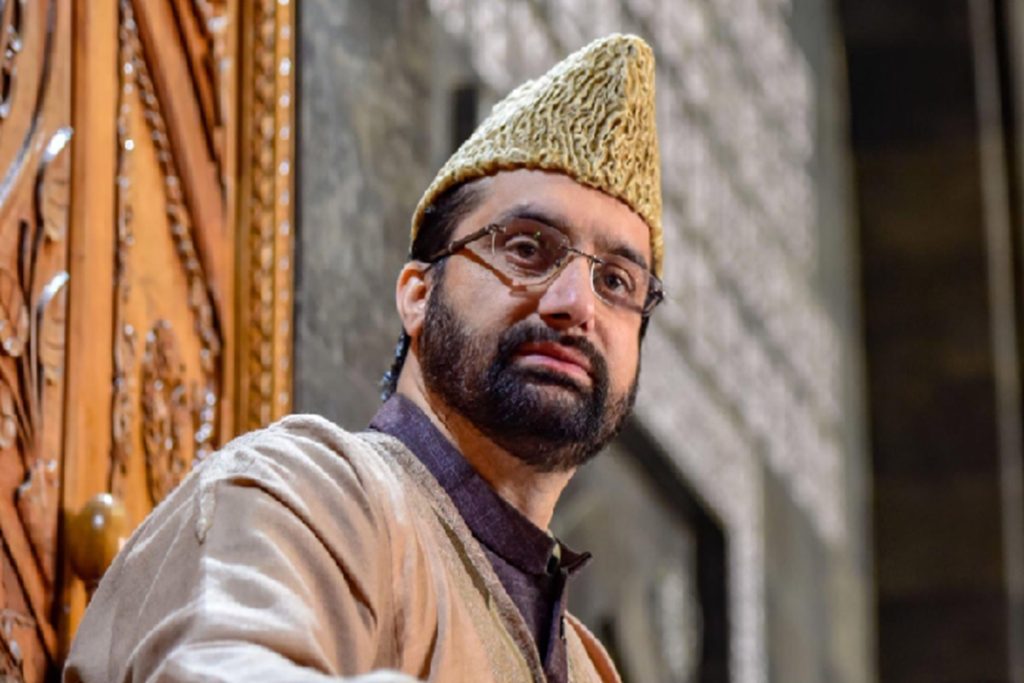
When Kashmir’s chief cleric Mirwaiz Umar Farooq quietly removed the description “Hurriyat chairman” from his X (formerly Twitter) bio in late December, the change appeared minor on the surface. In reality, it captured a much deeper shift: the narrowing of political space for separatist voices and the steady fading of an organisation that once claimed to represent Kashmir’s dissident conscience.
Mirwaiz said the decision followed sustained pressure from authorities. “For some time now, I was being pressed by the authorities to make changes to my X (formerly Twitter) handle as Hurriyat chairman,” he wrote. Officials, he said, warned that since “all the constituents of Hurriyat Conference, including the Awami Action Committee that I head have been banned under the UAPA, making Hurriyat a banned organisation,” his account would otherwise be taken down.
The choice, he said, amounted to a “Hobson’s choice.” “At a time when public space and avenues of communication stand severely restricted, this platform remains among the very few means available to me to reach out to my people and share my views on our issues with them, and the outside world,” the Mirwaiz wrote.
That explanation did little to calm the political storm the move unleashed across Kashmir. For some, it signalled pragmatic survival; for others, it was a troubling symbol of surrender. Yet beyond the immediate controversy lies a larger truth: the All Parties Hurriyat Conference (APHC), once the most recognisable umbrella of separatist politics in Kashmir, has been reduced to a shadow of its former self — legally banned, organisationally hollowed out, and politically sidelined.
Founded in 1993 as a coalition of more than 20 groups — separatist parties, trade bodies and civil society organisations — Hurriyat once described Kashmir as a “disputed territory” and demanded the implementation of United Nations resolutions. In the 1990s and early 2000s, it wielded moral and political influence disproportionate to its loose structure, mobilising shutdowns, issuing joint calendars and acting as a conduit — however imperfect — between Kashmiri separatist sentiment and New Delhi, Islamabad and international interlocutors. No longer.
Reactions that reflect a fractured politics
Political reactions to the Mirwaiz’s decision revealed as much about contemporary Kashmir as the move itself. Peoples Democratic Party (PDP) president Mehbooba Mufti framed it as a personal choice but defended the larger idea behind Hurriyat. “Hurriyat was ‘an idea and represented the alienation felt by people’,” she said. “A person could be jailed but not the idea.” Questioning the government’s claims of normalcy, she asked, “If everything is normal in Kashmir, then why do so many raids take place every day?”
PDP legislator Waheed-ur-Rehmaan Parra offered a religious analogy, likening the Mirwaiz’s decision to the Treaty of Hudaybiyyah. “The Prophet agreed to erase the words ‘Muhammad-ur-Rasoolullah (Prophet Muhammad)’, the very foundation of the Kalima, solely in the interest of peace,” he said, adding that history remembers it as “wisdom, foresight, and moral courage.” Mr. Farooq’s move, Parra argued, should be seen “as an act of peace” and “must never be weaponized against him.”
Others were less charitable. Sajad Lone, a former separatist who now leads the J&K Peoples Conference, rejected the comparison outright. “A surrender in lieu of protocol and CRPF security should not ever be compared with the peace treaty of Hudaybiyah in Mecca,” he said, urging politicians to avoid what he called a “religious overstretch.”
National Conference leader Tanvir Sadiq focused on the alleged coercion. “The Mirwaiz is a religious scholar and widely respected. He claimed that he was pressurised (to remove the Hurriyat chairman title). If a respectable person like the Mirwaiz says he has been pressurised, this should be re-examined by the government,” he said.
The diverging responses underscored a reality long in the making: Hurriyat no longer functions as a central pole around which opinion coalesces.
‘My beliefs have not changed — not even by a comma’
Amid the controversy, the Mirwaiz moved quickly to clarify that symbolism should not be mistaken for ideological retreat. In a detailed note issued after he was barred from addressing Friday prayers at Srinagar’s Jama Masjid — for the second consecutive week — he insisted his convictions remained intact.
“Let me make it clear, my beliefs and convictions have not changed — not even by a comma,” he wrote.
Social media, he argued, had become his last remaining channel of communication. “With Hurriyat constituents banned, all offices sealed and institutions closed, leaders and activists either in jails or under constant surveillance, social media remains the only platform that gives some voice and opportunity to connect with people and the outside world.”
He rejected accusations that the move was linked to security arrangements. “They make a strange argument — for being provided security. But it was provided to me since the day of my father’s martyrdom 35 years ago. If I did not compromise for it since then, why should I compromise now?”
Mirwaiz reiterated his long-held emphasis on dialogue, invoking former Prime Minister Atal Bihari Vajpayee’s formulation of “insaniyat aur jamhooriyat.” “My path remains the same,” he said, stressing that dialogue had worked elsewhere and could still offer a way forward.
Yet even as he spoke of continuity, the context around him told a different story — one of shrinking space, enforced silence and political redundancy.
A movement out of time
The decline of Hurriyat has been gradual but decisive. The death of Professor Abdul Gani Bhat in September marked not just the passing of a senior leader but the symbolic end of an era. A founding member and former chairman, Bhat had long been described as Hurriyat’s “voice of moderation.” His burial, hurried through amid restrictions, reflected the diminished stature of a leadership once capable of mobilising mass participation.
Yasin Malik’s long incarceration and the affidavit last year to the Delhi High Court provides another marker of the new state of affairs. Framing himself as a betrayed peacemaker, Malik wrote that despite working to strengthen peace, he was branded a terrorist “I should ideally be seen as an apostle of peace and harmony,” he wrote, lamenting the collapse of a political process he said he had once helped sustain.
Together, these moments highlight the disappearance of the political conditions that once made Hurriyat relevant. For decades, its influence rested on three pillars: organisational presence on the ground, moral authority over separatist sentiment, and tactical usefulness to New Delhi and Islamabad during phases of dialogue.
All three have eroded.
Post-2019, legal bans, detentions and administrative controls dismantled Hurriyat’s organisational networks. Leaders were confined, and offices sealed. Simultaneously, separatist constituencies fragmented: some activists drifted into mainstream politics, and others disengaged entirely.
Most critically, Hurriyat lost its strategic utility. Track-II diplomacy, mediated talks and international attention — once the lifeblood of its relevance — dried up. New Delhi hardened its position after the revocation of Article 370, while Islamabad’s diplomatic leverage waned globally. An amalgam designed to negotiate a disputed settlement found itself with no negotiating table.
Relic, reinvention or irrelevance?
What remains for Hurriyat today are bleak options. It can fade into memory as a political formation whose life cycle has ended. It can attempt reinvention, shedding separatist maximalism for mainstream politics — a path fraught with ideological contradictions. Or it can persist as a symbolic network.
The precedent of Jamaat-i-Islami’s unsuccessful foray into electoral politics suggests reinvention offers no guarantees. Once severed from its ideological core, Hurriyat risks becoming just another marginal party, devoid of either moral authority or electoral viability.
Against this backdrop, Mirwaiz’s removal of a title from a social media bio appears less an act of capitulation than a quiet acknowledgement of reality. Hurriyat’s decline was neither sudden nor triggered by a single decision; it is the outcome of a transformed political landscape in which the organisation no longer fits.
Mirwaiz insists that ideas cannot be banned. History suggests he may be right. But institutions can wither, and movements can outlive their moment. Hurriyat, once Kashmir’s most recognisable separatist platform, now stands as a relic of a political era that has decisively closed — leaving behind memories, arguments, and unresolved questions, but little organised power.