Frequent wildfires are adversely impacting the vegetative cover of protected forest areas in India, and leading to alien plant species replacing native vegetation, threatening ecosystems and the delicate balance sustaining India’s wildlife, writes Deepanwita Gita Niyogi
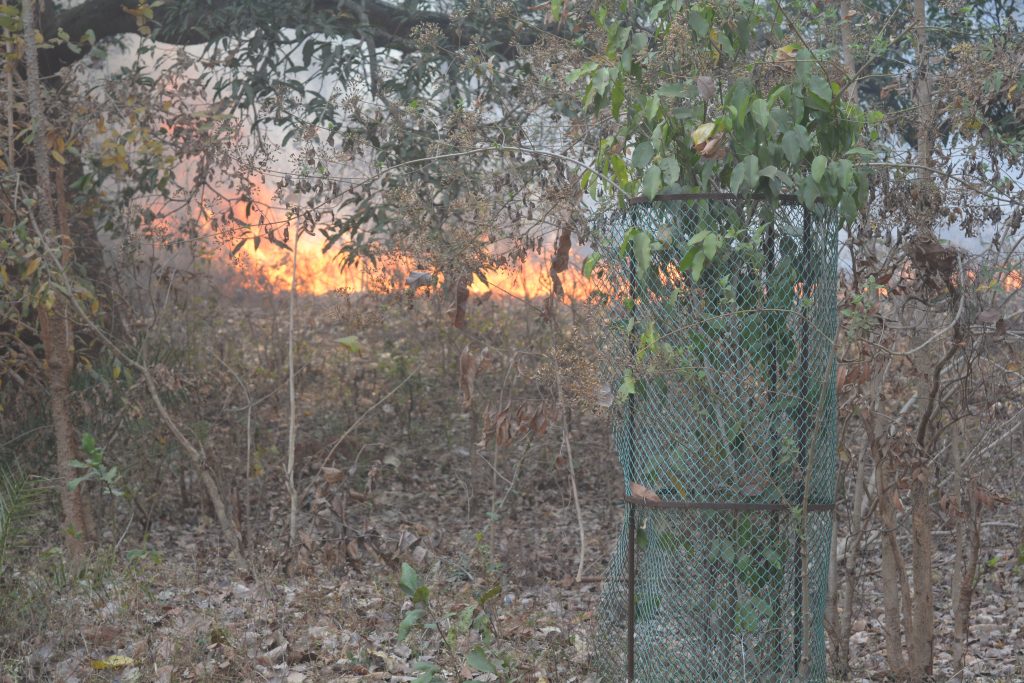
Across the world, forest fires are increasing due to climate change. In India, which is among the top ten forest-rich countries in the world, fires commonly occur in the summer season, from the months stretching from February to June.
In forested hilly terrains like Similipal in Odisha and Udanti-Sitanadi in Chhattisgarh, fires are difficult to control once they break out at higher elevations. In Udanti-Sitanadi, which is a tiger reserve, some 450 fire incidents occurred last year. In Similipal where fires are frequent, protection assistants help prevent forest fires and sensitise communities.
According to deputy director of Udanti-Sitanadi Tiger Reserve Varun Jain, this year was comparatively better. “Fortunately, there was no fire incident after April 10. Usually, the fire season continues till June, but this year, there were pre-monsoon showers in April. So, the jungle turned green in the middle of the month. Pre-monsoon showers usually happen in May.”
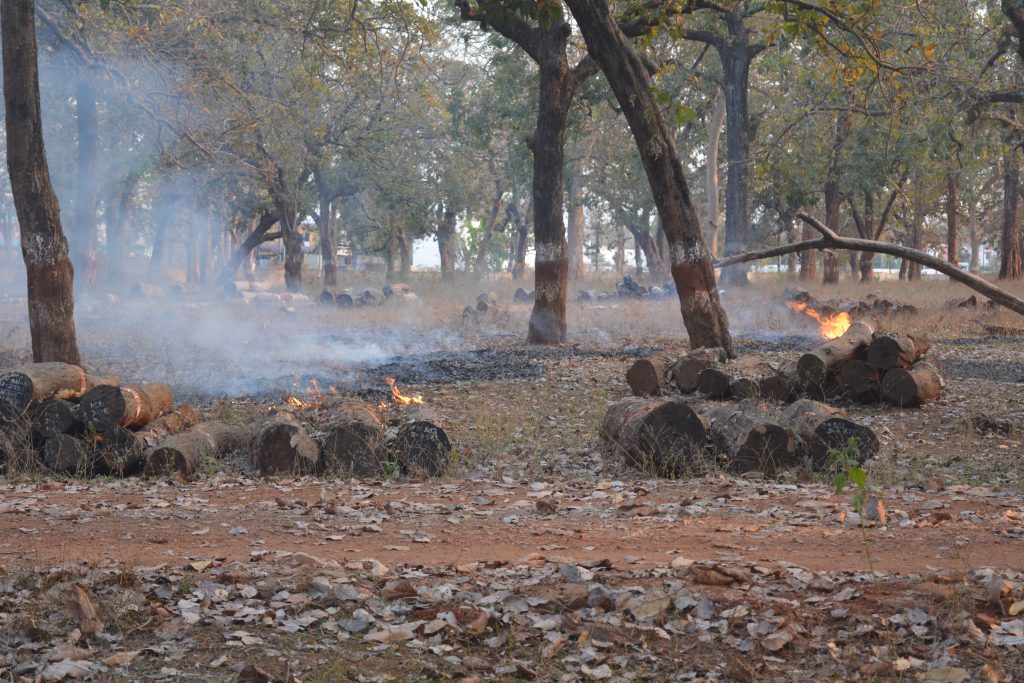
For forest guard Sudhanshu Verma, who is posted in Udanti-Sitanadi, fire management involves intense work. Fire lines are created to help prevent the spread of fires. But whenever fires spread, the hilly terrain poses a challenge in easy movement. Blower machines, which clear piles of dead leaves, come in handy but at present there are about 40 of them. More machines will be welcome.
The lack of adequate manpower as well as equipment deals a blow to the fire-fighting staff. “Fires take a huge toll on human resources. The biggest challenge is performing duty with minimum facilities and the lack of sophisticated tools. Uphill areas entail a lot for climbing for dousing fires,” a forest guard posted in Rajasthan shared on the condition of anonymity.
A shift in vegetative cover
Mohan Pargaien, a retired Indian Forest Service officer, who served as the former Chief Wildlife Warden of Telangana, said that fires in India, usually deliberate or as a result of human negligence, are quite common. But, in some areas, a few fires occur naturally. Whatever be the cause, fires are leaving lasting impacts on India’s biodiversity.
As an observant officer, Jain has noticed a transformation in Udanti-Sitanadi. As fires gradually lead to land degradation and the loss of soil moisture, eventually weeds come up. When this happens, the extent of grass availability on which herbivores depend for survival is reduced. A direct impact on the herbivore population can endanger the tiger, for the protection of which India has been striving hard since the inception of Project Tiger in 1973.
Over a call, Pargaien shared further information regarding this change. “In the past few decades, climate change has impacted the soil condition. High temperatures have led to soil infertility, and this has been exacerbated due to the lack of moisture. Forests are getting compromised. With hotter summers, fires are now more likely to occur. Once fires occur, the soil quality undergoes a change. So, the change is occurring through the soil.”
A direct impact of soil infertility is the rapid spread of alien and invasive species. These can grow in hostile conditions and take over local species. Invasive species come up even in challenging areas. It has been observed that lantana takes over and even Prosopis juliflora spreads. “But though any vegetation cover is good, from the point of view of biodiversity, it is not a great idea at all,” Pargaien told Tehelka. Citing the example of the famous Sal-dominated Saranda forest in Jharkhand, he pointed out that it is an ancient ecosystem. Any kind of disturbance will impact the region’s biodiversity and leave a lasting impact.
In India, lantana now covers almost 60 percent land area in protected areas. Originally, it was introduced by the British for gardens in the 1800s as an ornamental plant, as it is attractive in appearance. But it spreads fast and can grow in any kind of soil.
According to a study, lantana continues to spread and occupies 13 million hectares in India. Costs of control are US $200 per hectare in India, the study, Lantana in India: A Losing Battle? published in PLoS One, says.
The deputy director of Pench Tiger Reserve in Madhya Pradesh, Rajnish K Singh, admitted that the removal of lantana entails a huge expense and vast manpower. “If cut, it comes up again. It has to be uprooted. But after uprooting, there is a need for constant monitoring and replacement by other grasses. Unfortunately, forest fires accelerate such changes in ecology.”
The officer pointed out that sometimes tigresses hide their cubs inside lantana bushes and blue bulls feed on lantana in the monsoon, despite the abundance of grasses. As it is an invasive species, the park management tries to remove most of it, but retain it in some portions.
Singh underlined that in Madhya Pradesh, rainfall has become erratic, which is a clear sign of a changing climate. The officer who joined Pench in 2022 shared that the number of fires has thankfully reduced from 65 to 11. From a total of 280 hectares, it has reduced to 15 hectares in Pench. “However, as Udanti across the border has a huge area with over 50 villages, forest fires can often be uncontrolled. Compared to this, in Pench there are no villages in the core or critical habitat area.”
Vigilance to prevent fires
It is difficult to manage forest fires without community involvement. At times, the collection of mahua flowers in the summers leads to forest fires, as collectors burn the undergrowth for easy identification of the small flowers, an important minor forest produce. This calls for intense vigilance and awareness in fire-prone areas.
Last year, Uttarakhand was in news for uncontrolled forest fires. Reenu Paul, who is a resident of capital city Dehradun, said this year the situation improved due to rainfall. On her part, Paul runs a vigilance group which keeps an eye on the Rajpur reserve forest. She is the founding president of the Rajpur Community Initiative, a citizen-based organisation. Paul pointed out that over-tourism and faulty waste management are reasons behind forest fires. Sometimes, people set fire to dumped waste which spread to forest areas.
Saket Badola, who is posted in the Jim Corbett Tiger Reserve in Uttarakhand as a field director, said that fires damage the surface vegetation, and in India, it is mostly that. Badola listed the negative impacts of fires, especially in Corbett, which attracts tourists from across the world due to its association with hunter-turned conservationist and author Jim Corbett, magnificent tigers and the Terai grassland. “Fire-resistant species come up after forest fires. I have noticed soil run-off, as there is no cover left. Heavy rainfall aggravates the already worsening run-off situation.”
But the Corbett management is doing all it can to tackle forest fires, such as working with and utilising satellite data as well as thorough mapping to monitor active fires. In this regard, an app has also been developed to share timely information with field units.
“In Uttarakhand, fires which start from February 15 and last till June 15, are a challenge. But there are an adequate number of firewatchers. During the fire season, they have gear and protective equipment, and also get ration facility,” Badola said. He described last year as bad. Thankfully, preparation was good this year. As winter rains occurred, the soil moisture increased. But the real success lay in reducing the reaction time in forest fire management. The Kalagarh Tiger Reserve in Corbett just reported a solo incident this year as per data shared by the forest department. In Ramnagar, there was no incident.