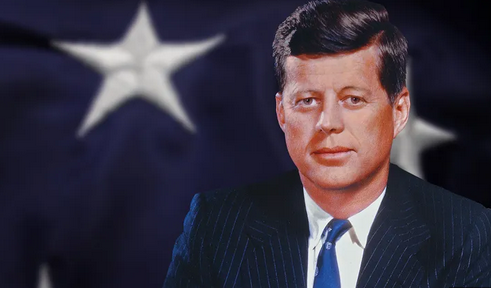
From 1944, long before he became President, John F. Kennedy battled to save himself and his men while adrift in the South Pacific. Extract from “Survival” by John Hersey, a Reporter at Large with newyorker.com
Our men in the South Pacific fight nature when they are pitted against her, with a greater fierceness than they could ever expend on a human enemy. Lieutenant John F. Kennedy, the ex-Ambassador’s son and lately a PT skipper in the Solomons, came through town the other day and told me the story of his survival in the South Pacific. I asked Kennedy if I might write the story down. He asked me if I wouldn’t talk first with some of his crew, so I went up to the Motor Torpedo Boat Training Centre at Melville, Rhode Island, and there, under the curving iron of a Quonset hut, three enlisted men named Johnston, McMahon, and McGuire filled in the gaps.
It seems that Kennedy’s PT, the 109, was out one night with a squadron patrolling Blackett Strait, in mid-Solomons. Blackett Strait is a patch of water bounded on the northeast by the volcano called Kolombangara, on the west by the island of Vella Lavella, on the south by the Island of Gizo and a string of coral-fringed islets, and on the east by the bulk of New Georgia. The boats were working about forty miles away from their base on the island of Rendova, on the south side of New Georgia. They had entered Blackett Strait, as was their habit, through Ferguson Passage, between the coral islets and New Georgia.
The night was a starless black and Japanese destroyers were around. It was about two-thirty. The 109, with three officers and ten enlisted men aboard, was leading three boats on a sweep for a target. An officer named George Ross was up on the bow, magnifying the void with binoculars. Kennedy was at the wheel and he saw Ross turn and point into the darkness. The man in the forward machine-gun turret shouted, “Ship at two o’clock!” Kennedy saw a shape and spun the wheel to turn for an attack, but the 109 answered sluggishly. She was running slowly on only one of her three engines, to make a minimum wake and avoid detection from the air. The shape became a Japanese destroyer, cutting through the night at forty knots and heading straight for the 109.
The thirteen men on the PT hardly had time to brace themselves. Those who saw the Japanese ship coming were curiously paralyzed by fear: they could move their hands but not their feet. Kennedy whirled the wheel to the left, but again the 109 did not respond. Ross went through the gallant but futile motions of slamming a shell into the breach of the 37-millimetre anti-tank gun, which had been temporarily mounted that very day, wheels and all, on the foredeck.
The urge to bolt and dive over the side was terribly strong, but still no one was able to move; all hands froze to their battle stations. Then the Japanese crashed into the 109 and cut her right in two. The sharp enemy forefoot struck the PT on the starboard side about fifteen feet from the bow and crunched diagonally across with a racking noise. The PT’s wooden hull hardly even delayed the destroyer. Kennedy was thrown hard to the left in the cockpit, and he thought, “This is how it feels to be killed.” In a moment, he found himself on his back on the deck, looking up at the destroyer as it passed through his boat. There was another loud noise and a huge flash of yellow-red light, and the destroyer glowed. Its peculiar, raked, inverted-Y stack stood out in the brilliant light and, later, in Kennedy’s memory.
…..A moment later, a PT came alongside. Kennedy jumped onto it and hugged the men aboard—his friends. In the American tradition, Kennedy held under his arm a couple of souvenirs: one of the improvised paddles and the Japanese gas mask.
With the help of the natives, the PT made its way to Bird Island. A skiff went in and picked up the men. In the deep of the night, the PT and its happy cargo roared back toward base. The squadron medic had sent some brandy along to revive the weakened men. Johnston felt the need for a little revival. He felt he needed quite a bit of revival. After taking care of that, he retired topside and sat with his arms around a couple of roly-poly, mission-trained natives. And in the fresh breeze on the way home, they sang together a hymn all three happened to know:
Jesus loves me, this I know,
For the Bible tells me so;
Little ones to him belong,
They are weak, but He is strong.
Yes, Jesus loves me; yes, Jesus loves me . . .