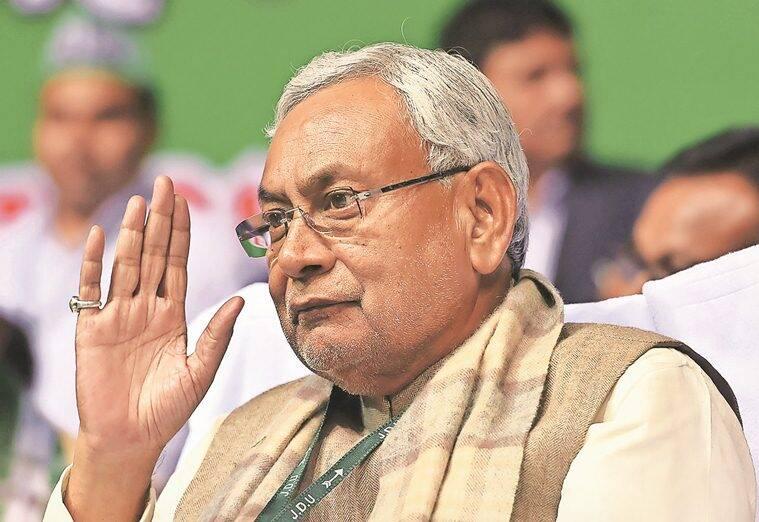
The decision of Nitish Kumar to file nomination papers for the Rajya Sabha appears to mark the closing chapter of one of the most consequential political careers in modern Bihar. For nearly two decades, Kumar shaped the state’s politics as chief minister—holding the office a remarkable ten times through shifting alliances, political recalibrations, and strategic adaptability.
His move to Parliament now signals a major transition not only for his party but for the political balance in Bihar. Behind the decision lies a combination of electoral arithmetic, health concerns, and the growing dominance of the Bharatiya Janata Party within the state’s ruling alliance.
The changing power equation within the National Democratic Alliance in Bihar has been evident for some time. In the 2020 Bihar Legislative Assembly election, the BJP secured 74 seats while Kumar’s Janata Dal (United) managed only 43. That result marked a turning point. For the first time in years, the BJP emerged as the larger partner in the alliance, fundamentally altering the internal dynamics of governance in the state.
The shift became even more pronounced in the 2025 Bihar Legislative Assembly election, when the BJP increased its tally to 89 seats while the JD(U) improved to 85 but still remained marginally behind its ally. Though the numbers suggested a closer contest, the broader trend was unmistakable: the BJP had consolidated its position as the principal political force in Bihar.
Within this evolving landscape, Kumar’s role increasingly resembled that of a senior statesman rather than the undisputed center of power. Another factor shaping the transition is the personal dimension. In recent months, concerns about Nitish Kumar’s health and stamina have surfaced repeatedly in political circles.
At 74, after decades of active politics and repeated stints in the chief minister’s office, the demands of daily governance in a complex state like Bihar are immense. Moving to the Rajya Sabha allows Kumar to remain politically relevant while stepping back from the intense pressures of state administration.
The development also reflects the broader political strategy of Narendra Modi and Amit Shah, who have systematically expanded the BJP’s footprint across states where it once depended heavily on regional allies.
In Bihar, the party has steadily strengthened its organizational base, leadership bench, and electoral machinery. With stronger seat tallies in consecutive elections, the BJP now finds itself well positioned to take command of the state’s political direction.
Nitish Kumar’s move to the Rajya Sabha therefore clears the way for a leadership transition that could see the BJP assert a more direct role in governing Bihar. Regardless of how the transition unfolds, Nitish Kumar’s legacy in Bihar remains significant.
When he first assumed office in 2005, the state faced deep governance challenges—poor infrastructure, weak law and order, and limited development indicators. Kumar’s early years in power were marked by efforts to improve roads, expand education initiatives, and strengthen administrative functioning.
His political journey, however, was equally notable for its fluid alliances. Over the years he partnered with and later opposed the BJP, aligned with the Rashtriya Janata Dal, and eventually returned to the National Democratic Alliance. These shifts reflected both ideological positioning and tactical survival in Bihar’s intensely competitive politics.
For supporters, this adaptability demonstrated political pragmatism; critics saw it as opportunism. Yet few dispute that Kumar remained one of the most influential figures in the state’s political landscape for nearly two decades. Nitish Kumar’s transition to the Rajya Sabha marks more than the end of a personal innings—it signals a generational and political shift in Bihar.
The BJP now appears poised to exercise greater authority within the alliance, potentially reshaping governance priorities and leadership structures. At the same time, opposition forces will seek to recalibrate their strategies in a post-Nitish political environment.
For Bihar’s electorate, the moment represents a turning point. The state is moving from an era defined largely by one leader’s political maneuvering to a new phase where party strength—particularly that of the BJP—may play a more decisive role.
In many ways, Nitish Kumar’s move to Delhi closes one of the most enduring chapters of Bihar politics while opening another whose contours are only beginning to take shape.